In the screening of fine and ultrafine powders, screen blinding has long been a core challenge affecting screening efficiency and stable operation. Especially in the classification of powders above 200 mesh, lightweight powders, or high–value-added materials, conventional vibrating screens often experience sharp efficiency declines due to particle agglomeration, electrostatic adhesion, or sieve aperture blockage.
Ultrasonic screening technology was developed precisely in response to these challenges. By employing a high-frequency, micro-amplitude physical mechanism, it fundamentally changes the interaction state between particles and the screen surface, significantly suppressing fine powder blinding.
What Is the Fundamental Cause of Fine Powder Blinding?
From a physical perspective, fine powder blinding is primarily caused by the combined effects of the following three mechanisms:
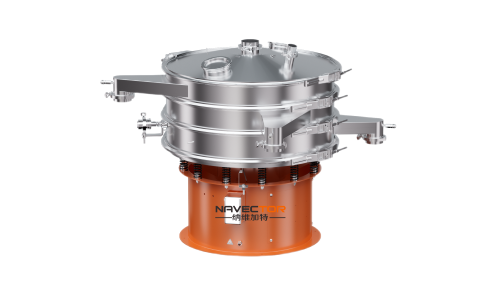
In conventional vibrating screens, materials rely mainly on mechanical vibration to roll and jump on the screen surface for classification. The vibration frequency and amplitude are designed to drive bulk material movement. This approach is effective for coarse particles, but for fine powders, energy transfer is clearly insufficient. Navector ultrasonic vibrating screens are specifically designed for fine powders and can effectively prevent screen blinding.
The Essential Difference Between Ultrasonic Screening and Conventional Vibrating Screens
Ultrasonic screening does not replace the original vibration mode. Instead, it superimposes a high-frequency energy system onto the screen surface. Its core characteristics include:
Unlike conventional vibrating screens that rely on low-frequency, large-amplitude mechanical excitation, ultrasonic systems act directly on the screen, inducing high-frequency, micro-amplitude elastic vibration. This fundamentally alters the particle dynamics during passage through the sieve apertures.
1. How Does High-Frequency Vibration Disrupt Particle Adhesion?
Under ultrasonic excitation, the screen surface generates high-speed periodic acceleration, resulting in:
Intermittent weightless states between particles and the screen
Continuous disruption of adhesive forces, preventing stable bonding
Fine powders no longer adhering to the screen or lodging in the apertures
Studies indicate that when vibration frequency increases into the ultrasonic range, the inertial forces acting on particles can significantly exceed their surface adhesion forces (NASA Granular Physics Report, 2019).
2. Why Is Micro-Amplitude More Suitable for Fine Screening?
Compared with large-amplitude vibration, micro-amplitude vibration offers clear advantages:
It does not damage the screen structure
It does not alter the overall material movement trajectory
Energy is concentrated directly in the sieve aperture region
As a result, sieve apertures remain in a continuously dynamic open state, greatly increasing the probability of fine particle passage.
3. How Does Ultrasonic Energy Reduce the Probability of Aperture Blockage?
Overall, the anti-blinding effect of high-frequency, micro-amplitude vibration is reflected in three aspects:
Reduction of particle–particle agglomeration
Weakening of particle–screen adhesion
Continuous cleaning of sieve aperture edges
Compared with conventional vibrating screens that rely on bouncing balls for passive cleaning, ultrasonic screening provides an active, continuous, and controllable anti-blinding mechanism.
Which Application Scenarios Are Best Suited for Ultrasonic Screening?
Ultrasonic screening demonstrates particularly strong performance under the following conditions:
Engineering Practice of Navector Ultrasonic Screening
According to the product and application data of Navector (Shanghai) Screening Technology Co., Ltd., its ultrasonic vibrating screens exhibit the following engineering characteristics:
Screening accuracy down to the micron level
High coupling efficiency between the ultrasonic system and the screen, resulting in low energy loss
Compatibility with multiple screening structures, including vibratory screens and tumbler screens
Significant reduction in downtime for manual screen cleaning while maintaining original throughput
In applications involving metal powders, fine chemicals, and new energy materials, Navector’s ultrasonic screening solutions have achieved stable continuous operation, significantly improving screen service life and screening consistency.
Do All Screening Applications Require Ultrasonic Systems?
Not all screening tasks require ultrasonic systems. Ultrasonic screening is generally recommended under the following conditions:
Conventional vibrating screens show clear signs of blinding
Screening efficiency declines rapidly during operation
Frequent manual screen cleaning disrupts continuous production
For coarse particles or low-mesh materials, conventional vibrating screens continue to offer advantages in terms of cost efficiency and structural simplicity.
From a physical standpoint, ultrasonic screening does not simply increase vibration intensity. Instead, it precisely regulates particle–screen interface behavior through high-frequency, micro-amplitude excitation, effectively overcoming blinding limitations dominated by surface forces in fine powder screening.
For industries focused on fine powders, stable production, and high consistency requirements, ultrasonic screening is no longer optional but a key component of efficient screening systems. In practical engineering applications, combining Navector’s mature screening structures with its ultrasonic integration expertise further unlocks the physical advantages of ultrasonic screening, enabling long-term, controllable, and reproducible improvements in screening performance.

 English
 中文
中文 Español
 ภาษาไทย
 Pусский
 Bahasa Indonesia
 Tiếng Việt