In the production of solid-state batteries, high-nickel ternary batteries, and lithium iron phosphate battery materials, an increasing number of powders are developing toward micron-scale and even submicron-scale particle sizes. For products such as sulfide electrolytes, high-nickel single-crystal materials, and single-crystal fine-particle lithium iron phosphate, particle size distribution not only affects subsequent processing performance but also directly impacts product consistency and final quality.
However, in actual production, many companies have found that screening equipment that previously met requirements begins to experience mesh clogging, reduced capacity, and unstable classification performance when handling finer particles.So why is ultrafine powder becoming increasingly difficult to screen? And how can manufacturers balance screening accuracy and processing capacity while meeting ever-increasing production requirements?
I. Why Is Ultrafine Powder Screening Becoming More Difficult?
In recent years, new energy materials such as sulfide electrolytes, high-nickel single-crystal materials, and single-crystal fine-particle lithium iron phosphate have continued to evolve toward finer particle sizes, placing increasingly stringent demands on particle size distribution and product consistency. While finer particles help improve material performance, they also create greater challenges for the screening process.
Compared with conventional powders, ultrafine powders are more prone to agglomeration, adsorption, and screen aperture blockage. In actual production, many companies encounter the same situation: screening performance is normal when the equipment starts operating, but as runtime increases, screening efficiency gradually declines, mesh clogging becomes more frequent, and processing capacity decreases accordingly.
Especially for ultrafine powders with a D50 particle size below 1 μm, the challenge is no longer simply achieving particle separation. The real difficulty lies in maintaining stable throughput and continuous operation while ensuring precise particle size control. This has become a common issue in the screening of new energy materials today.
II. What Is the Core Principle of the High-Speed Intelligent Screening Machine?
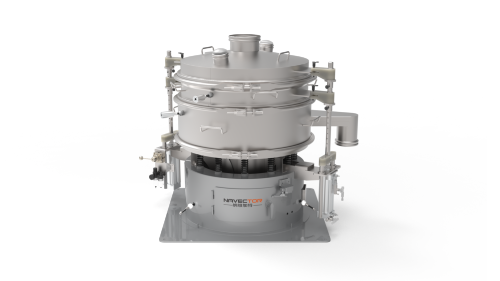
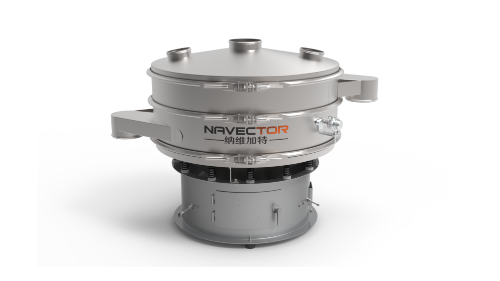
To address the screening requirements of ultrafine powders in the new energy industry, Navector (Shanghai) Screening Technology Co., Ltd. comprehensively upgraded its original ultrasonic fine-particle screening machine and developed a new-generation high-speed intelligent screening machine.
Unlike conventional vibrating screens that mainly rely on standard vibration force, the high-speed screening machine adopts low-frequency, high-speed vibration technology combined with a 0–3000 rpm stepless speed control system, enabling flexible adjustment according to different material characteristics.
During the screening process, materials are rapidly dispersed and evenly distributed across the screen surface, reducing particle accumulation and agglomeration. At the same time, the optimized material movement trajectory increases the frequency of contact between particles and the screen mesh, allowing fine particles to pass through the screen more efficiently.
To further improve screening efficiency, the equipment retains the classic flower-disc adjustment structure, allowing screening conditions to be adjusted for different operating requirements and achieving simultaneous optimization of screening accuracy and processing capacity.
In addition, the machine is equipped as standard with Magnatt high-performance screen mesh, featuring high tension, excellent wear resistance, and high screening efficiency. This effectively reduces mesh blockage and particle embedding, further improving continuous operation stability.
III. What Advantages Does the High-Speed Screening Machine Have Compared with the Original Ultrasonic Fine-Particle Screening Machine?
For conventional fine powder screening applications, traditional ultrasonic fine-particle screening machines can already meet production requirements. However, as ultrafine powders such as sulfide electrolytes, high-nickel single-crystal materials, and single-crystal fine-particle lithium iron phosphate become increasingly common, manufacturers are demanding higher screening accuracy, greater throughput, and improved continuous operation stability. The Navector High-Speed Intelligent Screening Machine was developed as an upgraded solution based on the original ultrasonic fine-particle screening machine and is better suited for ultrafine powder applications.
|
Comparison Dimension |
Ultrasonic Fine-Particle Screening Machine |
High-Speed Intelligent Screening Machine |
|
Applicable Particle Size |
20–300 μm powders |
Ultrafine powders with D50 below 1 μm |
|
Vibration Method |
Ultrasonic + 3D vibration mode |
Low-frequency high-speed vibration |
|
Speed Adjustment |
Mainly fixed parameters |
0–3000 rpm stepless speed control |
|
Screening Accuracy |
Meets conventional precision screening requirements |
Further enhanced classification accuracy for ultrafine powders |
|
Processing Capacity |
Standard capacity |
3 times the capacity of traditional fine-particle screening machines |
From practical applications, the two types of equipment are not simple replacements for one another. Ultrasonic fine-particle screening machines are more suitable for conventional fine powder screening, while high-speed intelligent screening machines demonstrate more significant advantages in ultrafine powder processing, high-capacity production, and long-term continuous operation. For new energy material manufacturers, when issues such as frequent mesh clogging, insufficient capacity, or difficulty controlling particle size begin to appear, high-speed screening machines often provide a more stable solution.
IV. In Which Applications Are the Advantages of High-Speed Screening Machines More Evident?
For conventional particles or standard fine powders, traditional screening equipment is usually sufficient. However, as materials become increasingly ultrafine or production lines demand higher capacity and greater operational stability, the advantages of high-speed screening machines become more pronounced.
For micron-scale powders such as sulfide electrolytes, high-nickel single-crystal materials, single-crystal fine-particle lithium iron phosphate, and conductive additives, the combination of fine particle size, strong agglomeration tendencies, and difficult screening characteristics often makes it challenging for conventional screening machines to balance accuracy and throughput. Through low-frequency high-speed vibration and stepless speed adjustment, high-speed screening machines improve material dispersion and screening efficiency while reducing the risk of mesh blockage.
At the same time, for production lines requiring long-term continuous operation, the high-speed screening machine is equipped with Magnatt high-performance screen mesh, which extends screen service life, reduces downtime for maintenance, and delivers more stable processing capacity while maintaining screening accuracy.
Simply put, when production processes encounter problems such as poor screening efficiency of ultrafine powders, frequent mesh blockage, insufficient throughput, or unstable continuous operation, the advantages of high-speed screening machines become much more apparent.
V. What Problems Does the High-Speed Screening Machine Actually Solve in Real Production?
From an engineering perspective, the purpose of purchasing screening equipment is not simply to add another machine, but to eliminate production bottlenecks.
For ultrafine powder manufacturers, the high-speed screening machine primarily addresses three core challenges:
First, it reduces mesh blockage and increases effective equipment operating time.
Second, it improves classification stability and enhances product particle size consistency.
Third, it solves capacity limitations and increases production efficiency while maintaining product quality.
As new energy materials continue to develop toward finer particle sizes, these three issues will increasingly affect manufacturing costs and market competitiveness.
VI. What Is the Future Direction of Ultrafine Powder Screening?
From an industry perspective, ultrafine powder screening technology is expected to develop in three major directions.
First, screening particle sizes will continue to become finer, gradually moving from micron-scale to submicron-scale applications.
Second, equipment processing capacity will continue to improve, enabling simultaneous growth in both screening accuracy and production throughput.
Third, screening systems will become increasingly intelligent, utilizing automatic parameter adjustment and online monitoring to achieve more stable production processes.
For new energy material manufacturers, screening equipment is no longer merely auxiliary equipment on the production line. It is becoming a critical process technology that directly influences product quality and manufacturing efficiency.
To meet the evolving market demands of solid-state batteries, high-nickel materials, and advanced functional powders, the Navector High-Speed Intelligent Screening Machine combines low-frequency high-speed vibration technology, a stepless speed control system, and high-performance screen mesh to provide a more efficient and stable solution for ultrafine powder screening, while offering reliable screening technology support for the continued development of the new energy materials industry.

 English
 中文
中文 Español
 ภาษาไทย
 Pусский
 Bahasa Indonesia
 Tiếng Việt