In the new energy materials industry, many engineers working with lithium iron phosphate (LFP) have encountered a very practical problem:
When measuring particle size in the laboratory, the data is always unstable.
A typical example:
For the same batch of lithium iron phosphate powder, the deviation between two screening tests can reach 10% or even higher. Many people’s first reaction is: Is the equipment unstable? Is the particle size distribution of the powder itself uneven?
But from an engineering perspective, the real reason is often just four words: powder agglomeration.
Today, we will use the six-step engineering logic most commonly used by engineers — What / Why / Who / When / Where / How — to explain this issue thoroughly.
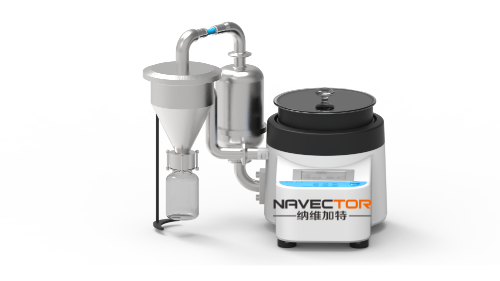
I. What | What is an Airflow Sieve?
If explained in the most straightforward sentence:
Airflow sieve = using “air” to sieve powder, rather than using “vibration.”
Traditional vibrating sieves rely on mechanical vibration to shake particles through the mesh, while the logic of an airflow sieve is completely different:
A negative pressure environment is established inside the equipment
The nozzle generates high-speed airflow
The airflow disperses agglomerated powder into individual particles
Fine particles pass through the sieve mesh with the airflow
The key technical parameters are generally:
Applicable particle size: 5–4000 µm
Single screening time: 0–99 min (adjustable)
Adjustable parameters: negative pressure, airflow velocity, screening time
Engineers often say:A vibrating sieve is “screening particles,” while an airflow sieve is “restoring particles.”
II. Why | Why Must Lithium Iron Phosphate Use an Airflow Sieve?
First, let’s look at a real testing scenario.
A new energy materials laboratory was verifying the particle size of lithium iron phosphate:
|
Screening method |
Test time |
Data deviation |
|
Vibrating sieve |
8–10 minutes |
±12% |
|
Airflow sieve |
2–3 minutes |
±3% |
Why is the difference so large?
There are three core reasons.
1.Lithium iron phosphate powder is highly prone to agglomeration
Typical LFP powder particle size: 5 μm – 30 μm
However, during storage and transportation, it is very easy to form:
50 μm – 150 μm agglomerated particles.
These particles are not actually “large particles,” but many small particles clumped together.
2.Traditional vibrating sieves can hardly disperse agglomerates
The vibration acceleration of a vibrating sieve is generally:
3–5 g
For micron-level agglomerated particles, this amount of energy is basically insufficient.
The result is:
Agglomerated particles are directly treated as “large particles,” and the particle size distribution is severely exaggerated.
3.Airflow impact can break up agglomerates
The nozzle airflow velocity of an airflow sieve is usually:
20–30 m/s
The airflow impact + shear force can break up agglomerated particles and form a dispersed single-particle state.
Engineers often joke:
A vibrating sieve is like “shaking dust,” while an airflow sieve is more like “blowing apart a lump of flour.”
III. Who | Who Needs This Equipment Most?
If your work involves the following scenarios, you will most likely need an airflow sieve:
1.New energy material R&D engineers
During the R&D stage, it is necessary to:
Quickly verify particle size distribution
Adjust sintering parameters
2.Battery material quality engineers
During QC inspection, the biggest concern is:
Different test results from the same batch of powder.
3.Laboratory particle size analysis personnel
Especially when working with the following materials:
Lithium iron phosphate
Ternary materials
Silicon-carbon anodes
Conductive carbon black
In one sentence:
As long as the powder particle size is below 30 μm, an airflow sieve is basically standard equipment.
IV. When | When Must It Be Used?
There are four situations in which it is recommended to directly use an airflow sieve.
1.Extremely light powder
For example:
LFP powder
Carbon materials
A vibrating sieve is prone to particle floating + mesh clogging.
2.Obvious powder agglomeration
The judgment method is simple:
Press the powder lightly by hand.
If obvious caking can be seen, agglomeration has already occurred.
3.Fast R&D pace
One characteristic of new energy material R&D is:
There may be 10 particle size tests in one day.
If each screening takes 10 minutes, laboratory efficiency will be significantly reduced.
An airflow sieve can complete one screening in 2–3 minutes.
4.High dust safety requirements
Lithium iron phosphate powder belongs to fine dust materials.
Airflow sieves usually adopt:
A negative-pressure closed system
Dust will not leak out.
V. Where | Which Industries Is It Mainly Used In?
Although today’s focus is lithium iron phosphate, airflow sieves are actually widely used in multiple industries:
New energy materials: lithium iron phosphate, ternary materials, conductive agents
Pharmaceutical industry: lactose powder, API raw materials
Fine chemicals: pigments, coating powders
Food industry: starch, additive powders
These industries share one common characteristic:
Fine powder, low density, and easy agglomeration.
VI. How | How to Choose an Airflow Sieve?
Engineers generally only look at three key parameters when selecting equipment.
1.Mesh aperture
Usually selected as:
Target particle size × 1.1
For example:
If you need to test 20 μm particles, it is recommended to choose a mesh of about 22 μm.
2.Negative pressure range
Common equipment range:
-2 kPa to -10 kPa
Higher negative pressure is not always better.
Excessive negative pressure may cause:
Fine powder to be directly sucked away.
3.Airflow velocity adjustment
It is best to have:
Multi-level airflow adjustment
Different materials require different airflow strengths.
For example:
Carbon black: low airflow
Lithium iron phosphate: medium airflow
VII. Real Engineering Case
A power battery material laboratory once encountered a problem:
The particle size detection data of lithium iron phosphate fluctuated greatly.
Test results:
Vibrating sieve: 11% deviation between two tests
After replacing it with an airflow sieve: deviation stabilized at ±3%
Detection time: reduced from 10 minutes to 3 minutes
The laboratory manager later summarized it in one sentence:
It was not that the particle size changed, but that we finally measured the true particle size.
VIII. Common Questions About Negative Pressure Airflow Sieves (FAQ)
1.Can an ordinary vibrating sieve be used for lithium iron phosphate powder screening?
Yes, it can be used, but the effect is usually limited when screening ultrafine powders.
When the powder particle size is small or agglomeration exists, vibrating sieves are prone to mesh clogging or low screening efficiency.
Therefore, many laboratories choose airflow sieves for screening tests.
2.How does an airflow sieve solve the agglomeration problem?
The airflow sieve disperses the powder through high-speed airflow, allowing agglomerated particles to redisperse into individual particles, and then completes the screening through the mesh.
This can improve screening accuracy and make particle size data more realistic.
3.How long does lithium iron phosphate powder screening generally take?
Under laboratory conditions, using an airflow sieve for screening tests usually takes only 2–3 minutes to complete one test.
The specific time will vary depending on sample quantity and equipment parameters.
4.Which new energy material powders are suitable for airflow sieves?
In addition to lithium iron phosphate, airflow sieves are also commonly used for screening the following new energy material powders:
Silicon-based anode materials, graphite powder, conductive carbon black, ternary material powders.
These materials are usually fine and prone to agglomeration, and airflow sieves can effectively improve the screening effect.
If I had to summarize the lithium iron phosphate screening issue in one sentence:
It is not that the particles cannot be screened out, but that the particles have not been broken apart.
The core issue solved by an airflow sieve is not “screening efficiency,” but:
First break up the agglomerates, then perform particle size analysis.
When the particles return to a single-particle state, the particle size data becomes more realistic, and the screening repeatability becomes more stable.
Laboratory efficiency is also higher.
This is why, in new energy material laboratories, more and more engineers are beginning to regard airflow sieves as standard equipment for particle size analysis.


 English
 中文
中文 Español
 ภาษาไทย
 Pусский
 Bahasa Indonesia
 Tiếng Việt