With the rapid development of the new energy vehicle and energy storage industries,the market demand for lithium-ion battery materials continues to grow. As one of the core materials of batteries,cathode materials(such as lithium iron phosphate,ternary materials,etc.)need to undergo multiple processes during production,including crushing,mixing,drying,and screeningAmong these processes,fine screening is an important step for controlling particle size distribution and ensuring stable material quality.
In actual production,screening of lithium battery cathode materials often encounters a very common problem—screen mesh blinding。When the screen apertures are blocked by fine particles,it can lead to decreased screening efficiency,reduced equipment processing capacity,and may even affect the stable operation of the entire production line.
Screen blinding usually brings the following impacts:
Significant decrease in screening efficiency
Reduction in equipment processing capacity
Unstable particle size classification accuracy
Increased screen replacement frequency
Rising production costs
Therefore,based on the powder characteristics of lithium battery cathode materials,rational design of screening equipment and optimization of screening processes are of great significance for improving production efficiency and ensuring product quality.
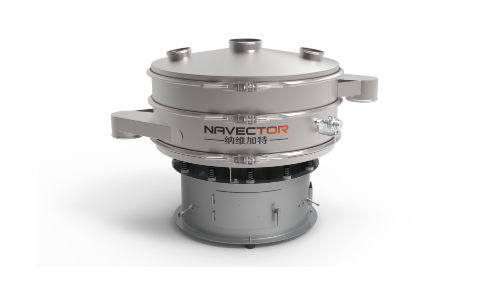
Table of Contents
1 The important role of screening in lithium battery material production
2 Main causes of screen blinding in lithium battery material screening
3 Key technical challenges in lithium battery material screening
4 Navector screening solutions
5 Recommended screening equipment
6 Suggestions for screening process optimization
7 Production operation recommendations
8 Equipment maintenance suggestions
9 Development trends in industrial screening technology
10 Common technical questions
11 About Navector screening technology
Ⅰ.The Important Role of Screening in Lithium Battery Material Production
In the production process of lithium battery cathode materials,screening technology is mainly used for particle size control,impurity removal,and particle homogenization。
The particle size distribution of cathode materials has an important impact on battery performance,such as:
Battery energy density
Compaction density
Electrochemical performance
Cycle life
Through fine screening,the particle size distribution of materials can be kept stable,thereby improving the consistency of battery products.
During powder production and drying processes,fine particles tend to form agglomerates。If these agglomerated particles enter subsequent processes,they may affect the quality of electrode coating.Screening equipment can effectively remove these larger agglomerated particles.
A stable and reliable screening system can ensure consistent particle size in each batch of materials,thereby improving the stability of the entire production process.
Ⅱ.Main Causes of Screen Blinding in Lithium Battery Material Screening
During the screening process of lithium battery cathode materials,screen blinding easily occurs,usually caused by the following factors.
The particle size of lithium battery cathode materials is usually between several microns and tens of microns。When the screen aperture size is close to the particle size,particles are likely to become embedded in the screen openings,causing blockage.
Strong intermolecular forces exist between fine powder particles,making them prone to forming agglomerates。These agglomerates can easily become lodged in the screen apertures during screening.
Some cathode material particles have irregular shapes and rough surfaces,resulting in poor powder flowability,which affects the distribution of materials on the screen surface.
Fine screen meshes have relatively low opening ratios。When the processing capacity is large,the screen apertures are more likely to be occupied by particles.
In environments with high humidity,powders tend to absorb moisture,leading to slight adhesion and increasing the risk of screen blinding.
Ⅲ.Key Technical Challenges in Lithium Battery Material Screening
Lithium battery material screening needs to overcome several technical challenges.
Lithium battery materials usually require micron-level particle size control while maintaining high processing capacity.
Fine powder particles easily embed in screen apertures,so equipment must have effective anti-blinding technology.
During the screening process,excessive mechanical action should be avoided to prevent particle breakage or morphology changes。
Lithium battery material production usually adopts continuous processing methods,so screening equipment must be capable of long-term stable operation.
Ⅳ.Navector Screening Solutions
To address the issue of screen blinding in lithium battery material screening,Navector has developed multiple solutions in equipment design and screening technology.
Ultrasonic Anti-Blinding Technology
By superimposing high-frequency vibration on the screen surface,the agglomeration state between particles can be effectively disrupted,allowing the powder to remain dispersed and improving screening efficiency.
Its main functions include:
Preventing screen aperture blockage
Improving screening efficiency
Enhancing classification accuracy
High-frequency vibration enhances particle movement on the screen surface,increasing the probability of particles passing through the screen apertures.
A multi-layer screen design can achieve multi-stage particle size classification and improve overall screening efficiency.
An enclosed design reduces dust emission while ensuring a clean production environment.
Ⅴ.Recommended Screening Equipment
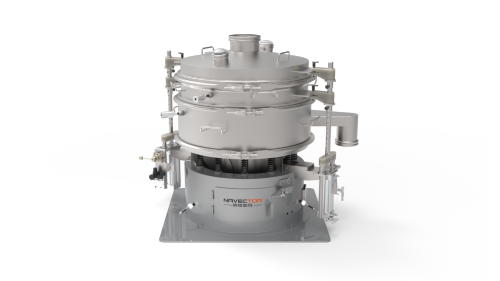
In response to the characteristics of lithium battery cathode materials—fine particles,easy agglomeration,and a tendency to cause screen blinding—Navector has developed a small-particle screening machine specifically designed for the lithium battery industry. This equipment is optimized for micron-level powder screening and can effectively reduce the risk of screen blinding while maintaining high screening accuracy.
The equipment is mainly applied to the screening of the following materials:
Lithium iron phosphate materials
Ternary cathode materials
Lithium cobalt oxide materials
Lithium battery precursor powders
Other new energy battery powder materials
In terms of structural design,the equipment improves particle passage efficiency by optimizing the vibration system,screen structure,and anti-blinding technology,allowing the powder to form a more uniform motion trajectory on the screen surface.
Ⅵ.Suggestions for Screening Process Optimization
To improve screening efficiency and reduce screen blinding issues,process design can be optimized in several aspects.
The screen aperture size is generally recommended to be 1.2 to 1.5 times the target particle size.
Excessively fast feeding increases the load on the screen surface,reduces screening efficiency,and increases the risk of screen blinding.
By adjusting vibration frequency and amplitude,the distribution of materials on the screen surface can be improved.
Ⅶ.Production Operation Recommendations
In actual production,standardized equipment operation can effectively improve screening efficiency.
Recommended practices include:
Maintaining stable and uniform feeding
Avoiding material accumulation on the screen surface
Regularly checking the condition of the screen mesh
Monitoring the vibration operation of the equipment
Stable operating conditions can reduce equipment failures and improve production efficiency.
Ⅷ.Equipment Maintenance Suggestions
Proper equipment maintenance is an important condition for ensuring the long-term stable operation of the screening system.
It is recommended to establish a regular maintenance system,including:
Regular cleaning of the screen mesh
Inspection of vibration motor operating conditions
Inspection of equipment sealing structures
Timely replacement of worn components
Comprehensive maintenance management can significantly extend the service life of the equipment。
Ⅸ.Development Trends in Industrial Screening Technology
With the development of the new energy materials industry,screening technology continues to advance.
Future development directions mainly include:
To meet the screening needs of ultrafine powders and high value-added materials.
Screening equipment will be integrated with conveying systems,batching systems,and automatic control systems to improve overall production efficiency.
Ⅹ.Common Technical Questions
Because the material particles are very fine and prone to agglomeration。When the screen aperture size is close to the particle size,particles can easily become embedded in the screen openings.
Ultrasonic vibration technology,high-frequency vibration technology,and appropriate screen specifications can be adopted.
Typically between 200 mesh and 500 mesh,depending on the particle size requirements of the material.
Efficiency can be improved by optimizing the feeding rate,adjusting vibration parameters,and improving the screening process.
Ⅺ.About Navector Screening Technology
Navector(Shanghai)Screening Technology Co., Ltd. focuses on the research,development,and manufacturing of fine powder screening equipment。Its products include ultrasonic vibrating screens,tumbler screens,and various powder processing systems。These equipment solutions are widely used in lithium battery materials,pharmaceuticals,food,metal powders,and fine chemical industries. With long-term accumulated experience in powder engineering,Navector is committed to providing customers with stable,efficient,and precise screening solutions.
 English
 中文
中文 Español
 ภาษาไทย
 Pусский
 Bahasa Indonesia
 Tiếng Việt