During food powder processing, the screening performance of materials such as flour and starch directly affects subsequent production. Some lightweight, fine powders are prone to agglomeration and electrostatic adsorption, and may adhere to the screen surface and cause clogging, restricting material passage and reducing screening efficiency.
For food powders that are prone to agglomeration and screen clogging, how can material dispersion be improved to ensure continuous and stable screening? To address this issue, Navector centrifugal screens use airflow-assisted particle separation combined with an ultrasonic system to enhance screen cleaning, improve material passage, and increase screening efficiency. This article analyzes how centrifugal screens solve screen clogging problems in the screening of food powders such as flour and starch from the perspectives of operating principles, technical features, and application scenarios.
I. Causes of Screen Clogging in Food Powder Screening from the Perspective of Material Characteristics
The difficulty of screening food powders often lies not simply in particle separation, but in dealing with agglomeration, static electricity, and adhesion caused by the material itself. Lightweight powders such as flour and starch are typically prone to agglomeration and static electricity, which can lead to poor material passage during screening.
Material agglomeration prevents particles from being fully dispersed, affecting the passage of fine powders through the screen. Static electricity causes some powders to adhere to the screen surface, gradually blocking the openings and reducing the effective screening area. At the same time, lightweight powders are easily affected by their movement state during screening. If good dispersion cannot be maintained, screening efficiency will be further affected.
Therefore, the key challenge in food powder screening is to improve material dispersion, reduce adhesion and screen clogging caused by agglomeration and static electricity, maintain good screen permeability, and achieve continuous and efficient screening.
II. Limitations of Traditional Solutions: Why Are Conventional Screening Methods Unable to Solve Screen Clogging Problems?
Traditional vibrating screens mainly rely on screen surface vibration to move materials and classify them according to differences in particle size. For conventional materials with good flowability, this screening method can meet basic production requirements. However, when processing fine powders such as flour and starch, powder adhesion can easily occur on the screen surface, and traditional vibration has limited effectiveness in addressing screen clogging.
During long-term continuous screening, some fine powders can adhere to the screen surface, reducing the effective open area of the screen and affecting material passage efficiency. Especially for lightweight powders that are prone to agglomeration and static electricity, mechanical vibration alone makes it difficult to continuously maintain good material dispersion, which can lead to fluctuations in screening efficiency.
Therefore, for food powders that are prone to screen clogging, screening equipment needs not only to perform particle classification but also to provide stronger screen cleaning and material dispersion capabilities, reducing powder adhesion and improving screening stability during continuous operation.
III. Operating Principle Analysis: How Does a Centrifugal Screen Use Airflow for Particle Separation?
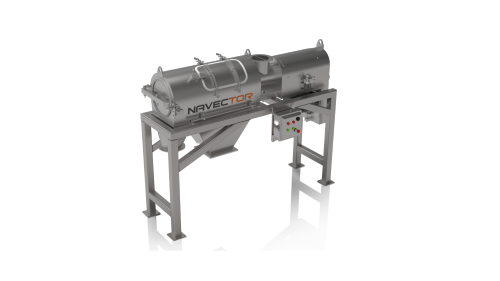
To address the problems of agglomeration, adhesion, and screen clogging in lightweight powders such as flour and starch, the Navector centrifugal screen does not rely solely on screen vibration for separation. Instead, it uses airflow to improve material movement, allowing particles to remain better dispersed during screening.
During operation, the material is first mixed with airflow through a screw conveying system and then enters the cylindrical screen under the action of the airflow. As the impeller blades rotate, the material is simultaneously subjected to centrifugal force and cyclone conveying force. The particles are driven to move along the screen surface. Fine particles that meet the required particle size pass through the screen and are discharged through the fine material outlet, while coarse particles that do not pass through the screen move along the cylinder wall and are discharged through the coarse material outlet.
This screening method uses airflow to assist particle dispersion, reducing the difficulty of screening caused by powder agglomeration. At the same time, the equipment can be equipped with an ultrasonic system to enhance screen cleaning, reduce screen clogging caused by fine powder adhesion, and improve operational stability when screening fine and ultrafine powders.
IV. Advantages Analysis: How Does a Centrifugal Screen Solve Food Powder Screening Problems?
To address screen clogging problems that commonly occur when screening lightweight powders such as flour and starch, the Navector centrifugal screen further optimizes screen cleaning and material handling based on airflow separation, improving the equipment's continuous operating capability.
First, the equipment can be equipped with an ultrasonic system to enhance screen cleaning, reduce screen openings from becoming blocked by fine powder adhesion, improve screening stability, and extend screen service life. Second, the centrifugal screen adopts an externally mounted transducer design, so the transducer does not directly contact the material, reducing the risk of contamination during screening and making it more suitable for applications such as food processing that have high cleanliness requirements. In addition, for agglomerated materials formed during screening, the equipment can perform secondary crushing to reduce the impact of agglomerated particles on screening performance and maintain better material passage.
Through screen cleaning, hygienic design, and agglomerate processing, the centrifugal screen provides a more stable solution to screen clogging problems in food powder screening and is suitable for continuous screening of lightweight powders such as flour and starch.
V. Application Scenarios: Which Food Powders Are More Suitable for Centrifugal Screens?
Centrifugal screens are mainly used for the rapid screening of lightweight materials, fine powders, and ultrafine powders. Their applications cover industries such as chemicals, metallurgy, mining, pharmaceuticals, food, metal powders, and non-metallic materials. In the food industry, lightweight powders such as flour and starch are typical application materials. These materials are prone to agglomeration during screening, while fine powders may also adhere to the screen surface and cause clogging. Centrifugal screens use airflow to drive material separation and combine it with an ultrasonic system to improve the screening condition of difficult-to-screen materials and enhance screen cleaning performance.
VI. Equipment Selection: How Should Food Companies Choose the Right Centrifugal Screen?
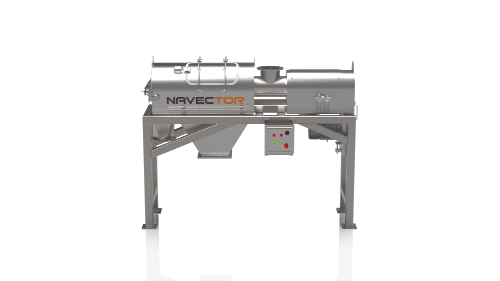
Food powders are generally lightweight, prone to agglomeration, and susceptible to static electricity. When selecting a centrifugal screen, equipment suitability should be evaluated according to material characteristics, with particular attention to screening efficiency and anti-clogging performance.
For powders that are prone to adhering to the screen, an ultrasonic system can be added to enhance screen cleaning. For materials containing agglomerates, the equipment's secondary crushing capability can be considered. At the same time, the food industry has high cleanliness requirements, and the externally mounted transducer design can prevent material contamination during screening. The key to selecting a centrifugal screen is to match the appropriate equipment configuration according to material characteristics to meet continuous screening requirements.
VII. Frequently Asked Questions: Key Questions About Centrifugal Screens for Food Powders
Q1: What type of centrifugal screen is suitable for starch screening?
It should be selected according to the material characteristics. For starch materials with a high fine-powder content that are prone to agglomeration or screen clogging, particular attention should be paid to screening efficiency, screen cleaning capability, and continuous screening performance.
Q2: Why can centrifugal screens reduce screen clogging?
Centrifugal screens use airflow to drive material separation. After entering the cylindrical screen, the material remains in motion under the action of centrifugal force and cyclone conveying force, reducing screen clogging caused by powder adhesion and accumulation.
Q3: How can centrifugal screens for food powders meet cleanliness requirements?
Centrifugal screens adopt an externally mounted transducer design, preventing contamination of the material during screening and making them more suitable for food powders and other applications with cleanliness requirements.
The key to food powder screening is not simply completing particle classification, but more importantly, maintaining stable screening conditions during continuous production. When processing materials such as flour and starch that are prone to agglomeration and screen clogging, screening equipment needs to move beyond simply improving screening capacity and focus instead on fine processing based on material characteristics.
Centrifugal screens optimize the screening process through technologies such as airflow dispersion and ultrasonic screen cleaning, reducing the impact of powder adhesion and screen clogging on production and providing a new approach to continuous and stable food powder processing. In the future, as food processing moves toward greater precision and automation, screening technology will place greater emphasis on matching material characteristics with equipment performance, driving powder processing toward higher efficiency and greater stability.
 English
 中文
中文 Español
 ภาษาไทย
 Pусский
 Bahasa Indonesia
 Tiếng Việt