In the biopharmaceutical and in vitro diagnostics fields, microspheres, as important functional materials, are widely used in IVD testing, drug-loaded microspheres, chromatography packing media, and other applications. As product performance requirements continue to increase, post-processing has gradually become an important factor affecting production efficiency and product quality.
Filtration, washing, dehydration, and drying may seem simple, but they directly affect microsphere processing performance. Due to their small particle size, microspheres are prone to agglomeration. How to achieve stable separation while maintaining a good drying state has become a key issue in post-processing.
To address this need, a microsphere sieve that integrates filtration, washing, dehydration, and drying provides a new solution for microsphere post-processing. How does it achieve integrated microsphere post-processing through a closed environment, centrifugal and negative-pressure fluid separation, and ultrasonic vibration? This article provides an in-depth analysis of its working principles and application value.
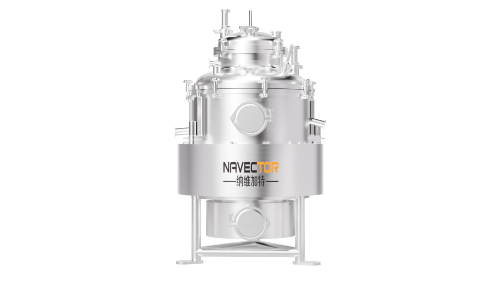
I. Why Are IVD Microspheres Difficult to Process? Process Challenges in Microsphere Post-Processing
IVD microspheres are characterized by small particle size and a tendency to agglomerate, making their post-processing different from conventional powder processing. During filtration, washing, and drying, microspheres are easily affected by interactions between particles, resulting in agglomeration and consequently affecting the stability of subsequent processes.
Therefore, the difficulty of IVD microsphere post-processing lies not only in achieving solid-liquid separation, but also in maintaining good dispersion performance throughout the process. It is necessary to ensure separation efficiency while avoiding changes in microsphere morphology caused by improper processing methods.
For IVD microspheres, post-processing affects not only separation performance but also the processing quality of subsequent drying. How to reduce agglomeration and maintain good microsphere processing performance throughout each stage is an issue that post-processing processes need to address.
II. What Are the Limitations of Conventional Microsphere Post-Processing Methods?
Conventional microsphere post-processing usually requires different equipment to separately complete filtration, washing, dehydration, and drying, with material transfer required between each stage. This segmented processing approach increases process complexity and also makes process control more difficult.
For IVD microspheres with small particle sizes and a tendency to agglomerate, multiple transfers can increase the risk of changes in material conditions and affect subsequent processing stability. At the same time, coordinated operation of multiple pieces of equipment also places higher requirements on cleanliness control during production.
The problem therefore becomes clearer: optimizing a single process step alone cannot solve the connection issues between different stages. How to reduce transfers between equipment and complete multiple post-processing steps within the same equipment has become a practical requirement for microsphere post-processing equipment.
III. What Is a Microsphere Sieve? Why Does Microsphere Post-Processing Require Integrated Equipment?
A microsphere sieve, simply put, is a solid-liquid separation device designed for the post-processing of microspheres, mainly used for the post-processing of IVD microspheres, medical aesthetic microspheres, drug-loaded microspheres, chromatography packing media, and other materials. Unlike conventional screening equipment, which is mainly used for particle classification, a microsphere sieve is designed for the processing stage after microsphere preparation and needs to meet the continuous processing requirements from wet materials to the final product.
Since microsphere materials typically require multiple post-processing steps, using separate equipment for each process increases production complexity. Therefore, integrating multiple post-processing steps into a single piece of equipment can reduce intermediate transfers and improve process continuity. For materials such as IVD microspheres that have high requirements for product consistency, integrated post-processing can help improve the controllability of the production process.
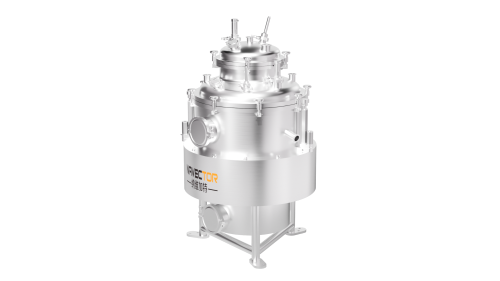
IV. How Does a Microsphere Sieve Integrate Filtration, Washing, Dehydration, and Drying?
The core function of a microsphere sieve is not to perform a single process independently, but to connect solid-liquid separation with subsequent drying within the same equipment. The equipment achieves solid-liquid separation through centrifugal and negative-pressure fluid separation, while subsequent processing is completed inside the equipment, reducing transfers between different pieces of equipment.
During the drying process, ultrasonic vibration distributes the material evenly across the filter screen. Combined with the negative-pressure conditions inside the equipment, this accelerates the drying process and reduces the formation of agglomerates. The entire process is carried out inside a closed piece of equipment, concentrating the originally separate post-processing steps into a single system.
The key to this design is to reduce material transfers between process steps rather than simply combining multiple functions. For IVD microspheres that are prone to agglomeration, shortening transfer stages can reduce changes in material conditions during processing and enable closer integration of separation, dehydration, and drying.
V. What Industries and Application Scenarios Are Microsphere Sieves Suitable for?
As important functional materials, microspheres are widely used in the biopharmaceutical and in vitro diagnostics fields. Since different types of microspheres have different material characteristics, their production processes have different requirements for separation and post-processing.
Navector microsphere sieves are mainly used for solid-liquid separation and post-processing of IVD microspheres, drug-loaded microspheres, chromatography packing media, and medical aesthetic microspheres. IVD microspheres include silica microspheres, polymer microspheres such as fluorescent microspheres and latex microspheres, as well as inorganic-organic composite magnetic microspheres. Drug-loaded microspheres mainly include materials such as PLA and PLGA, while medical aesthetic microspheres include types such as PLLA and PCL.
To meet the post-processing requirements of these microsphere materials, the microsphere sieve adopts a closed integrated design, reducing material transfers between different pieces of equipment and providing a more compact processing approach for high-requirement microsphere production.
VI. Development Trend of Microsphere Post-Processing: From Single-Process Treatment to Full-Process Control
As the application of microspheres in the biopharmaceutical field continues to expand, post-processing processes are also gradually developing toward greater integration and controllability. Compared with conventional single-process treatment methods, future microsphere post-processing equipment will place greater emphasis on multi-stage coordination, improving production stability and reliability by reducing material transfers and optimizing processing flows.
For applications such as IVD microspheres and drug-loaded microspheres, equipment capable of combining a closed environment, process continuity, and processing stability will be better suited to the requirements of high-demand microsphere production.
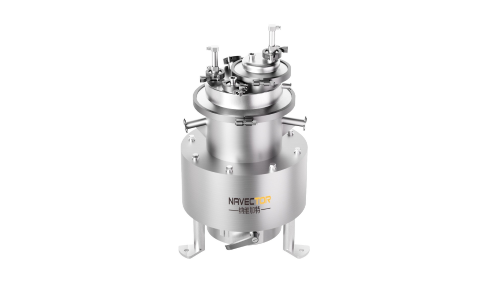
The value of a microsphere sieve lies not simply in replacing a single separation device, but in integrating the workflow throughout microsphere post-processing. By reducing process transitions and material transfers and optimizing filtration, drying, and other processing steps, it provides a more stable post-processing solution for the production of high-requirement microsphere materials.
From IVD microspheres and drug-loaded microspheres to medical aesthetic microspheres, the importance of post-processing is becoming increasingly evident as the application range of microspheres continues to expand. In the future, equipment capable of combining a closed environment, process stability, and multi-stage coordinated processing will become an important force in advancing the microsphere industry.


 English
 中文
中文 Español
 ภาษาไทย
 Pусский
 Bahasa Indonesia
 Tiếng Việt