Quartz powder is a common powder material used in mineral processing and new material production. After crushing and grinding, the material contains particles of different sizes. For samples with a high proportion of fine particles, screening analysis can sometimes be affected by particle agglomeration and screen clogging, resulting in insufficient sample dispersion and fluctuations in screening results.
These problems are relatively common in laboratory particle size analysis and process research. Traditional mechanical vibrating sieves mainly rely on screen surface movement to separate particles. When sample particles are fine and prone to agglomeration, mechanical vibration alone may not achieve the desired dispersion effect. Small negative pressure airflow sieves use aerodynamic screening technology, in which airflow drives particle movement to help disperse samples and clean the screen mesh, providing an alternative for the screening analysis of fine mineral powders such as quartz powder.
I.What Is the Working Principle of a Small Negative Pressure Airflow Sieve?
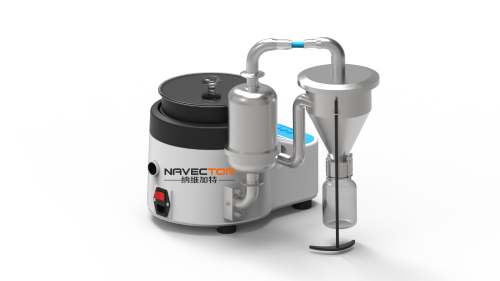
The core principle of a small negative pressure airflow sieve is to use airflow to disperse particles and complete the screening process. After the equipment is connected to a vacuum cleaner or air extraction device, a negative pressure environment is created inside the screening unit. Under the pressure difference, air at the nozzle forms an airflow that is directed onto the screen surface and then drawn through the area beneath the screen.
Under the action of airflow, the sample is continuously dispersed. Particles smaller than the screen aperture pass through the mesh along with the airflow and enter the vacuum cleaner or cyclone separator, while particles that cannot pass through the openings remain on the screen. While driving particle movement, the airflow also helps clean the screen mesh, reducing interference from fine particle agglomeration during screening.
Compared with methods that rely solely on mechanical vibration, this screening method places greater emphasis on improving particle dispersion through airflow. For low-density fine powders that are prone to agglomeration, airflow assistance helps samples make sufficient contact with the screen mesh, contributing to a more stable screening process.
II.Why Is Airflow Assistance Needed for Quartz Powder Screening Analysis?
The particle size composition of quartz powder affects its subsequent processing and application performance. Screening analysis needs to reflect the actual particle size distribution of the sample as accurately as possible. For fine quartz powder samples that are prone to agglomeration, particles may form larger agglomerates, making it difficult for some fine particles to pass through the screen openings effectively. This can affect the screening results.
Screen clogging is another issue that needs to be considered. Fine particles can easily adhere to or accumulate around the screen mesh during screening, reducing the effective screening area. If the sample is not sufficiently dispersed, simply extending the screening time may not necessarily improve the screening performance.
The small negative pressure airflow sieve uses continuous airflow to disperse particles and clean the screen mesh, helping reduce the impact of these factors on the screening process. The screening process is relatively gentle, with an average screening time of approximately 2–3 minutes, making it suitable for samples that require fine particle screening analysis.
It should be noted that airflow assistance mainly improves particle dispersion and screen cleaning conditions. This does not mean that all quartz powder samples will achieve the same screening results. Actual performance also depends on factors such as particle size composition, degree of agglomeration, moisture content, and screen aperture.
III.What Mineral Powder Screening Applications Are Suitable for Small Negative Pressure Airflow Sieves?
Navector's small negative pressure airflow sieve is used in industries including minerals, chemicals, ceramics, plastics, rubber, pharmaceutical materials, and food. In the mineral industry, screening analysis of quartz powder and other fine mineral powders is one of its potential applications.
In laboratory testing, the equipment can be used to observe how samples pass through different screen apertures and analyze their particle size composition. During process research, screening results can also be used to evaluate particle size changes after crushing, grinding, and other processing operations, providing a reference for subsequent process adjustments.
This type of equipment is more suitable for screening analysis of small samples and process research. Its design focuses on improving the dispersion of fine particles and enhancing the repeatability of the screening process. It should not be directly regarded as a continuous screening machine designed for large-volume material production.
IV.What Are the Key Features of a Small Negative Pressure Airflow Sieve?
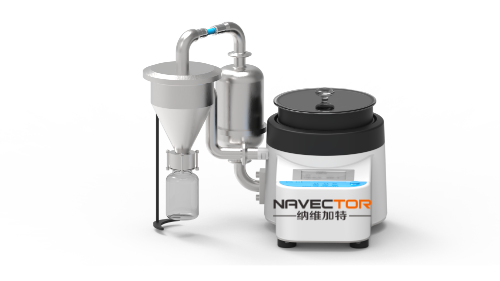
The small negative pressure airflow sieve is compatible with analytical sieves with apertures of 10 μm and above. Parameters such as nozzle velocity, screening time, and negative pressure can be adjusted. Depending on actual operating requirements, the equipment can use standard manual operation or be optionally equipped with an automatic pressure adjustment function. It can also be connected to manually adjustable industrial air extraction equipment or automatic air extraction equipment to provide a continuous airflow for the screening process.
For laboratories that need to conduct repeated particle size analyses, screening stability is important. Adjustable airflow parameters make it possible to modify screening conditions according to the characteristics of different samples, while continuous airflow helps maintain consistency throughout the screening process. The equipment also incorporates a silencer for relatively quiet operation, with an overall structure designed to ensure ease of use.
These design features primarily serve sample screening analysis. During actual operation, appropriate screen apertures and operating parameters still need to be selected according to the material properties of quartz powder and the analysis requirements. The final screening results cannot be determined solely by the equipment specifications.
V. How to Select Suitable Equipment for Quartz Powder Screening Analysis?
The key to selecting screening equipment is to clarify the sample characteristics and analysis objectives. If quartz powder samples contain relatively coarse particles and have good flowability, conventional screening methods may already meet the analysis requirements. If the samples contain a high proportion of fine particles and are prone to agglomeration or screen clogging during screening, airflow-assisted screening can be considered.
The small negative pressure airflow sieve is primarily designed for screening analysis of low-density fine particles that are prone to agglomeration, and is compatible with analytical sieves with apertures of 10 μm and above. Whether it is suitable for a particular quartz powder sample still needs to be determined based on the actual particle size range, sample condition, and testing requirements. In particular, when screening results have a significant impact on process research, it is recommended to conduct material testing first before determining the screen specifications and operating parameters.
Quartz powder screening analysis requires attention not only to screen aperture but also to whether particles can be sufficiently dispersed. For fine powders that are prone to agglomeration, airflow-assisted screening provides an approach different from traditional mechanical vibration. By creating a negative pressure environment and using air jets, the small negative pressure airflow sieve improves particle dispersion while assisting in screen cleaning, making it suitable for laboratory screening analysis of relevant samples. Equipment selection should still be based on the specific material and testing objectives, with appropriate screening conditions determined through practical testing.

 English
 中文
 Español
 ภาษาไทย
 Pусский
 Bahasa Indonesia
 Tiếng Việt