Many companies in the food and beverage, plant extraction, and biopharmaceutical industries encounter similar challenges during solid-liquid separation. After juice clarification, subsequent filtration may still place considerable pressure on downstream processes. Plant extracts need to undergo solid-liquid separation as early as possible, while fermentation broth treatment and cell harvesting in biopharmaceutical production often involve high solid-liquid separation loads. Different production stages have different requirements for separation efficiency, processing capacity, and continuous operation. Choosing the right separation equipment has therefore become an important part of production process design.
The Navector disc stack centrifuge provides an efficient equipment solution for these separation requirements. It generates a centrifugal force field through high-speed rotation of the bowl, separating components with different densities in a mixture. But how exactly does this process work? And what separation tasks can the equipment perform in different production scenarios?
I. Separation Principle: How Does a Disc Stack Centrifuge Achieve Efficient Clarification?
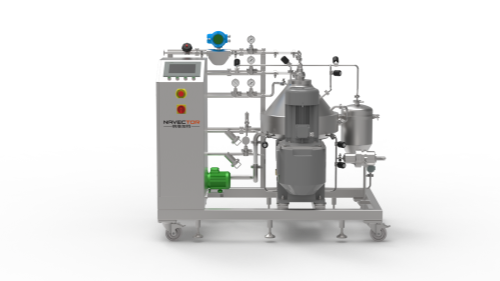
The separation efficiency of a disc stack centrifuge mainly depends on the centrifugal force field generated by high-speed rotation and the disc stack inside the bowl. It uses density differences between different components in the material to achieve solid-liquid separation and multiphase separation.
The material enters the bowl through the central inlet and flows through a distributor into the spaces between the stacked discs. Under the influence of strong centrifugal force, solid particles with higher density gradually settle toward the inner surfaces of the discs, move along the discs toward the outer edge of the bowl, and accumulate there. The lighter liquid phase flows toward the center and is eventually discharged from the bowl.
The disc stack may appear to be just a set of conical structures inside the bowl, but it plays a critical role. It divides the settling space into multiple narrow gaps, shortening the settling distance for particles while increasing the effective settling area. In simple terms, particles can complete the separation process without having to travel through a long settling path. This is one of the reasons why disc stack centrifuges can achieve efficient clarification.
Once a certain amount of solids has accumulated, they need to be discharged promptly. In automatic solids-discharge models, operating water controls a sliding piston to discharge the solid phase at scheduled intervals or according to preset quantities. The piston then automatically resets. The liquid phase is discharged continuously, while the solid phase is discharged periodically, allowing the entire separation process to operate continuously.
II. Application Scenarios: What Separation Challenges Can Disc Stack Centrifuges Solve?
Disc stack centrifuges are primarily used for fine solid-liquid separation, liquid clarification, and multiphase separation. They perform different separation tasks across various industries.
Food and Beverage Industry: Continuous Clarification to Reduce Downstream Filtration Pressure
The production of beer, wine, juice, dairy products, plant-based beverages, and edible oils all involves liquid clarification. Disc stack centrifuges can provide continuous clarification during production, reducing the pressure on downstream filtration and helping subsequent processing stages operate more smoothly.
Plant and Traditional Chinese Medicine Extraction: Moving Solid-Liquid Separation Upstream to the Extraction Stage
The production of plant extracts, traditional Chinese medicine extracts, essential oils, and natural products all involves solid-liquid separation during extraction. Disc stack centrifuges can move this process upstream to the extraction stage, separating solids from the extract and reducing the separation workload in subsequent processing stages.
Biopharmaceuticals: Meeting High-Load Solid-Liquid Separation Requirements
In biopharmaceutical production, fermentation broth treatment, biomass harvesting, and cell harvesting are all important separation processes. The production of vaccines, monoclonal antibodies, recombinant proteins, enzymes, and other biological products may involve these processes. Disc stack centrifuges can be used to meet the high-load separation requirements of such production stages.
Industrial Applications: Liquid Clarification and Multiphase Separation
In industrial production, disc stack centrifuges can be used for liquid clarification, oil-water separation, and multiphase separation to meet the separation requirements of components with different densities.
III. Process Value: How Does Efficient Separation Affect Production Processes?
The process value of a disc stack centrifuge is first reflected in improved separation efficiency and processing capacity. The disc stack inside the bowl increases the settling area and shortens the settling distance for particles, allowing different components in the material to be separated more effectively. For production processes, this means that the separation stage can perform a more clearly defined processing task while reducing the workload of subsequent operations.
The positioning of the separation stage within the production process also affects the overall workflow. Moving solid-liquid separation upstream to the extraction stage allows solid components to be separated earlier during extraction. In food and beverage production, continuous clarification helps reduce downstream filtration pressure. By integrating separation earlier into the process, subsequent treatment stages have less separation work to handle.
For processes with high solid-liquid separation loads, such as biopharmaceutical production, whether the equipment's processing capacity matches actual operating conditions can also affect production planning. Disc stack centrifuges provide the corresponding separation capacity, but specific applications still require equipment selection based on material characteristics and processing requirements.
IV. Equipment Selection: How Should a Disc Stack Centrifuge Be Selected for Different Process Conditions?
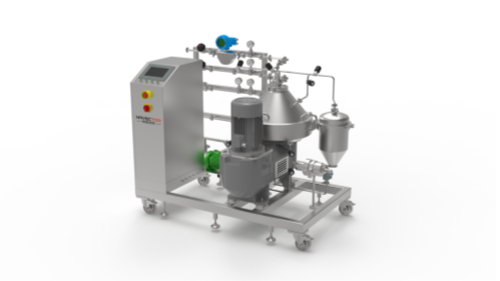
When selecting a disc stack centrifuge, the first step is to clarify the separation task and process requirements of the material. Liquid clarification, solid-liquid separation, oil-water separation, and multiphase separation have different requirements for equipment processing capacity and separation performance. It is recommended to conduct process tests using the actual material and determine the equipment model and configuration based on the test results.
Processing capacity and equipment materials also need to be considered. The actual processing volume should be evaluated based on material test results and separation requirements. Water throughput alone should not be used as a direct indicator of production processing capacity. For food and biopharmaceutical applications, attention should also be paid to product-contact materials, surface roughness, and cleaning methods. The Navector LNC Series uses 316L stainless steel for all product-contact surfaces, with a surface roughness of Ra 0.4 μm. All models support CIP cleaning, while models LNC10 and above also support SIP.
V. System Integration: Why Should Disc Stack Centrifuges Be Evaluated Beyond Individual Machine Performance?
Disc stack centrifuges perform core separation tasks, but in actual production, their integration with upstream and downstream processes must also be considered. How materials enter the bowl, how the separated liquid and solid phases are discharged, and how solids discharge, cleaning, and automated control work together are all factors that need to be considered during system design.
For processes requiring fine solid-liquid separation or multiphase separation, selecting an individual machine is only one part of the overall equipment configuration. Feed and discharge pipelines, solids-discharge control, and CIP/SIP cleaning methods all need to be designed according to actual process requirements.
From preliminary process testing and equipment selection to subsequent pipeline system construction, automation configuration, and on-site commissioning, Navector can provide corresponding supporting services. By combining actual material separation characteristics with production process requirements and coordinating equipment selection with system configuration, individual machines can be better integrated into the entire production process.
Whether a separation solution is suitable ultimately needs to be verified against actual materials and production operating conditions. For disc stack centrifuges, successful application likewise depends on a thorough understanding of material characteristics and process requirements. After all, separation equipment performs one specific stage of production, and its operating performance also affects the coordination between upstream and downstream processes, influencing the entire production workflow. This is precisely why the value of equipment becomes clearer when evaluated in actual production environments, where separation processes can be better aligned with real production requirements.
 English
 中文
 Español
 ภาษาไทย
 Pусский
 Bahasa Indonesia
 Tiếng Việt