Silicon carbide is a common hard material in the abrasives industry, and powder particle size classification affects particle size distribution and subsequent application performance. For fine silicon carbide powder, particles tend to agglomerate, and fine particles may adhere to the screen surface or become lodged in the mesh openings during screening, affecting material passage. Some production processes impose strict limits on the introduction of metallic contaminants. In addition to meeting screening requirements, equipment must also comply with the corresponding material contact requirements.
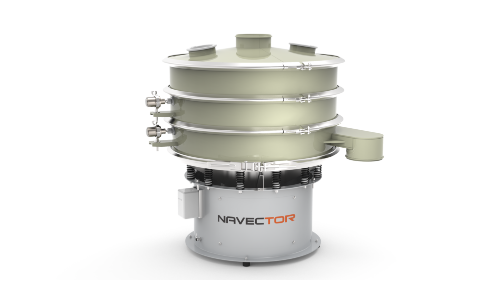
Navector's non-metallic screening machine is designed for special powder screening applications and can be equipped with the UCS ultrasonic screening system to improve screening conditions for fine powders, providing an effective solution for silicon carbide powder screening.
I. What Are the Challenges in Fine Particle Classification of Silicon Carbide Powder?
Fine particles tend to agglomerate, affecting particle size classification. When silicon carbide powder has a fine particle size, adhesion between particles may cause the fine powder to form agglomerates. These agglomerates are difficult to disperse fully during screening, and some particles may move together with larger agglomerates, affecting the screening results. For production processes that require control over the proportion of fine particles, the dispersion state of the material is a factor that needs to be considered during screening.
Particles can easily become lodged in the mesh, reducing screening capacity. After entering the screen openings, fine particles may become trapped due to the relationship between particle shape, particle size, and mesh opening dimensions. As the openings gradually become occupied, the effective screening area decreases, potentially affecting the material passage rate. If screen cleaning cannot keep pace with the rate of blockage, continuous production can easily be disrupted.
Control of metallic contaminants places additional requirements on equipment. In some new materials, electronic materials, and lithium battery materials production processes, strict limits apply to the introduction of metallic contaminants. In addition to meeting particle size classification requirements, screening equipment must also take into account the materials and structure of components that come into contact with the material. For these operating conditions, equipment selection must consider both screening performance and material cleanliness requirements.
These issues correspond to different technical requirements. Particle agglomeration requires improving dispersion based on material characteristics, screen blockage requires an effective screen cleaning method, and metallic contaminant control requires attention to equipment structure and contact materials.
II. How Can Non-Metallic Screening Machines Improve Fine Powder Screening?
Navector's non-metallic screening machine is designed for the screening requirements of special powders, is suitable for screening applications using mesh sizes ranging from 50 to 625 mesh, and can be equipped with the UCS ultrasonic screening system. Its design focuses on reducing screen blockage and particle entrapment during the screening of fine particles while meeting the requirements of applications with strict controls on the introduction of metallic contaminants.
For fine powders prone to screen blockage, the ultrasonic system can provide high-frequency vibrations to the screen, helping fine particles adhering to the screen surface or trapped near the mesh openings to detach and improving the effective operating condition of the screen. Keeping the mesh openings clear also improves the conditions for material to pass through the screen, helping maintain screening continuity.
Ultrasonic-assisted screening can also help loosen some agglomerates, making it easier for particles that meet the required size specifications to pass through the screen. However, the primary function of the ultrasonic system is to improve screening conditions; it does not perform crushing or guarantee complete deagglomeration. If the material has a strong tendency to agglomerate, screening performance must still be evaluated based on its actual characteristics. The ultrasonic system alone cannot be relied upon to solve all agglomeration problems.
The non-metallic design of the equipment primarily addresses powder processing applications with strict requirements for controlling the introduction of metallic contaminants. In practical applications, the materials and structure of the material-contact components must be verified for the specific model to ensure that the equipment configuration meets production process requirements.
III. Applications of Non-Metallic Screening Machines in the Abrasives Industry and Related Sectors
The screening requirements for silicon carbide powder are closely related to the target particle size, particle size distribution, and material condition. For fine powders, if screen blockage, particle entrapment, or reduced screening efficiency occurs during production, an appropriate screen can be selected according to the target particle size, and the suitability of ultrasonic-assisted screening can be evaluated.
In addition to silicon carbide, powders such as corundum, silica powder, and glass microspheres used in the abrasives industry may also require fine particle classification. Different materials vary in particle morphology, particle size distribution, and tendency to agglomerate, so equipment configurations cannot simply be copied from one application to another. Screening tests using the specific material can help determine whether the screen specifications and ultrasonic system are appropriately matched.
In sectors such as lithium battery materials, electronic materials, and powder metallurgy, controlling metallic contaminants may be an important factor in screening equipment selection. Navector's non-metallic screening machine is designed for these special powder processing requirements. In practical applications, the configuration of material-contact components should be verified against process requirements.
The equipment can also be used for screening and filtration of pharmaceutical powders, food powders, and certain chemical materials. When handling corrosive media such as strong acids or strong alkalis, the corrosion resistance of the contact materials must be further confirmed. For pharmaceutical and food applications, it is also necessary to verify whether the equipment meets the relevant cleaning and hygiene requirements. Equipment suitability ultimately depends on the specific material properties and process conditions.
IV. What Should Be Considered When Selecting Screening Equipment for Silicon Carbide Powder?
Screen specifications must correspond to the target particle size. During equipment selection, the particle size distribution of the silicon carbide powder, target particle size range, and classification requirements must first be defined, followed by the selection of appropriate screen specifications. The equipment supports screen sizes ranging from 50 to 625 mesh. The specific mesh size should be determined through testing with the actual material.
The ultrasonic system must match the material characteristics. For fine powders that tend to adhere, agglomerate, or become lodged in the mesh, the suitability of the UCS ultrasonic screening system can be evaluated. Ultrasonic assistance helps improve screen cleanliness, but the extent to which throughput, screening accuracy, and the proportion of oversized particles remaining in the product can be improved must be confirmed through actual testing.
Material contact requirements must be reflected in the equipment structure. If the production process strictly limits the introduction of metallic contaminants, the material and structural requirements for relevant contact components must be clearly defined, and the equipment configuration must be verified against applicable standards. For corrosive materials, material compatibility must also be checked. Suitability cannot be determined solely from the name of a non-metallic screening machine.
Equipment capacity must be verified under actual operating conditions. Material particle size, feed rate, degree of agglomeration, and target classification results all affect screening performance. Testing with the actual material can help evaluate screening efficiency, throughput, and continuous operation under specific operating conditions, providing a basis for equipment configuration.
The screening performance of fine silicon carbide powder is affected by several factors, including particle dispersion, screen openness, and target particle size requirements. Navector's non-metallic screening machine is designed for special powder screening applications and, when equipped with the UCS ultrasonic screening system, can improve screening conditions for fine powders prone to screen blockage. For processes with strict controls on the introduction of metallic contaminants, the material-contact structure and materials of the equipment must also be verified. Only by considering material characteristics, particle size requirements, and production conditions together can a more suitable screening solution be determined.
 English
 中文
 Español
 ภาษาไทย
 Pусский
 Bahasa Indonesia
 Tiếng Việt