The particle size distribution of lithium battery materials affects subsequent processing and product quality. The screening process must ensure effective classification while also accounting for processing capacity and material cleanliness. For powders with strong adhesion, a tendency to agglomerate, high static electricity, and low bulk density, screening is often far from straightforward. Particles tend to adhere to one another, agglomerates are difficult to disperse, and fine powders may become lodged in the screen openings, gradually clogging the mesh and reducing throughput.
Some lithium battery materials have strict requirements regarding the introduction of metallic contaminants such as copper and zinc. Equipment selection must therefore also consider the materials used in parts that come into contact with the product and their compatibility with the process. To meet the screening needs of these specialized powders, Navector's non-metallic screening machine can be equipped with the UCS ultrasonic screening system to improve screening conditions for fine powders. This article examines material characteristics and practical screening challenges to explain how non-metallic screening machines address the difficulties of screening lithium battery powders.
I. Why Are Lithium Battery Powders Prone to Screening Difficulties?
The finer the powder, the more pronounced the effects of interactions between particles tend to be during screening. Some lithium battery materials exhibit strong adhesion or electrostatic effects, causing particles to gather together and form larger agglomerates. When these agglomerates enter the screening process, they may be retained as oversized particles, affecting the final particle size distribution.
The screen itself also faces challenges. Fine particles tend to adhere to the mesh surface, while some may become trapped in the openings. As the effective open area decreases, it becomes more difficult for material to pass through the screen, potentially reducing both screening efficiency and throughput.
These problems are often interconnected. Insufficient particle dispersion can affect classification results, while reduced screen permeability slows the passage of material. For powders that readily agglomerate, the equipment must provide both effective particle dispersion and screen cleaning capabilities. If the production process also imposes strict requirements on the introduction of metallic contaminants, the materials used in product-contact components must not be overlooked.
II. How Can Non-Metallic Screening Machines Improve the Screening of Fine Powders?
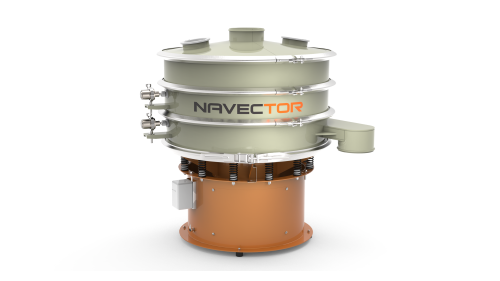
Navector's non-metallic screening machine is designed for specialized powder screening applications and is suitable for materials subject to strict controls on metallic contamination. To address problems such as fine powder adhesion, agglomeration, and screen blockage, the machine can be equipped with the UCS ultrasonic screening system to improve screen permeability while balancing screening efficiency and material cleanliness.
1. Combining the Ultrasonic Screening System to Reduce Screen Clogging
Powders with strong adhesion and high static electricity tend to stick to the screen surface, and some particles may become lodged in the mesh openings. This reduces the effective screening area and affects throughput. The UCS ultrasonic screening system applies high-frequency vibration to the screen, helping reduce particle adhesion and blockage of the mesh openings and improving screening conditions for fine powders. Using this system eliminates the need for additional cleaning devices and can also help increase throughput and reduce the proportion of oversized particles. Actual results must be confirmed based on material characteristics and operating conditions.
2. Handling Fine Powders While Controlling Operating Temperature Rise
This equipment is suitable for screening powders measuring 20–300 μm, with screen mesh sizes ranging from 50 to 625 mesh. For materials prone to agglomeration, screening performance depends not only on the mesh specification but also on particle dispersion and the openness of the mesh. Reducing particle adhesion and blockage helps improve screen utilization and maintain screening stability. The equipment features a system-matched design that helps control operating temperature rise, making it suitable for materials that are relatively sensitive to temperature changes. Its actual performance must be verified under real operating conditions.
3. Meeting Metallic Contamination Control Requirements for Specialized Powders
Some lithium battery materials are subject to strict limits on metallic contaminants such as copper and zinc. In addition to meeting particle size classification requirements, screening equipment must also account for the materials used in product-contact components. Navector's non-metallic screening machine is specifically developed to address requirements for "zero metallic contamination" and applications where metal contact with the material is prohibited. It can be used in relevant powder screening processes. During equipment selection, the materials used in product-contact components and the equipment configuration should be verified against process requirements. The metallic content of the final product is also affected by factors such as material sources, upstream and downstream processes, and on-site management. These factors must be controlled and verified across the entire production line.
III. How Should Screening Equipment for Lithium Battery Powders Be Selected?
Equipment selection should not be based solely on mesh size. For fine powders that readily agglomerate and adhere, material characteristics, classification objectives, and production conditions must be evaluated together.
Determine the screen specifications according to the target particle size. The appropriate screen must be selected based on the material's particle size distribution, target classification range, and actual screening test results.
Focus on particle dispersion and screen cleaning capabilities. For powders with strong adhesion, high static electricity, a tendency to agglomerate, or low bulk density, attention should be paid to whether particles readily adhere during screening, whether agglomerates can be effectively dispersed, and whether the screen is prone to clogging. If mesh openings are easily blocked under conventional screening conditions, the suitability of integrating the UCS ultrasonic screening system should be evaluated.
Verify metallic contamination control requirements. For lithium battery materials subject to strict limits on metallic contaminants such as copper and zinc, the materials used in product-contact components must be confirmed, and the equipment configuration must be checked against production process requirements. Contamination control must cover the relevant stages of production and cannot rely solely on a single screening machine.
Evaluate equipment performance through testing with actual materials. Even with the same screen specification, different powders may produce different screening results. Testing should focus on the particle size distribution after screening, throughput, screen clogging, and continuous operating performance. For materials sensitive to temperature rise, temperature changes during equipment operation should also be recorded to provide a basis for subsequent equipment selection.
IV. Conclusion
The main challenges in screening lithium battery powders often involve particle dispersion, screen permeability, and metallic contamination control. For fine powders with strong adhesion, a tendency to agglomerate, high static electricity, and low bulk density, simply adjusting the mesh size may not resolve the problem. The screen cleaning capabilities and material compatibility of the equipment are equally important.
Navector's non-metallic screening machine is designed for specialized powder screening applications and can be equipped with the UCS ultrasonic screening system. It is suitable for screening relevant lithium battery materials and other fine powders. The specific configuration should be determined according to the target particle size, material characteristics, and contamination control requirements, and verified through testing with actual materials. Only when the screening solution is properly matched to the material and process can it provide reliable support for stable production.
 English
 中文
 Español
 ภาษาไทย
 Pусский
 Bahasa Indonesia
 Tiếng Việt