Copper powder is a commonly used metal powder in industrial production. For fine copper powder with stringent screening requirements, the screening process must balance particle passage capability with particle size separation performance. When materials are affected by static electricity, particle agglomeration, or similar conditions, conventional vibrating screens may experience particle adhesion to the screen surface and mesh clogging, reducing screening efficiency.
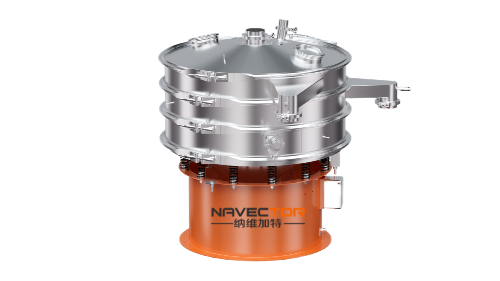
To address these difficult-to-screen fine powders, Navector ultrasonic vibrating screens combine an ultrasonic system with a conventional vibrating screen. High-frequency, low-amplitude ultrasonic vibration waves are superimposed on the screen surface to improve screen cleaning performance and powder flow conditions. How does this equipment work, and what aspects deserve attention when screening copper powder?
I. Challenges in Copper Powder Screening: Fine Particles Are Prone to Screen Adhesion and Clogging
The particle size, particle morphology, and surface condition of copper powder affect its movement and passage through the screen during the screening process. When copper powder has a fine particle size and exhibits strong electrostatic effects, adhesion, or agglomeration, particles can easily stick to the screen surface. Some particles may also enter the mesh openings and become lodged, causing screen clogging.
Conventional vibrating screens mainly rely on mechanical vibration to move materials. This method can perform basic screening for conventional particles. However, when handling difficult-to-screen fine powders, mechanical vibration alone may not effectively prevent particle adhesion and screen clogging. Once the effective screening area is reduced, material passage rates and screening efficiency are also affected.
The condition of the copper powder itself must also be considered. Copper powders produced through different manufacturing processes may vary in particle size distribution, particle morphology, and degree of agglomeration, resulting in different screening performance. Equipment selection should not be based solely on the material name. It must also take into account the specific screening requirements of the actual material sample.
II. Working Principle: How Does Ultrasonic Vibration Improve Copper Powder Screening?
An ultrasonic vibrating screen is developed by integrating an ultrasonic system into a conventional vibrating screen. It is primarily used to address screening and classification challenges associated with difficult-to-screen fine powders in industrial production.
Its operating principle involves superimposing high-frequency, low-amplitude ultrasonic vibration waves onto the screen mesh. Ultrafine powder particles are subjected to high ultrasonic acceleration, allowing the material on the screen surface to remain in a suspended state of motion. This helps suppress screen clogging caused by adhesion, friction, blinding, and wedging. The ultrasonic vibration acts directly on the screen mesh, helping improve screening efficiency and screen cleaning performance while enhancing the passage of fine particles through the mesh.
For metal powders such as copper powder, equipment specifications explicitly list them among the applicable materials. If copper powder experiences electrostatic adhesion, particle agglomeration, or mesh blockage during screening, the ultrasonic system can address these difficult screening factors and reduce the impact of screen clogging on the screening process.
Navector ultrasonic vibrating screens cover a mesh range of 2–400 mesh and can be used for screening and classification under different particle size requirements. The equipment also operates at a low and stable temperature, without causing localized temperature increases, and supports continuous operation. The screening process does not alter the original properties of the material, and no additional screen cleaning devices are required, helping extend screen mesh service life.
III. What Factors Should Be Considered When Selecting Copper Powder Screening Equipment?
When selecting copper powder screening equipment, the target particle size and screening objective should be clearly defined first. If the main purpose is to remove oversized particles mixed into the material during production, the mesh aperture should be determined according to the size of the impurities. If copper powder needs to be classified by particle size, the mesh specification should be selected based on the target particle size range and the requirements for each particle fraction. Navector ultrasonic vibrating screens cover a mesh range of 2–400 mesh. The specific specifications still need to be determined according to material samples and process requirements.
Next, determine whether the copper powder exhibits significant adhesion, agglomeration, or screen clogging. The ultrasonic system primarily addresses adhesion, friction, blinding, and wedging during fine powder screening. If the particle condition, impurity content, or feeding conditions of the material are relatively complex, the final screening performance cannot be accurately determined from equipment parameters alone. Material testing is recommended before finalizing the equipment configuration.
In addition, the number of screening decks, equipment model, and processing capacity must be evaluated against actual production requirements. Navector ultrasonic vibrating screens are available in different models and specifications. The specific selection should match the screening area, target particle size, and on-site process conditions. Equipment suitability should not be judged solely by its mesh range.
IV. Navector Ultrasonic Vibrating Screens: Designed for Fine Screening Requirements of Metal Powders
Navector has long been dedicated to screening technology research and development, as well as equipment applications. Its product range includes ultrasonic vibrating screens, gyratory screens, ultrasonic gyratory screens, and rotary vibrating screens.
In ultrasonic vibrating screen applications, copper powder, iron powder, titanium powder, alloy powder, and solder powder are all listed as suitable metal powder materials. For fine powders prone to adhesion, agglomeration, and screen clogging during screening, the ultrasonic system helps improve screen cleanliness and supports fine screening and particle size classification.
V. The Key to Copper Powder Screening Lies in Matching Material Characteristics with Equipment Principles
Ultrafine copper powder screening requires consideration of particle size requirements as well as the material's electrostatic properties, adhesion, and agglomeration behavior. When conventional mechanical vibration cannot adequately address particle adhesion and screen clogging in certain fine powders, ultrasonic vibrating screens use high-frequency, low-amplitude ultrasonic vibration to improve screen cleaning performance and increase screening efficiency.
For copper powder manufacturers, the target particle size, screening objective, and material condition should be clearly identified before selecting equipment. Screening performance should then be verified through testing with actual material samples. By matching material characteristics, screen specifications, and equipment operating principles, screening equipment can be better adapted to specific production processes.


 English
 中文
 Español
 ภาษาไทย
 Pусский
 Bahasa Indonesia
 Tiếng Việt