Silicon powder is widely used in semiconductors, photovoltaics, and advanced materials. Its particle size and distribution are subject to specific requirements during production. When screening fine powders, attention must be paid to particle dispersion, screen aperture size, and the stability of the screening process. If the material is prone to agglomeration, particles may not disperse sufficiently, which can affect screening results.
A small negative pressure airflow sieve uses an aerodynamic screening method. It disperses particles through airflow and helps fine particles pass through the screen, making it suitable for screening analysis of low-density, easily agglomerated fine particles. For fine powders such as silicon powder, the suitability of this equipment must be evaluated based on the actual particle size, material condition, and screening objectives. The following analysis covers screening challenges, equipment operating principles, and practical selection considerations.
I. What Factors Affect Screening Results During Silicon Powder Screening?
The screening performance of fine powders is influenced not only by screen aperture size but also by particle dispersion, material properties, and screening conditions.
Particle agglomeration affects screening. Fine particles may experience van der Waals forces, electrostatic forces, and other interactions, resulting in varying degrees of agglomeration. If these agglomerates are not adequately dispersed during screening, some particles may be unable to pass through the screen according to their actual particle size, affecting the screening results.
Particle dispersion affects screening stability. For powders with very small particle sizes, relying solely on mechanical vibration to move particles may not sufficiently improve their agglomeration state. Insufficient material dispersion across the screen surface may also affect the repeatability of the screening process.
Screen cleanliness affects the passage of particles. Fine particles tend to adhere to or accumulate around the screen during screening. When particle buildup obstructs the screen apertures, the material's ability to pass through the screen may decrease. Screening equipment must therefore account for both particle dispersion and screen cleaning to maintain relatively stable screening conditions.
The actual screening performance of silicon powder also depends on its production process, particle size distribution, and material condition. The screening difficulty of different silicon powders cannot be determined solely by their material name. Sample testing is recommended before selecting equipment.
II. How Does a Small Negative Pressure Airflow Sieve Help Fine Powders Disperse and Pass Through the Screen?
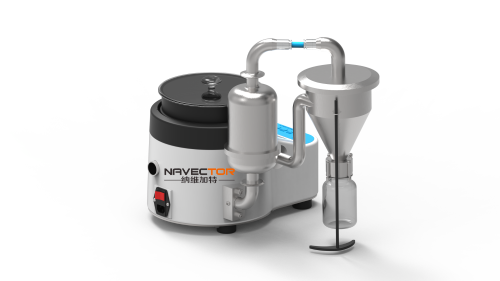
A small negative pressure airflow sieve operates on the principle of aerodynamic screening. After the equipment is connected to a vacuum cleaner, negative pressure is created inside the screening chamber. Due to the pressure difference, a strong airflow is generated at the nozzle. The airflow is directed toward the screen surface and then drawn through the screen apertures from below.
During this process, particles smaller than the screen aperture pass through the screen with the airflow and enter the vacuum cleaner or cyclone separator. At the same time, the airflow helps disperse the particles and clean the screen.
This screening method has several key characteristics:
First, airflow helps reduce particle agglomeration. Air jetting improves the dispersion of fine particles, reducing the impact of agglomeration on the screening process. This makes the method suitable for screening analysis of low-density, easily agglomerated fine particles.
Second, the screening process is relatively gentle. The equipment uses airflow to disperse particles and facilitate their passage through the screen without requiring additional non-mechanical screening accessories. It is suitable for sample analysis applications with specific screening process requirements.
In addition, screening parameters are adjustable. The screening time, negative pressure, and nozzle speed can all be digitally adjusted. Operators can modify the screening conditions according to the sample characteristics. The standard configuration uses manual operation, while an automatic pressure regulation function is available as an option to improve the repeatability of the screening process.
III. What Silicon Powder Screening Requirements Are Suitable for a Small Negative Pressure Airflow Sieve?
The small negative pressure airflow sieve is primarily designed for screening analysis of fine particles. It accommodates analytical test sieves with aperture sizes of 10 microns and above, with an average screening time of 2–3 minutes. For silicon powder samples, if the target particle size and screening requirements fall within the equipment's applicable range, sample testing can be conducted to evaluate its performance.
In practical applications, three aspects require particular attention:
Determine the Target Particle Size and Screen Aperture. The screen aperture should be selected according to the target particle size requirements of the silicon powder. The small negative pressure airflow sieve accommodates analytical test sieves with aperture sizes of 10 microns and above. During equipment selection, the sample's particle size distribution and screening objectives should be checked to ensure that the equipment's applicable range matches the actual screening requirements.
Adjust Screening Parameters According to Material Conditions. Different silicon powder samples may vary in their degree of agglomeration and dispersion. During testing, the screening time, negative pressure, and nozzle speed can be adjusted as needed. Particle dispersion, screening results, and repeatability should be observed before determining the appropriate operating conditions.
Confirm the Extraction Equipment and On-Site Conditions. The equipment needs to be connected to a vacuum cleaner to create a negative pressure environment. It can be used with manually adjustable industrial air extraction equipment or an optional automatic extraction system to provide continuous airflow during screening. Before operation, it is necessary to confirm that the connection and operating conditions of the extraction equipment are compatible with the screening unit.
It should be noted that the small negative pressure airflow sieve is primarily intended for screening analysis and sample processing. It should not be regarded as a high-capacity continuous production machine. If silicon powder requires large-scale production screening, the equipment solution should be evaluated separately according to processing capacity, particle size requirements, and production line conditions.
IV. What Factors Should Be Considered When Selecting Screening Equipment for Silicon Powder?
The selection of silicon powder screening equipment should be based on actual sample characteristics and intended applications rather than simply comparing equipment specifications.
First, clarify whether the screening process is intended for raw material inspection, process research, or product testing during production. Different applications have different requirements for sample processing capacity, screening time, and result repeatability.
Second, it is recommended to provide representative silicon powder samples to the equipment supplier for testing. Particular attention should be paid to particle dispersion, screening results, and repeatability under different parameter settings. For samples with a high degree of agglomeration, it is also important to evaluate whether adjusting the airflow parameters can improve the screening conditions.
Finally, confirm the screen specifications, air extraction equipment configuration, and daily operating procedures. The small negative pressure airflow sieve supports manual adjustment or optional automatic pressure regulation, with adjustable screening time, negative pressure, and nozzle speed. Determining the operating conditions based on sample testing results allows the equipment to better meet specific analytical requirements.
Navector has long been engaged in the research, development, and application of screening equipment and related technologies. It can provide testing and equipment selection services based on material characteristics and screening requirements. For fine powders such as silicon powder, a reliable equipment selection process starts with identifying the sample condition and target particle size, followed by practical testing to evaluate equipment compatibility.
V. Conclusion: Particle Dispersion Is an Important Part of Fine Powder Screening
Silicon powder screening requires consideration of the particles themselves, as well as screen aperture size, airflow conditions, and screening objectives. The small negative pressure airflow sieve uses aerodynamic forces to disperse particles and negative pressure airflow to help fine particles pass through the screen, while also supporting screen cleaning. It is suitable for screening analysis of low-density, easily agglomerated fine particles.
The suitability of this equipment for silicon powder samples still needs to be verified according to actual particle sizes and process requirements. Clearly defining the screening objectives, conducting sample tests, and then determining the appropriate screen specifications and operating parameters are essential to obtaining more meaningful and reliable screening results.
 English
 中文
 Español
 ภาษาไทย
 Pусский
 Bahasa Indonesia
 Tiếng Việt