Most people involved in ceramic material R&D have encountered similar situations. A batch of zirconia powder (ZrO₂) has just been prepared in the laboratory, and particle size screening analysis is about to be carried out. The theoretical particle size is about 8 μm, but the screening results are somewhat strange: particles above 20 μm account for more than ten percent. When tested again with another screening machine, it becomes only a few percent.
The same batch of powder, yet the data does not match. The first reaction of many engineers is usually: has the powder agglomerated? But after further investigation, it is sometimes found that the problem is not with the material itself, but with the screening method.
For micron-level ceramic powders such as zirconia, if a traditional vibrating sieve is still being used, the screening process is easily affected by factors such as agglomeration and mesh clogging. Therefore, many material laboratories later switched to a different type of equipment — the negative pressure airflow sieve.
Below, based on the analytical logic commonly used by engineers, let’s discuss the real-world application of this equipment in zirconia powder screening.
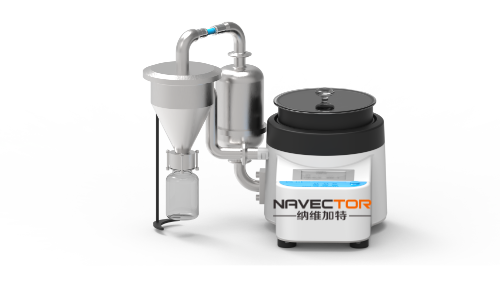
I. What Exactly Is a Negative Pressure Airflow Sieve?
Simply put, a negative pressure airflow sieve is a device that uses airflow to complete powder screening. Its working method is completely different from that of a traditional vibrating sieve.
Traditional screening relies on:
mechanical vibration → powder jumping → passing through the mesh openings
The principle of an airflow sieve is:
airflow disperses the powder → negative pressure draws away fine powder → classification through the sieve mesh
During equipment operation, a stable negative pressure is formed below the sieve mesh, while the air nozzle continuously blows air toward the sieve surface. Under the action of airflow, the powder is dispersed, fine particles are carried through the mesh by the negative pressure airflow, while larger particles remain on the sieve surface.
Many engineers say the same thing the first time they see the equipment running: “This doesn’t look like powder screening, it looks more like airflow classification.” It is precisely this method that makes micron-level powder screening more stable.
II. Why Is Zirconia Powder More Suitable for Airflow Screening?
The difficulty of zirconia powder screening mainly comes from three aspects.
1.Fine powder, easy to agglomerate
Many ceramic-grade zirconia powders have a particle size range of 0.5 μm–10 μm. Powders at this level are very likely to form clumps, pseudo-particles, and artificially “enlarged” particle sizes on a vibrating sieve.
A common laboratory situation is that powder with an actual particle size of 8 μm may show screening results similar to 15 μm particles. The reason is often not that the particles have become larger, but that the agglomeration has not been dispersed.
During operation, the airflow sieve nozzle continuously generates airflow to disperse the powder. Usually, an air pressure of about 3000 Pa is enough to disperse fine powder.
2.High-mesh screens are prone to clogging
Zirconia powder screening usually uses:
1000 mesh screen (about 13 μm)
1250 mesh screen (about 10 μm)
On traditional vibrating sieves, this type of screen often starts clogging halfway through the screening process. The finer the powder, the more obvious the clogging.
During operation, the airflow continuously sweeps across the sieve surface, providing a certain cleaning effect on the mesh openings. If combined with a diamond-coated screen, the clogging problem can be significantly reduced. Many laboratories notice during their first use that the screen can remain in a relatively clean condition.
3.Experimental data requires repeatability
In ceramic material R&D, it is often necessary to conduct particle size distribution tests, material batch comparisons, and powder classification verification.
If the screening results vary greatly each time, the experimental data becomes difficult to use as a reference.
The advantage of the airflow sieve is that its screening parameters can basically be stably controlled, such as: negative pressure value, nozzle speed, and screening time. The same set of parameters can be repeatedly used, thereby improving the repeatability of experimental results.
III. Who Needs This Equipment the Most?
The negative pressure airflow sieve is mainly laboratory equipment, and common users include three categories.
1.Material R&D engineers
For example, ceramic material R&D involving zirconia powder, alumina powder, and silicon nitride powder. These materials usually have fine particle sizes and require high screening precision.
2.Powder testing laboratories
Many in-house corporate laboratories need to carry out powder particle size screening and quality control testing. The sample volume is usually not large, but the requirements for data stability are very high.
3.Universities and research institutions
University materials schools and powder research institutes also frequently use airflow sieves for powder particle size analysis and experimental data verification.
IV. When Should You Consider an Airflow Sieve?
In laboratory practice, if the following situations occur, an airflow sieve is usually considered.
First: the powder particle size is below 20 μm, such as zirconia powder and nano ceramic powder, where vibrating sieves find it difficult to provide stable screening.
Second: the mesh count exceeds 1000 mesh, as high-mesh screens are prone to clogging on vibrating sieves.
Third: the sample volume is relatively small. Many laboratories only screen 50 g–100 g at a time, which is more suitable for laboratory equipment.
Fourth: stable experimental data is required. An airflow sieve can usually complete one screening in just a few minutes, with good repeatability.
V. In Which Industries Is This Equipment Commonly Used?
Although many people first encounter airflow sieves in the ceramic industry, their applications are actually quite broad. Common industries include:
Advanced ceramics: zirconia powder, alumina powder, silicon nitride powder
Electronic materials: MLCC ceramic powder, electronic slurry powders
New energy materials: graphite powder, silicon powder, ternary materials
Fine chemicals: pigment powders, coating powders
These industries share one common characteristic: the powders are fine and prone to agglomeration.
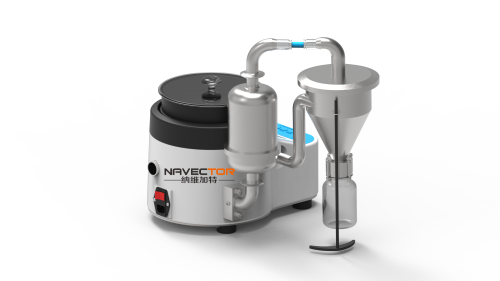
VI. How Should Laboratories Choose a Suitable Airflow Sieve?
From an engineer’s perspective, several key factors are usually considered.
1.Screen size
The most common laboratory standard is a 200 mm screen, suitable for most powder screening tests.
2.Screening particle size range
In general, airflow sieves can support 5 μm – 4000 μm, but the most commonly used range is usually 10 μm – 200 μm.
3.Screen material
For high-mesh screening, diamond screens are usually recommended. This type of screen has a wear-resistant coating on the surface, is less prone to clogging, and has a longer service life.
4.Whether ultrasonic assistance is required
If the powder particle size is ≤10 μm, many engineers recommend adding an ultrasonic module, which can further reduce agglomeration.
VII. Common Problems in Zirconia Screening Analysis
Question 1: How to perform micron-level screening of zirconia powder?
For zirconia powder of 10 μm and below, it is recommended to prioritize the use of a negative pressure airflow sieve. Through airflow dispersion + negative pressure suction, the impact of agglomeration can be reduced, improving screening accuracy and data stability.
Question 2: Why does zirconia powder show a larger particle size after screening?
The main reason is not that the particles have become larger, but that the powder agglomeration has not been dispersed. Especially when using a vibrating sieve, agglomerated particles are counted as “large particles,” causing result deviations typically in the range of 5%–15%.
Question 3: Does zirconia powder screening require ultrasonic assistance?
If the particle size is below 10 μm, ultrasonic configuration is recommended. It can effectively reduce powder agglomeration and improve screening pass rate and data consistency.
Question 4: How to determine whether you need a negative pressure airflow sieve?
If the following situations occur, it can basically be considered:
particle size below 20 μm, unstable data when using vibrating sieves, high-mesh screens prone to clogging, small experimental sample volume (<100 g)
After working with powder screening for a long time, one pattern becomes clear: the finer the powder, the more critical the screening method.
For ceramic powders such as zirconia at the 10 μm level, many problems are not with the material itself, but with agglomeration, mesh clogging, and unstable data during the screening process.
The core functions of the negative pressure airflow sieve are actually three things: dispersing the powder, stabilizing the screening process, and improving the repeatability of experimental data. Therefore, many material laboratories tend to have a fairly consistent evaluation after use: it may not be the fastest screening device, but it is often one of the most stable in terms of data.
If your laboratory is currently working on zirconia powder, ceramic micropowder, or 10-micron-level powder screening, you can also bring samples for an actual test to see whether the screening effect is suitable for your material. Welcome to call 15601937055 to book a free sample test.
 English
 中文
中文 Español
 ภาษาไทย
 Pусский
 Bahasa Indonesia
 Tiếng Việt