In new energy material laboratories, there is often a rather troublesome situation.
R&D engineers take a batch of ternary material powder for particle size analysis. Today’s screening result shows D50=12.4μm; after screening the same sample again two days later, the result becomes D50=13.8μm. The material has not changed, and the operating steps are almost the same, yet the particle size distribution is different. Many people initially suspect the material batch, but those who have worked in powder engineering for a long time know that many times the issue lies in the screening method itself.
Especially for fine powders in the 10μm–30μm range, if a traditional vibrating sieve is still used, the screening process is easily affected by agglomeration, mesh clogging, and false particles. Today, from an engineer’s perspective, let’s talk about a piece of equipment that is becoming increasingly common in new energy laboratories: the negative pressure airflow sieve.
I. What Exactly Is a Negative Pressure Airflow Sieve?
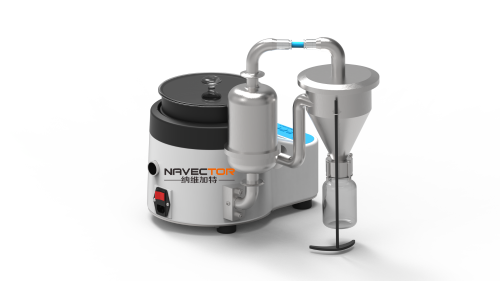
To explain it in a simple and practical way: a negative pressure airflow sieve is actually a screening device that uses air to “blow apart the powder” and then uses negative pressure to “draw the fine powder through.”
Its working principle is completely different from that of a traditional vibrating sieve.
Traditional screening is: vibration → powder bouncing → passing through the mesh
While negative pressure airflow screening is: air jet → powder dispersion → airflow carrying fine powder through the mesh
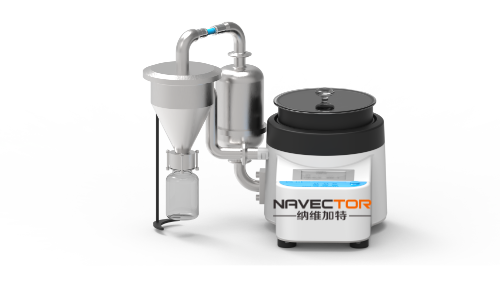
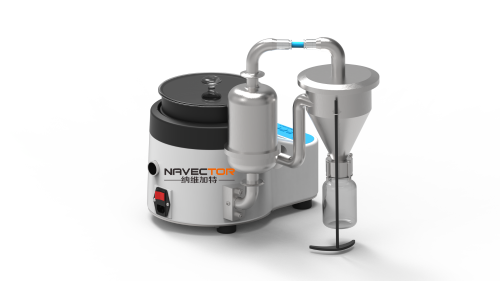
Taking the Navector NQV200 ultrasonic negative pressure airflow sieve as an example, the main structure of the equipment is actually not complicated:
Rotating air nozzle (30±2 rpm)
200 mm standard sieve mesh
Negative pressure suction system (0–10 kPa)
Ultrasonic dispersion module
Filter and collection bottle
Control system
When the equipment is running, a negative pressure environment is formed beneath the sieve mesh, and the nozzle continuously sprays air onto the sieve surface. Engineers usually describe its working method like this: on one side, the airflow disperses the powder; on the other side, the negative pressure draws away the fine powder.
As a result, particles smaller than the mesh aperture pass through the sieve along with the airflow. For micron-level fine powders, this method is much gentler than a vibrating sieve.
II. Why Are Ternary Materials More Suitable for Airflow Sieving?
If you have worked with ternary material screening, you have most likely encountered three typical problems.
1.First issue: the powder is especially prone to agglomeration
The particle size of ternary materials is generally in the range of 5μm–30μm. With such fine powder, when placed on a vibrating sieve, issues such as powder clumping, false particles, and mesh clogging easily occur. The final particle size distribution is usually 5%–10% larger than the actual value. Many R&D engineers have encountered this situation.
2.Second issue: poor repeatability of screening results
An engineer engaged in battery material R&D once said something very realistic to me: “What we fear most in the lab is not unattractive data, but unstable data.”
For example, for the same batch of ternary material:
First screening: D50=12 μm
Second screening: D50=14 μm
Such deviations are actually very troublesome during the R&D verification stage.
The advantage of the negative pressure airflow sieve is that all screening parameters are digitally controlled.
For example:
Negative pressure range: 0–10 kPa
Nozzle speed: 5–55 rpm
Screening time: 0–99 minutes
Every screening condition can be completely reproduced.
3.Third issue: high-mesh sieves are easily clogged
Especially:
1000 mesh sieve (about 13 μm)
1250 mesh sieve (about 10 μm)
A vibrating sieve often gets clogged halfway through the process. The idea of the airflow sieve, however, is to first disperse the powder and then let the airflow carry the fine powder through the mesh openings. Generally speaking, an air pressure of about 3000 Pa is enough to lift the fine powder. When the powder bulk density is between 0.5 and 0.7, the screening effect is best. Combined with an ultrasonic system + diamond sieve mesh, high-mesh screening becomes much more stable.
III. Who Uses Negative Pressure Airflow Sieves Most Frequently?
In fact, this type of equipment is not used in every factory, but it is especially common in laboratory scenarios.
1.New energy material R&D engineers
Their daily work mainly includes particle size analysis, powder classification verification, and material consistency testing.
Many laboratories do not handle large daily screening volumes, usually only 50 g–100 g, but they have extremely high requirements for data stability.
2.University material research institutes
Such as schools of materials science and powder research institutes, which often conduct particle size distribution experiments, powder behavior studies, and new material development. The two indicators they value most are: screening precision + data repeatability.
3.New material enterprise laboratories
In new energy material R&D, this type of equipment is basically one of the standard laboratory configurations.
IV. When Is It Recommended to Directly Use an Airflow Sieve?
Based on the practical experience of many laboratories, there are roughly 4 situations where an airflow sieve can be directly considered.
1.Particle size below 20 microns
For example: ternary materials, silicon powder, graphite. For powders below 20 μm, vibrating sieves almost always encounter agglomeration problems.
2.Sieve mesh above 1000 mesh
For example:
1000 mesh (13 μm)
1250 mesh (10 μm)
The airflow sieve can achieve a screening capability of 5 μm (1250 mesh) and stable screening at 10 μm.
3.Very small sample quantity
Many R&D experiments only have sample quantities of several dozen grams to 100 grams per day, and industrial screening equipment is actually not suitable.
4.High repeatability data required
The average screening time of a negative pressure airflow sieve is 2–3 minutes. Once the parameters are fixed, each test result will be very close.
V. Which Industries Commonly Use Negative Pressure Airflow Sieves?
Although it has been widely used in new energy materials recently, its application industries are actually quite broad. Common industries include:
New energy materials: ternary materials, graphite, silicon powder
Pharmaceutical industry: lactose powder, active pharmaceutical powders
Fine chemicals: pigments, toners, coating powders
Ceramic materials: micron-level ceramic powders
Food industry: food additives, spice powders
These industries all share one common characteristic: fine powders that are prone to agglomeration.
VI. How to Select an Airflow Sieve for Ternary Materials?
From an engineer’s perspective, 5 core parameters are generally considered.
1.Sieve mesh size
The NQV200 adopts a 200 mm standard sieve mesh, which is widely used in laboratories.
2.Screening particle size range
The equipment supports 5 μm – 4000 μm, but the commonly used practical range is 10 μm – 200 μm.
3.Screening efficiency
In an actual case test at a company site:
Sample quantity: 100 g
4.Screening time: 15 minutes
It can complete about 1/3 of the screening volume, which is already sufficient for laboratory testing.
5.Mesh material
For high-mesh screening, it is recommended to use diamond sieve mesh. This type of mesh has a diamond-coated surface structure, and its advantages are obvious: a smoother surface, smoother powder flow, and a significantly reduced probability of clogging.
6.Whether ultrasonic configuration is included
If the powder particle size is ≤10 μm, engineers usually directly recommend adding an ultrasonic module because agglomerated powder will be significantly reduced.
VII. Common Problems in Ternary Material Powder Screening
Question 1: Why are ternary material powder screening results unstable?
The most common reasons are powder agglomeration + mesh clogging. Especially in the 10–30 μm particle size range, vibrating sieves can easily cause data fluctuations of 5%–10%.
Question 2: Is a vibrating sieve or an airflow sieve more suitable for ternary materials?
If the particle size is >30 μm, a vibrating sieve can be used.
If it is in the 10–30 μm range, it is recommended to use a negative pressure airflow sieve for better stability.
Question 3: Why is the screening data different every time for the same batch of material?
Usually it is not a material issue, but rather: inconsistent screening process, different degrees of agglomeration, and changes in mesh condition. The airflow sieve can improve repeatability by fixing parameters.
Question 4: Why is ternary material screening prone to mesh clogging?
There are mainly two reasons:
Fine powder (<20 μm)
Strong surface activity, easy to adhere
The general solution is: airflow sieve + ultrasonic system + high-performance mesh (such as diamond sieve mesh)
A final engineer’s summary: after working in powder screening for a long time, you will actually discover one thing: what truly troubles many laboratories is not that the powder cannot be screened, but that “the result is different every time.”Especially for fine powders like ternary materials in the 10–30 μm range, even slight agglomeration or mesh clogging can cause particle size data deviations of 5% or even 10%.For R&D, such deviations often mean: the formula needs to be revalidated, the experimental cycle is prolonged, and the data is difficult to reproduce.
What the negative pressure airflow sieve actually solves is precisely this issue—first dispersing the powder, then using airflow to carry the fine powder through the sieve mesh, making the screening process more controllable and more stable.Therefore, many material laboratories have the same feeling after using it: it may not be the fastest screening equipment, but it is often the most “reliable” type.
If your laboratory is currently working on ternary materials, silicon powder, graphite, or 10-micron-level powder screening, you are also welcome to bring samples for actual testing.
Book a free sample test: 15601937055
 English
 中文
中文 Español
 ภาษาไทย
 Pусский
 Bahasa Indonesia
 Tiếng Việt