Against the backdrop of the rapid development of the new energy industry, lithium carbonate, as one of the core raw materials of lithium batteries, continues to see growing demand. As an important precursor of cathode materials, the particle size distribution, purity, and stability of lithium carbonate powder directly affect the quality of subsequent material preparation.
In actual production processes, lithium carbonate powder needs to undergo a screening process to achieve particle size control and impurity removal. However, due to the characteristics of fine particle size, easy agglomeration, and moisture absorption, problems such as screen clogging, low screening efficiency, and unstable accuracy are very likely to occur during the screening process.
These issues can lead to the following impacts:
Reduced screening efficiency
Uneven particle size distribution
Decreased product consistency
Increased production costs
Higher equipment maintenance frequency
Therefore, how to solve the clogging problem while ensuring screening accuracy has become a key technical challenge that lithium carbonate manufacturers must address.
Table of Contents
1 The Importance of Screening in Lithium Carbonate Production
2 Causes of Lithium Carbonate Screening Problems
3 Key Technical Challenges in Lithium Carbonate Screening
4 Navector Ultrasonic Screening Solution
5 Recommended Equipment: Navector Ultrasonic Screening System
6 Process Optimization Suggestions
7 Production Operation Recommendations
8 Equipment Maintenance Suggestions
9 Development Trends in Industrial Screening Technology
10 Frequently Asked Technical Questions
11 About Navector Screening Technology
I. The Importance of Screening in Lithium Carbonate Production
In the production of lithium carbonate, the screening process is mainly used to control product particle size, remove impurities, and ensure powder uniformity.
Particle Size Distribution Control
The particle size of lithium carbonate powder directly affects the synthesis performance of subsequent cathode materials, such as:
Reaction uniformity
Sintering performance
Electrochemical performance
A stable particle size distribution is the basis for ensuring consistent product quality.
Removal of Agglomerated Particles
During drying and storage, lithium carbonate powder tends to form agglomerates, which can affect the stability of subsequent processes.
Screening can effectively remove abnormal particles and ensure powder uniformity.
Improvement of Product Purity
The screening process can remove impurity particles, improve product purity, and meet battery-grade material requirements.
II. Causes of Lithium Carbonate Screening Problems
The difficulty in screening lithium carbonate powder is mainly determined by its physical properties.
Fine particle size
The particle size of lithium carbonate powder is usually in the tens of microns range, which can easily approach the mesh size, causing blockage.
Easy agglomeration
There is strong adhesion between fine particles, making them prone to forming agglomerates.
Strong moisture absorption
Lithium carbonate has certain hygroscopicity and tends to adhere under high humidity conditions.
Poor powder flowability
Irregular particle morphology leads to uneven distribution on the screen surface.
III. Key Technical Challenges in Lithium Carbonate Screening
The screening process of lithium carbonate usually faces the following technical challenges.
High anti-clogging requirements
Fine powder easily blocks mesh openings, requiring efficient anti-clogging technology.
High-precision classification requirements
Stable processing capacity must be maintained under high screening accuracy conditions.
High screening stability requirements
Continuous operation is required during production, with minimal fluctuations in screening performance.
Environmental adaptability requirements
The system must adapt to production environments with varying humidity levels.
IV. Navector Ultrasonic Screening Solution
To address the screening challenges of lithium carbonate powder, Navector has developed an ultrasonic screening system that superimposes high-frequency vibration on the screen surface to effectively improve powder screening conditions.
Core technical features of the system include:
Ultrasonic anti-clogging technology
High-frequency vibration disperses agglomerated structures between particles, keeping the powder in a dispersed state and reducing mesh blockage.
Improved screening efficiency
Enhances the contact frequency between particles and the screen, increasing the probability of passing through the mesh.
Enhanced screening accuracy
Reduces the impact of agglomerates on screening results, making particle size classification more accurate.
Stable screening process
Maintains stable screening efficiency during continuous production.
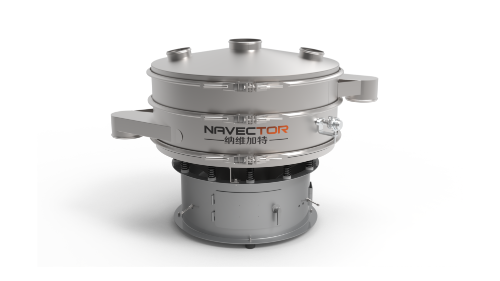
V. Recommended Equipment: Navector Ultrasonic Screening System
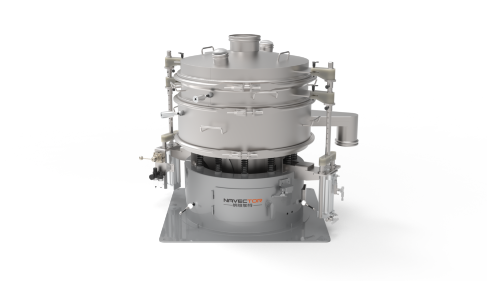
For the characteristics of lithium carbonate powder, the Navector ultrasonic screening system has been specifically optimized in both structure and function.
|
Technical Module |
Function Description |
|
Ultrasonic vibration system |
Prevents mesh clogging and improves screening efficiency |
|
Precision screen assembly |
Enables high-accuracy particle size classification |
|
Vibration drive system |
Ensures uniform powder distribution |
|
Sealed structure design |
Reduces dust leakage |
|
Quick replacement structure |
Improves maintenance efficiency |
This system is suitable for:
Battery-grade lithium carbonate
Industrial-grade lithium carbonate
Lithium salt powder materials
In practical applications, it achieves a balance between high-precision screening and stable operation.
VI. Process Optimization Suggestions
To further improve screening performance, optimization from the process perspective is recommended.
Control environmental humidity
Reducing air humidity can minimize powder adhesion.
Select appropriate screen specifications
Mesh size should match the target particle size.
Control feed uniformity
Avoid excessive instantaneous feeding that increases screen load.
Optimize vibration parameters
Adjust vibration frequency and amplitude according to material characteristics.
VII. Production Operation Recommendations
In actual production, the following operational points should be noted:
Maintain continuous and stable feeding
Avoid material accumulation
Regularly check screen condition
Monitor equipment operating parameters
Standardized operation helps improve screening stability.
VIII. Equipment Maintenance Suggestions
To ensure long-term stable operation, proper maintenance management is required.
Screen cleaning
Prevent blockage that affects efficiency.
Equipment inspection
Regularly check the operating status of the vibration system.
Seal maintenance
Ensure good sealing performance.
Component replacement
Replace worn parts in time.
IX. Development Trends in Industrial Screening Technology
With the development of the lithium battery materials industry, screening technology continues to evolve.
Future development directions include:
High-precision screening technology
Intelligent screening equipment
Automated production systems
Upgraded anti-clogging technology
Integrated powder handling systems
X. Frequently Asked Technical Questions
Question 1: Why does lithium carbonate screening easily cause clogging?
Because the powder is fine and prone to agglomeration, particles can easily become embedded in the mesh openings.
Question 2: Is ultrasonic screening suitable for lithium carbonate?
Yes, it can effectively improve clogging issues.
Question 3: How can screening efficiency be improved?
It can be achieved by optimizing process parameters and adopting anti-clogging technology.
Question 4: How is screening accuracy ensured?
It requires proper screen selection and control of process conditions.
XI. About Navector Screening Technology
Navector (Shanghai) Screening Technology Co., Ltd. focuses on the research and manufacturing of fine screening equipment. Its products are widely used in lithium battery materials, powder engineering, and new materials fields. The company has extensive engineering experience in ultrasonic screening technology, fine classification, and powder handling systems, and can provide targeted screening solutions for different powder materials.
 English
 中文
中文 Español
 ภาษาไทย
 Pусский
 Bahasa Indonesia
 Tiếng Việt