During the production of chemical powders, resin powder often encounters problems such as difficult material dispersion, electrostatic adsorption, particle agglomeration, and screen clogging during the screening process due to its lightweight and fine particle characteristics. When traditional screening equipment handles such materials, it is prone to reduced screening efficiency, frequent screen cleaning, and insufficient stability in continuous production.
How to improve the passing rate of lightweight powders and ensure stable equipment operation while maintaining screening accuracy has become an important issue in powder processing for the chemical industry.
To meet the screening requirements of lightweight, easily agglomerated, electrostatic, and screen-clogging materials, Navector has developed the NCF series centrifugal sieve. By using airflow to drive particle separation and combining it with an ultrasonic system to enhance screen cleaning performance, the equipment effectively improves problems such as screen blockage and reduced screening efficiency, providing a continuous and efficient screening solution for lightweight fine powders and ultrafine powders such as resin powder.
I. What Is the Working Principle of This Equipment?
As a common lightweight powder in the chemical industry, resin powder is easily affected by material characteristics during the screening process. For example, some resin powders have low density and poor flowability. Meanwhile, the material is prone to generating static electricity, causing particles to attract each other, form agglomerates, and further block the screen, reducing screening efficiency.
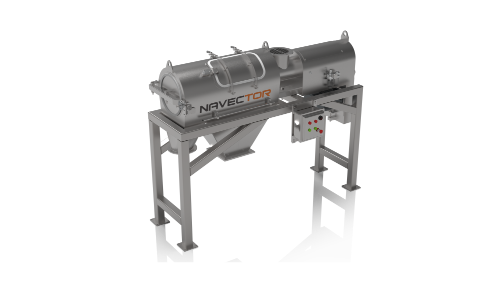
To address these screening challenges, the Navector NCF series centrifugal sieve adopts an airflow-driven particle separation method. Through the combined action of centrifugal force and cyclone propulsion force, it achieves rapid screening of lightweight and ultrafine powders.
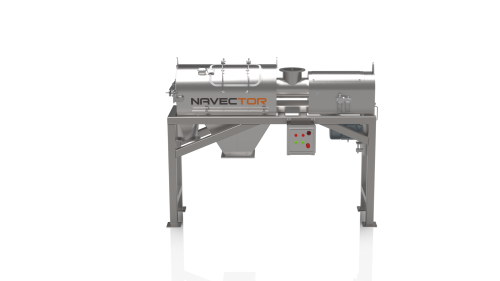
The equipment adopts a cylindrical screen structure. After entering the equipment through the screw conveying system, the material is mixed and dispersed with airflow before entering the screen cylinder. Under the action of the impeller blades, the material is simultaneously affected by centrifugal force and cyclone propulsion force. Fine particles pass through the screen and are discharged through the fine material outlet, while materials that do not pass through the screen move along the cylinder wall and are discharged through the coarse material outlet, completing continuous screening.
At the same time, the equipment can be equipped with an ultrasonic system to improve screen cleaning performance and reduce screen clogging caused by material adhesion.
II. Why Can It Solve the Agglomeration Problem?
During resin powder screening, agglomeration and screen clogging are usually important factors affecting screening efficiency. When powders are affected by static electricity or particle-to-particle adhesion, they can easily form larger agglomerated particles, reducing the effective screening area.
The NCF series centrifugal sieve uses airflow dispersion to fully mix and disperse materials before entering the screening area, improving particle dispersion. At the same time, the combined action of centrifugal force and cyclone propulsion force enables materials to contact the screen more effectively, improving screening efficiency.
For materials that are prone to sticking to the screen, the equipment can be equipped with an ultrasonic system. Through high-frequency vibration, it enhances screen cleaning performance, reduces screen hole blockage, and extends screen service life.
In addition, the equipment adopts an external transducer design, preventing direct contact between the transducer and the material, reducing the risk of material contamination during the screening process.
III. Who Needs This Type of Equipment?
The NCF series centrifugal sieve is mainly suitable for the rapid screening of lightweight materials, fine powders, and ultrafine powders. Typical application industries include:
Synthetic resin manufacturers:Used for particle size classification during resin powder production to improve powder screening stability.
Coating and chemical material manufacturers:Suitable for screening easily agglomerated materials such as powder coatings and resin-based powders.
Pharmaceutical industry:Used for the fine screening of certain lightweight powders and fine powder materials.
Metal powder and non-metallic material manufacturers:Suitable for the screening and processing of lightweight metal powders, non-metallic fine powders, and other materials.
For powder materials with characteristics such as lightweight, easy agglomeration, static electricity generation, and screen clogging, the NCF series centrifugal sieve provides a more stable screening solution.
IV. Which Production Processes Can It Be Used In?
During resin powder production, the NCF series centrifugal sieve can be applied in multiple processes:
Raw material processing stage:
Classifies powders with different particle sizes generated during production, improving the stability of subsequent processing.
Post-drying treatment stage:
Separates agglomerated materials that may form during the drying process through screening.
Finished product inspection stage:
Uses different screen specifications to perform particle size screening inspections of resin powder, ensuring product particle size consistency.
During continuous production, the equipment can reduce the frequency of manual screen cleaning through airflow assistance and ultrasonic screen cleaning, improving production continuity.
V. Under What Conditions Is It More Suitable Than Traditional Screens?
Compared with ordinary screening equipment, the NCF series centrifugal sieve is more suitable under the following operating conditions:
Lightweight powder screening:
For powders with low density and poor flowability, airflow assistance improves material dispersion.
Easily agglomerated material screening:
The combination of airflow dispersion and centrifugal action reduces the impact of particle agglomeration on the screening process.
Electrostatic material screening:
For material adhesion caused by static electricity, the ultrasonic system can be added to enhance screen cleaning performance.
Screen-clogging material screening:
Ultrasonic assistance reduces screen hole blockage and improves screening stability.
VI. How to Select the Right Model for Resin Powder?
The selection of resin powder screening equipment needs to be comprehensively evaluated based on material characteristics and production requirements:
1. Select screen specifications according to material characteristics
The appropriate screen should be selected based on resin powder particle size range, agglomeration conditions, and screening accuracy requirements.
2. Match equipment specifications according to processing capacity
Different production scales require different equipment models to ensure screening efficiency and continuous production requirements.
3. Configure functions according to special process requirements
For materials that are prone to screen blockage or adhesion, an ultrasonic system can be added. For applications requiring higher material cleanliness, an external transducer design can be adopted to reduce contamination risks.
In practical applications, screening performance can be verified through material testing, and equipment configuration can be optimized based on screening results.
The challenges of resin powder screening are not only related to particle size control but also involve how to address the flowability, electrostatic adsorption, and screen clogging issues of lightweight powders. The NCF series centrifugal sieve combines airflow dispersion, centrifugal screening, and ultrasonic screen cleaning technologies to provide a stable screening method for lightweight powders and ultrafine powders in the chemical industry.
From improving screening efficiency to enhancing production continuity, the value of centrifugal sieves lies in solving difficult-to-screen material problems in actual production through structural optimization and achieving more reliable powder separation.
 English
 中文
中文 Español
 ภาษาไทย
 Pусский
 Bahasa Indonesia
 Tiếng Việt