Walking into a corn starch processing workshop, fine powder particles float in the air while operators wearing masks continuously tap the screen mesh. “As soon as the humidity rises, the starch starts clumping together, and the screen openings get completely blocked,” one worker says while wiping sweat from his forehead. “Now we have to stop the machine two or three times every hour to clean the mesh. Even running production at maximum capacity still can’t keep up with orders.”
This situation is not uncommon in the food industry. Due to the hygroscopic and adhesive properties of starch materials, flocculent agglomeration easily forms under high-temperature and high-humidity conditions. Traditional screening equipment often falls into a dilemma: increasing vibration amplitude can break up clumps, but it also causes severe dust dispersion; reducing amplitude worsens mesh blockage. Data shows that during summer production, the failure rate of the screening section at one starch factory increased by 40% compared to normal seasons, while screen mesh consumption costs tripled.
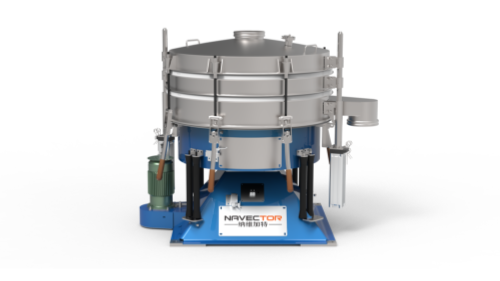
I. Starch Screening Always Suffers from Mesh Blocking? How Tumbler Screens + Ultrasonic Screening Technology Solve the Agglomeration Problem
Facing these challenges, we attempted to precisely match the characteristics of tumbler screens with the properties of starch materials. The equipment adopts a three-dimensional composite motion trajectory — combining horizontal circular movement of 60-80mm with vertical throwing motion of 5-40mm to form a three-dimensional spiral conveying path. This design cleverly avoids two key contradictions:
Dust control: Traditional vibrating screens operate with an acceleration of 5-7g, causing lightweight starch powder to disperse heavily, while tumbler screens suppress acceleration within the range of 1.3-1.8g. This is equivalent to conveying materials in slow motion, reducing dust emissions by more than 90%;
Anti-clogging capability: By adjusting eccentricity parameters, the equipment can generate a “kneading” effect similar to manual flour sifting. Actual testing shows that when corn starch moisture content rises to 18%, the tumbler screen can still maintain an effective screening rate above 85%, while ordinary screening equipment drops below 50%.
In a renovation project at a potato starch processing plant in Northeast China, the installation of an ultrasonic auxiliary system became the turning point. When a 1200-mesh screen encountered starch gel, the 18kHz high-frequency vibration waves instantly shattered micron-level sticky particles, while the pneumatic lifting device enabled rapid screen replacement. After the upgrade, the production line’s daily capacity increased significantly, screen mesh lifespan was greatly extended, and impurity removal efficiency improved substantially.
II. How to Choose Starch Screening Equipment? Hygienic Design Is the Real Core
“Hygiene is not something that can be solved simply by putting an SS304 label on the equipment.” A quality inspector pointed to a cross-sectional view of the machine and explained: “Look here — the inner wall has a mirror-polished finish of 0.8μm, all corners feature R5 or larger arc transitions, and even the bottom of the screen box is designed with self-cleaning grooves.” These details form the defense system of a food-grade tumbler screen:
Pneumatic quick-change system: Complete disassembly of the entire screen mesh assembly within 10 seconds, preventing cross-contamination;
CIP cleaning compatibility: The equipment reserves high-pressure spray interfaces to enable online cleaning;
Sealed isolation: FDA-certified silicone sealing strips are used to prevent dust leakage while also making daily wiping and disinfection more convenient.
At a baby food manufacturer in East China, these designs enabled the equipment to pass BRCGS AA-level certification. “In the past, changing production batches required a 2-hour shutdown for disinfection. Now it can be completed in just 30 minutes,” the production supervisor said while showing validation records under the HACCP system.
III. High-Precision Starch Screening Solutions: How Tumbler Screens Balance Capacity, Screening Accuracy, and Low Dust
A food additive company once conducted a comparative test: the same batch of wheat starch was processed separately by a traditional rotary vibrating screen and a tumbler screen, producing significantly different results:
Index Traditional Rotary Vibrating Screen Tumbler Screen (with Ultrasonic System)
Processing Capacity 450kg/h 1120kg/h
300-Mesh Screening Rate 82% 97.5%
Daily Screen Consumption 4 pieces 0.8 pieces
Workshop Dust Concentration 1.2mg/m³ 0.08mg/m³
“The key point is that we can simultaneously complete three-stage separation of coarse powder, fine powder, and ultra-fine powder.” The engineer opened the operation interface, showing that the equipment was synchronously performing multi-stage screening tasks ranging from 20 mesh to 800 mesh. This capability comes from the equipment’s unique dynamic load distribution system — by adjusting the excitation angle, materials of different particle sizes can follow predetermined trajectories, avoiding the “short-circuit phenomenon” commonly seen in traditional multi-layer screening.
IV. Tumbler Screen Usage Tips: Three Key Details Food Factories Must Pay Attention To
Preheating and commissioning period: During the first operation, it is recommended to start with one-third load and gradually increase to full load, allowing the equipment to adapt to material characteristics;
Humidity monitoring: Install an online moisture meter at the screening inlet. When moisture content exceeds 15%, the ultrasonic system is automatically activated;
Screen mesh material upgrade: Optional Navector diamond screen mesh can be equipped. By adding a special coating to the mesh surface, it can effectively improve material passing rates and reduce fine powder mesh blockage problems.
As one process engineer with over twenty years of experience said: “Screening equipment is not purchased just for display. You must deeply understand the material — understand its characteristics and master its behavior — only then can you achieve twice the result with half the effort.”
If your company is also struggling with efficiency and hygiene challenges in starch screening, you may start with small-scale laboratory testing. By simulating real production line conditions, we can help you find the most economical and effective solution. After all, in the food industry, safety and efficiency have never been an either-or choice.


 English
 中文
中文 Español
 ภาษาไทย
 Pусский
 Bahasa Indonesia
 Tiếng Việt