Silica powder is a common fine powder in the abrasives industry. The screening stage is responsible for controlling particle size and separating nonconforming particles. As the target particle size becomes finer, the screening process places greater demands on screen mesh condition and particle dispersion. Fine particles tend to adhere to one another and agglomerate, while some may become trapped in the mesh openings, reducing screening efficiency and affecting the consistency of the finished particle size.
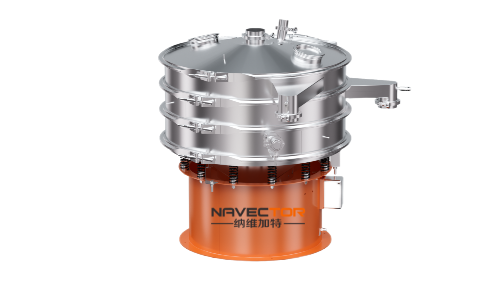
Conventional vibrating screens rely primarily on mechanical vibration to move materials and allow particles to pass through the mesh. When the mesh openings are small and the material is difficult to disperse, mechanical vibration alone may struggle to maintain stable screening performance. Ultrasonic vibrating screens superimpose high-frequency, low-amplitude ultrasonic vibrations on conventional vibration to help clear mesh openings and improve the passage of fine powders through the screen. Understanding this technology starts with the screening challenges of silica powder and the movement of particles across the screen surface.
I. What Makes Silica Powder Difficult to Screen?
Screening separates particles based on the size relationship between the particles and the mesh openings. In theory, particles smaller than the mesh openings can pass through the screen. In actual production, however, particles may not reach the openings efficiently or pass through them successfully.
When silica powder has a fine particle size, factors such as adhesion, agglomeration, and static electricity can affect material dispersion. Some fine particles adhere to the screen wires, while others remain at the mesh openings or become lodged inside them. As screening continues, the effective open area of the screen gradually decreases, reducing the opportunities for material to pass through. Operators may notice that the equipment continues running while screening throughput begins to decline, the amount of oversize material increases, and the particle size of the finished product becomes less consistent.
These problems cannot simply be attributed to insufficient vibration force. Vibration intensity, feed rate, and screen specifications are all important, but the ability of fine particles to disperse promptly and the ability of the mesh openings to remain clear also affect the final screening results. For difficult-to-screen materials such as silica powder, screen-cleaning capability is a key factor to consider when selecting equipment.
II. How Can Ultrasonic Vibrating Screens Improve Silica Powder Screening?
1. Adding High-Frequency Vibration to the Mechanical Vibrations
Conventional vibrating screens generate excitation force through a motor, causing the screen surface to move along a defined trajectory. The material spreads out and moves across the screen surface. Particles that meet the size requirements pass through the mesh openings, while larger particles remain on the screen surface. Throughout this process, particles must continuously approach the mesh openings and reach a suitable orientation to pass through.
When processing fine powders, particle adhesion and mesh blinding can interrupt this process. Even when the material continues moving, particles may adhere to the screen wires or become difficult to pass through the mesh because of agglomeration. Vibration across the screen surface does not necessarily mean that every mesh opening is being used effectively.
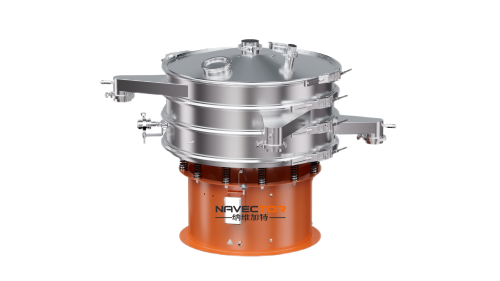
An ultrasonic vibrating screen superimposes high-frequency, low-amplitude ultrasonic vibrations on the screen mesh, providing additional high-frequency vibration. Conventional mechanical vibration drives the overall movement of the material across the screen surface, while ultrasonic vibration focuses on improving the movement of fine particles near the mesh. The two work together to complete the screening process.
2. Reducing Particle Adhesion and Mesh Blinding
The purpose of ultrasonic vibration is not simply to make the screen vibrate faster. For fine powders, high-frequency vibration changes the forces and movement patterns involved when particles contact the screen mesh. This helps reduce particle adhesion to the screen wires and lowers the risk of mesh blinding caused by factors such as particle friction, spreading, and particles becoming lodged in the mesh openings.
When the screen mesh remains relatively clean, particles that meet the required size specifications can more easily reach the mesh openings and pass through. The effective working area of the screen can also be maintained more consistently. This is particularly important for materials requiring small mesh openings, where conventional mechanical vibration may struggle to keep the mesh clear over extended periods.
3. Improved Screen Conditions Create More Opportunities to Optimize Screening Accuracy and Throughput
Mesh blinding reduces the available pathways for particles to pass through the screen and extends the screening time for some particles. In continuous production, this affects not only throughput per unit of time but may also cause particles of different sizes to remain on the screen surface for too long, increasing the likelihood of fluctuations in screening results.
By helping keep the screen mesh clean, ultrasonic vibration creates more stable conditions for fine particles to pass through and helps reduce the loss of screening capacity caused by mesh blinding. However, screening accuracy is not determined by the ultrasonic system alone. The target particle size, mesh aperture, particle size distribution, feed rate, and equipment operating parameters must all be properly matched. If the mesh specifications are unsuitable or the feed rate exceeds the equipment's reasonable processing capacity, ultrasonic vibration alone is unlikely to deliver the desired results.
III. What Other Process Conditions Affect Silica Powder Screening Performance?
Ultrasonic vibration helps improve screen cleanliness, but screening performance still depends on the entire screening process. For silica powder, screen specifications, feed conditions, and equipment operating parameters must work together. Improving just one stage may not resolve every problem.
Screen specifications establish the basic conditions for particle separation. The finer the target particle size, the greater the demands generally placed on mesh aperture and screen condition. Mesh specifications should be determined according to the required finished particle size and the actual particle size distribution of the material. If the mesh aperture does not match the classification requirements, maintaining a clear screen mesh alone will not guarantee the desired separation results.
Feed conditions affect how efficiently the screen is used. If the feed rate is too high, material can accumulate on the screen surface, reducing opportunities for particles to contact the mesh openings. Uneven feeding can also create differences in material loading across different areas of the screen. An ultrasonic system can help reduce mesh blinding, but it cannot replace proper feed control. During production, feed conditions need to be adjusted according to material characteristics and equipment processing capacity.
Equipment configuration must meet the requirements of continuous production. In addition to screening accuracy and throughput, factors such as screen installation and tensioning methods, equipment sealing, dust control, and cleaning and maintenance conditions should also be considered. The ultrasonic system must be compatible with the screen structure and equipment model. It should not be assumed that every vibrating screen is suitable for direct retrofitting.
These factors collectively affect screening performance. In actual production, if mesh blinding is severe, attention should be paid to screen cleaning and particle dispersion. If throughput is insufficient, feed conditions and equipment loading should also be checked. If the finished particle size fluctuates, the mesh specifications and classification conditions require further verification. Identifying the specific problem first makes it possible to determine which aspects of the equipment need improvement.
IV. Beyond Silica Powder, Which Materials Are Suitable for Ultrasonic Vibrating Screens?
Ultrasonic vibrating screens are primarily used for fine powders that are prone to adhesion and agglomeration and tend to cause mesh blinding during fine screening. High-frequency vibration improves screen cleanliness and helps particles pass through the mesh more smoothly.
In the abrasives industry, silica powder, silicon carbide, glass beads, and corundum are all within the scope of application. The equipment can also be used to screen materials such as pigments, powder coatings, graphite, metal powders, sweeteners, and starch.
Suitability for a specific application must be assessed based on material characteristics, target particle size, and screening requirements. Actual material testing is necessary to determine the appropriate equipment configuration.
The key to screening silica powder lies in ensuring that fine particles are adequately dispersed while maintaining the effective working condition of the mesh openings as much as possible. By improving particle movement near the screen mesh, ultrasonic vibration helps reduce the impact of adhesion and mesh blinding on the screening process, supporting fine powder classification. Whether the equipment can deliver the desired results also depends on the compatibility of the mesh specifications, feed conditions, and actual production capacity. Only by evaluating these factors together can screening accuracy and production efficiency be improved on a reliable basis.


 English
 中文
 Español
 ภาษาไทย
 Pусский
 Bahasa Indonesia
 Tiếng Việt