In fertilizer production, urea granules need to undergo screening to meet the required finished particle size specifications. For large-scale production lines, the equipment must handle high material throughput while separating granules of different particle sizes. Insufficient screening area, uneven material distribution, or screen mesh clogging can all affect processing capacity and classification performance.
Navector's NTS Series Gyratory Sifter is designed to meet the demands of high-throughput, high-precision particle screening. Its three-dimensional gyratory motion, combined with multiple screen layers, makes it suitable for finished urea granule screening and particle size classification. This article explores the screening capabilities and applicable conditions of gyratory sifters from a technical perspective, as well as how they support precise granule classification in the fertilizer industry.
I. How Does the NTS Series Gyratory Sifter Work?
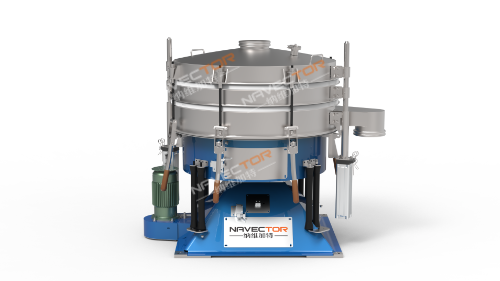
The NTS Series Gyratory Sifter is a circular screening machine that simulates manual sieving by combining circular motion with an upward throwing motion to create a three-dimensional tumbling trajectory.
After entering the screen surface, the material gradually spreads outward from the center toward the periphery and moves forward along a spiral trajectory. During movement, the granules repeatedly come into contact with the screen mesh. Particles small enough to pass through the openings fall onto the lower screen layer or enter the corresponding discharge outlet, while larger particles continue moving forward, thereby completing particle size separation.
This motion helps distribute the material across the screen surface, creating conditions for particle-screen contact and the passage of fine particles through the mesh. Screening performance also depends on screen aperture size, feed rate, and the particle size distribution of the material itself. It cannot be determined solely by the equipment's motion pattern.
The NTS Series Gyratory Sifter can have a screening diameter of up to 3,000 mm and achieve separation into 1–6 grades through multiple screen layers. Screen aperture size, the number of layers, and equipment specifications should be determined according to the target particle sizes and required throughput.
II. Why Are Material Distribution and Screen Cleanliness Important When Screening Urea Granules?
A large screening area does not necessarily mean that every part of the screen surface is fully utilized. If material accumulates in a localized area, the screening capacity of other areas cannot be fully utilized. When the material contains a high proportion of fines or the screen openings become clogged, the effective screening area is further reduced, potentially affecting throughput and classification stability.
The moisture content, surface condition, and proportion of fines in urea granules all influence actual screening performance. If particle adhesion, agglomeration, or poor passage through the screen occurs during production, the causes need to be analyzed in conjunction with the material condition, screen specifications, and feeding conditions.
The NTS Series Gyratory Sifter promotes material distribution through three-dimensional motion and offers strong screen-cleaning capabilities. For materials with a high fines content or greater screening difficulty, an ultrasonic system can also be installed as an option. This system transmits high-frequency ultrasonic waves to the screen mesh to improve screen-cleaning conditions.
The ultrasonic system primarily addresses screen-cleaning and particle passage issues. If the urea granules themselves are prone to agglomeration, their moisture content and material condition still need to be investigated. Adding a screen-cleaning device alone cannot solve every problem.
III. Which Stages of Urea Production Can Benefit from the NTS Series Gyratory Sifter?
Urea granule screening mainly involves finished product particle size control, classification into multiple particle size ranges, and the separation of fines and oversized particles. The NTS Series Gyratory Sifter is suitable for applications in the fertilizer industry and can be configured with appropriate screen combinations according to production objectives.
1. Finished Urea Granule Screening
After urea granulation, screening can be carried out according to the required product particle size specifications to separate granules that meet the requirements from fines and oversized particles, thereby controlling the particle size distribution of the finished product.
The screen aperture size should match the product specifications. If the feed has a broad particle size distribution, the actual feed rate and material distribution across the screen surface must also be considered to prevent localized accumulation from affecting screening performance.
2. Multi-Grade Classification of Urea Granules
When a production line needs to divide urea granules into multiple particle size ranges, the NTS Series Gyratory Sifter can use multiple screen layers to perform classification. The equipment supports separation into 1–6 grades, with the specific number of grades depending on product requirements and screen configuration.
During equipment selection, the target particle size for each grade should first be defined, followed by the determination of screen aperture sizes and the number of layers. For applications with stringent classification requirements, material testing is also needed to confirm the separation performance of each grade.
3. Separation of Fines and Oversized Particles
Fines and oversized particles generated during screening can be collected separately according to the production process. If the process permits material recovery and reuse, these fractions can subsequently be directed to a return-feed or reprocessing stage.
This involves coordination across the entire production line. The return-feed method, conveying equipment, and reuse ratio need to be determined according to downstream processing capacity and cannot be assessed based solely on the screening equipment itself.
IV. What Operating Conditions Are Suitable for the NTS Series Gyratory Sifter?
The NTS Series Gyratory Sifter is designed for high-throughput, high-precision particle screening. For urea production lines, its suitability mainly depends on processing capacity, classification requirements, and the actual screening performance of the material.
High-throughput screening. When a production line handles large volumes of material, equipment specifications should be determined according to hourly throughput, feed conditions, and particle size distribution. The NTS Series Gyratory Sifter offers a screening diameter of up to 3,000 mm, providing a large screening surface for high-throughput applications. Actual processing capacity must still be verified under specific operating conditions.
Multi-grade particle classification. When products need to be divided into multiple particle size ranges, multiple screen layers can be used to achieve multi-stage separation. The number of grades and screen combinations should match product specifications, and testing should be conducted to verify the separation performance of each grade.
Stringent particle size control requirements. If the finished product must meet clearly defined particle size ranges, particular attention should be paid to screen aperture size, feed rate, and material distribution. The three-dimensional motion of the NTS Series Gyratory Sifter helps distribute the material, but actual classification accuracy still depends on material properties and equipment configuration.
Risk of screen mesh clogging. For materials with a high fines content or a tendency to clog the screen mesh, the suitability of an ultrasonic system can be evaluated. Whether it is necessary should be determined based on material testing results.
V. How to Select the Right NTS Series Gyratory Sifter for Urea Granules
Equipment selection should start with production objectives by clarifying the required material throughput, the number of particle size grades, and whether the material is prone to screen mesh clogging. Screening area, the number of screen layers, and the screen-cleaning method need to be considered together. Equipment suitability cannot be determined by evaluating a single parameter in isolation.
1. Determine Equipment Specifications Based on Processing Capacity.
Clarify the production line's hourly throughput, continuous operation requirements, and feeding method, then determine equipment specifications based on the particle size distribution of the urea granules. The NTS Series Gyratory Sifter can have a screening diameter of up to 3,000 mm, but the specific model should still be selected according to actual throughput requirements and testing results.
2. Configure Screen Meshes According to Target Particle Sizes.
Define the target particle size range of the finished product, fines control requirements, and requirements for handling oversized particles before determining screen aperture sizes and the number of layers. For multi-stage separation, the equipment's capability to separate materials into 1–6 grades can be used to plan the screen configuration, with verification to ensure that each grade meets the required specifications.
3. Assess Screen-Cleaning Requirements Based on Material Conditions.
If the urea granules contain a high proportion of fines, exhibit particle adhesion, or pass through the screen poorly, these material conditions should be specified during equipment selection. For applications where the screen mesh is prone to clogging, an ultrasonic system can be evaluated, with testing used to confirm its actual effectiveness.
4. Verify the Configuration Through Material Testing.
Theoretical parameters cannot fully reflect the screening performance of a specific material. It is recommended to provide representative urea granule samples and conduct tests based on the target throughput, screen aperture sizes, and classification requirements. Particular attention should be paid to the particle size distribution of each grade, the separation of fines and oversized particles, and operational stability during continuous running. The test results can be used to verify equipment specifications, screen configuration, and the screen-cleaning method, reducing the risk of a mismatch between production capacity and classification requirements after equipment installation.
The particle size distribution of urea granules is closely related to finished product quality and also affects subsequent storage, transportation, and use. The value of screening equipment lies not only in separating particles of different sizes, but also in ensuring that classification results meet the requirements of stable, continuous production. Navector's NTS Series Gyratory Sifter provides a technical option for high-throughput, multi-grade particle screening, while the specific solution still needs to be verified through material testing and operating condition assessments. Only by integrating screening principles, equipment configuration, and actual production conditions can particle size control be effectively implemented on the production line.
 English
 中文
 Español
 ภาษาไทย
 Pусский
 Bahasa Indonesia
 Tiếng Việt