Advanced ceramics are widely used in semiconductors, electronic information technology, and other fields due to their high strength, high-temperature resistance, wear resistance, and excellent electrical and magnetic properties. From electronic components to precision ceramic parts, the particle size and distribution of powder raw materials are closely related to subsequent forming and processing, and also affect the final material properties. Different applications have increasingly specific requirements for the fineness and uniformity of ceramic powders, making accurate particle size distribution analysis particularly important.
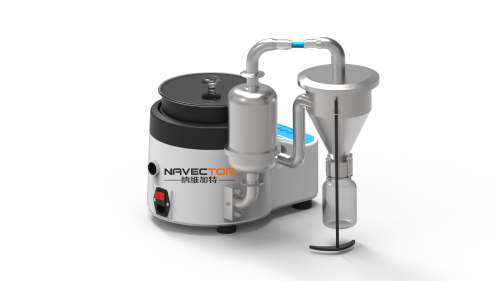
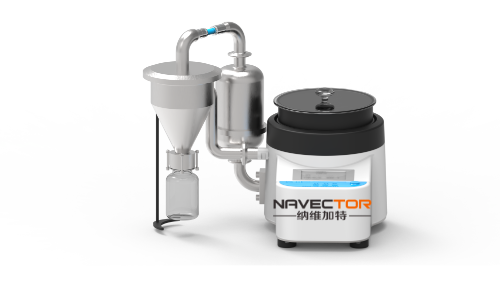
However, fine powders with low density and a tendency to agglomerate require suitable dispersion conditions during screening. Mechanical vibration alone may sometimes be insufficient to achieve the desired dispersion. To address the screening and analysis requirements of such powders, Navector's small negative pressure airflow sieve uses an aerodynamic screening method. It utilizes airflow to help disperse particles and clean the screen mesh, providing a new solution for the fine screening of ceramic powders.
I. What Practical Problems Can Particle Agglomeration Cause?
Particle agglomeration affects the accuracy of particle size analysis. The overall size of an agglomerate may exceed the screen aperture, causing fine particles that could otherwise pass through the mesh to remain on the screen surface, resulting in deviations in particle size analysis. For R&D personnel, inaccurate particle size data often means that sampling and testing must be repeated, while formulation adjustments and process validation may also be affected.
Agglomerates remaining on the screen surface reduce screening efficiency. Agglomerated particles may block the screen apertures, reducing the effective screening area and slowing down the passage of fine particles. For factories that frequently conduct raw material inspections and batch testing, longer testing times can also affect the coordination between raw material inspection and production.
Inconsistent screening conditions make it difficult to ensure repeatability of test results. Even when testing the same batch of ceramic powder, differences in particle dispersion, negative pressure, or air jet velocity may lead to different particle size distributions. As a result, data from different batches lack a reliable basis for comparison, making raw material quality assessment, formulation optimization, and production process adjustments more difficult.
II. How Does a Small Negative Pressure Airflow Sieve Improve the Dispersion and Passage of Fine Powders?
The operating principle of a small negative pressure airflow sieve differs from that of a conventional vibrating sieve. It primarily relies on airflow to separate particles. After the equipment is connected to a vacuum cleaner, negative pressure is generated inside the screening chamber. The pressure difference creates high-speed airflow at the nozzle, which passes across the screen surface before being drawn away from underneath the screen. Fine particles smaller than the screen aperture are carried by the airflow through the mesh and into the vacuum cleaner or cyclone separator.
This method is particularly suitable for fine ceramic powders that tend to agglomerate. The continuous airflow helps disperse particles while also cleaning the screen mesh, reducing the interference caused by agglomeration during screening. For fine powders with low density and a tendency to agglomerate, the equipment can be used with analytical sieves with apertures of 10 μm and above, with an average screening time of approximately 2–3 minutes.
In actual testing, material conditions and screening requirements are not always the same, so the equipment provides corresponding adjustment options. Screening time, negative pressure, and nozzle velocity can all be digitally set. The extraction system can be connected to manually adjustable industrial vacuum equipment, or configured with an automatic extraction system. Operators can adjust airflow conditions according to sample characteristics, helping maintain consistent testing conditions and reduce the impact of variations in screening parameters on test results.
III. What Are the Main Differences Between a Small Negative Pressure Airflow Sieve and a Conventional Vibrating Sieve?
The main difference between the two types of equipment lies in how particles move and disperse. The specific differences are as follows:
|
Comparison Criteria |
Conventional Mechanical Vibrating Sieve |
Small Negative Pressure Airflow Sieve |
|
Screening Mechanism |
Uses vibration of the sieve body to move materials |
Uses air jets to generate airflow, combined with negative pressure to achieve screening |
|
Particle Dispersion |
Moves materials across the screen surface through mechanical vibration |
Uses airflow to assist in dispersing fine particles and reduce particle agglomeration |
|
Screen Cleaning |
Relies mainly on vibration and material movement |
Airflow passes through the screen, helping disperse particles and clean the mesh |
|
Suitable Applications |
Selected according to material characteristics and screening requirements |
Suitable for screening analysis of fine particles with low density and a tendency to agglomerate |
For conventional material screening, mechanical vibrating sieves can be selected according to processing requirements. For fine powders with low density and a tendency to agglomerate, especially in laboratory particle size analysis, a small negative pressure airflow sieve uses airflow to improve sample dispersion and assist in screen cleaning, making it more suitable for screening and analysis of such fine particles.
IV. What Materials Can a Small Negative Pressure Airflow Sieve Handle Besides Ceramic Powders?
Small negative pressure airflow sieves are primarily designed for the screening analysis of fine particles with low density and a tendency to agglomerate. Their applications are not limited to ceramic powders. They are also used in industries involving pharmaceutical materials, chemicals, plastics, rubber, minerals, powder coatings, pigments, toners, and food products.
Of course, suitability for a specific material still depends on the characteristics of the sample itself and needs to be evaluated based on particle conditions and particle size requirements. For samples that require fine screening and are prone to agglomeration, conducting practical tests in advance is a more reliable approach and helps determine more accurately whether the equipment meets the application requirements.
V. What Should Be Considered When Selecting Screening Equipment for Ceramic Powders?
The selection of screening equipment for ceramic powders mainly depends on the target particle size, particle characteristics, and processing requirements. Different powders vary in particle size distribution, density, and degree of agglomeration, so the screening method needs to be adjusted accordingly.
The target particle size determines the basic direction of equipment selection. If the primary purpose is to remove coarse particles or foreign matter, attention should be paid to the equipment's processing capacity and separation performance. If the application involves fine classification or particle size analysis of ultrafine powders, the equipment's ability to disperse fine particles and whether the screen aperture meets testing requirements should be key considerations.
Particle characteristics are closely related to the choice of screening method. Some fine ceramic powders are prone to agglomeration, causing fine particles to remain on the screen surface along with agglomerates and affecting screening results. In such cases, airflow-assisted screening can be considered. Airflow helps improve particle dispersion and reduce the interference caused by agglomeration during screening.
The equipment type must also match the processing scale. Laboratory particle size analysis, small-batch sample testing, and continuous industrial production have different requirements for processing capacity, operating methods, and automation levels. During equipment selection, it is important to clarify whether the equipment will be used for sample testing, process validation, or continuous screening on a production line, avoiding confusion between laboratory analysis equipment and production equipment.
Ceramic powders are developing toward finer particle sizes, higher purity, and more application-specific properties, placing greater demands on powder quality control. Throughout powder preparation and application, particle size distribution and particle dispersion directly affect powder processing performance and the properties of the final material. Navector will continue to focus on the material characteristics and process requirements of different industries, further developing screening technology and improving equipment and application solutions to provide practical screening and analysis solutions for ceramic powders and other fine powders.
 English
 中文
 Español
 ภาษาไทย
 Pусский
 Bahasa Indonesia
 Tiếng Việt