From aerospace and healthcare to high-end manufacturing, the applications of 3D printing technology continue to expand, placing higher demands on the quality of metal powders. Sphericity affects powder flowability and spreading performance, while particle size distribution determines the powder's range of applications and suitability for different forming processes. In metal powder production, it is essential to ensure powder quality while making full use of the powder within the target particle size range.
Traditional gas atomization technology has been widely used in metal powder production and has accumulated extensive experience in large-scale powder manufacturing. However, it also has certain limitations when addressing small-batch powder production and new alloy development requirements. The ultrasonic atomization powder production machine combines induction melting with ultrasonic vibration atomization, providing a new option for producing highly spherical powders and adjusting particle size. How exactly does this technology improve powder quality? And what role can it play in fine powder production? This article explores these questions in detail.
I. What Requirements Does High-Quality 3D Printing Metal Powder Place on Powder Production Processes?
Powder morphology and sphericity directly affect flowability and powder spreading performance during printing. For 3D printing metal powders, particle roundness is an important indicator of powder quality. Highly spherical powders offer better flowability and can be distributed more evenly during the powder spreading process, helping to reduce printing defects. Irregular particles and defective powders, such as hollow particles and satellite particles, can affect powder performance and may increase the risk of porosity and cracking during additive manufacturing.
Particle size distribution and the collection of target-sized powders are closely related to actual material utilization. Metal powders with different particle sizes have different application ranges. During powder production, particle size distribution needs to be adjusted according to the target particle size requirements. More precise particle size control can simplify subsequent screening processes and help improve material utilization.
Reactive metals are sensitive to oxygen content, so proper protection is required during both melting and cooling. Magnesium alloys, for example, require strict oxygen content control during powder production. Protective conditions need to be maintained throughout raw material melting, ultrasonic atomization, droplet cooling and solidification, and powder collection.
II. How Does Ultrasonic Vibration Transform Molten Metal into Spherical Powder?
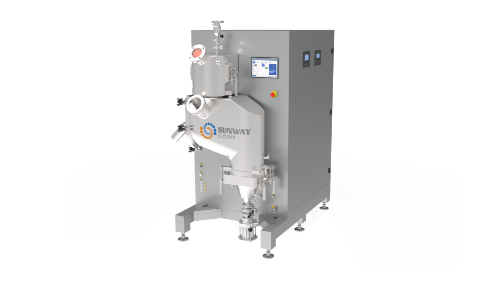
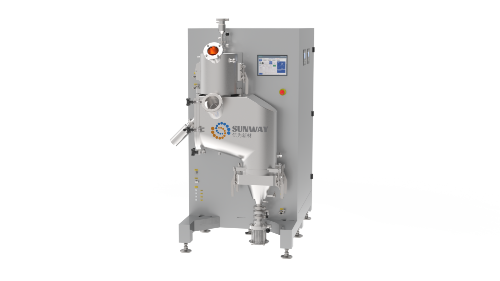
Sunway's ultrasonic atomization powder production machine combines induction melting with ultrasonic atomization and is equipped with two crucible sizes: 0.4 L and 0.8 L. It is primarily designed for small-batch metal powder production. The key to the entire process is using ultrasonic vibration to break molten metal into fine droplets.
Before powder production begins, the equipment first evacuates the chamber and then fills it with high-purity argon or nitrogen to establish an inert gas protective environment. The metal raw materials inside the crucible are then melted through medium-frequency induction heating. Once the molten metal flows steadily toward the ultrasonic atomization tip, it spreads across the vibrating surface to form a thin liquid film. When the vibration reaches a certain amplitude, ultrasonic action breaks the liquid film into fine droplets, which are ejected from the vibrating surface. The droplets rapidly cool and solidify under argon or nitrogen protection, eventually forming spherical metal powders.
During ultrasonic atomization, both the ultrasonic frequency and molten metal flow rate can be adjusted to fine-tune the powder particle size distribution. After solidification, the powder undergoes particle size classification through a cyclone separator and classification system to collect powders that meet the target particle size requirements.
III. What Are the Technical Advantages of Ultrasonic Atomization Powder Production Machines Compared with Traditional Gas Atomization?
Small-batch powder production supports new alloy development. New alloy development often involves adjusting formulations and conducting repeated trials, with relatively small quantities of raw materials required for each batch. Sunway's ultrasonic atomization powder production machine can produce approximately 100 g to several kilograms of powder per batch. It also places no restrictions on raw material shape. Finished alloys, master alloys, and pure elements can all be used directly as melting materials. The equipment occupies only a few square meters, making it well suited to small-batch powder production and new alloy trials.
High sphericity makes powders more suitable for 3D printing. The particle morphology of metal powders affects their flowability and spreading performance. Powders produced by this equipment achieve a sphericity of ≥95% and offer good flowability. They can be distributed more evenly during powder spreading, helping to reduce printing defects.
Adjustable particle size improves material utilization. Both ultrasonic frequency and molten metal flow rate can be adjusted. Combined with cyclone separation and classification, the system can collect powders within the target particle size range, helping to improve material utilization.
No high-pressure gas system is required, resulting in lower energy consumption. Traditional gas atomization relies on high-pressure gas to break up molten metal, whereas ultrasonic atomization uses vibration to achieve melt atomization. It does not require a high-pressure gas system. Compared with traditional gas atomization, energy consumption can be reduced by more than 90%, while eliminating the need for a high-pressure gas system.
IV. What Metal Powder R&D and Production Applications Are Suitable for Ultrasonic Atomization Powder Production Machines?
Ultrasonic atomization powder production machines are primarily designed for small-batch metal powder production, new alloy development, and process validation. For 3D printing material research institutions, the equipment can be used to produce trial batches of alloy powders with different formulations and evaluate indicators such as sphericity and particle size distribution. Universities and research institutes can use it for new alloy powder preparation and material experiments. Metal powder manufacturers can also use the equipment for small-batch production and the development of specialty alloys.
In terms of material compatibility, the equipment can be used to produce powders from magnesium alloys, aluminum alloys, copper alloys, and certain precious metals and specialty alloys. Induction melting can generally process alloys with melting points of up to approximately 1,300°C. Specific projects still require process validation based on material properties, target particle size, and powder quality requirements. For production requirements involving large-scale continuous powder manufacturing, different atomization processes should also be compared based on production capacity, powder specifications, and overall costs to select a more suitable powder production solution.
V. Frequently Asked Questions About Ultrasonic Atomization Powder Production Machines
FAQ 1: Which metal materials are suitable for ultrasonic atomization powder production machines?
The equipment can be used to produce powders from aluminum alloys, magnesium alloys, copper alloys, and certain precious metals. The maximum melting point of alloys suitable for induction melting is approximately 1,300°C. Whether a specific material can be processed still needs to be verified based on its properties and process conditions.
FAQ 2: Can ultrasonic atomization ensure high powder sphericity?
Sunway's ultrasonic atomization powder production machine can achieve powder sphericity of over 95%. However, the final powder morphology is also related to the material and atomization conditions. Actual results should be determined through testing.
FAQ 3: Can ultrasonic atomization completely replace gas atomization?
The two technologies have different application ranges. Ultrasonic atomization is suitable for small-batch powder production, new alloy development, and process validation. For large-scale production projects, an appropriate powder production solution should be selected based on production capacity, target particle size, powder quality, and overall costs.
Producing high-quality 3D printing metal powders requires careful matching of material properties and powder production processes. Ultrasonic atomization provides a new option for small-batch powder production and new alloy development, while its application performance still needs to be continuously verified under specific material and process conditions. To address the growing demand for developing new alloys, Sunway will continue to build its powder production process expertise and explore preparation solutions for different materials, providing further support for high-quality metal powder development.
 English
 中文
 Español
 ภาษาไทย
 Pусский
 Bahasa Indonesia
 Tiếng Việt