Precipitated calcium carbonate is widely used in industries such as plastics, rubber, and coatings. Its particle size distribution and screening stability can affect subsequent processing. When screening fine calcium carbonate powder, particle adhesion, agglomeration, and screen mesh clogging can easily occur. After a period of operation, the rate at which material passes through the screen may gradually decrease, affecting screening efficiency and production continuity.
To meet the screening requirements of these fine powders, Navector ultrasonic vibrating screens combine an ultrasonic system with a vibrating screen. By applying high-frequency, low-amplitude ultrasonic vibrations, the system improves the working condition of the screen mesh and helps reduce clogging. This article examines how ultrasonic vibrating screens address screening challenges associated with precipitated calcium carbonate, starting with the underlying technical principles.
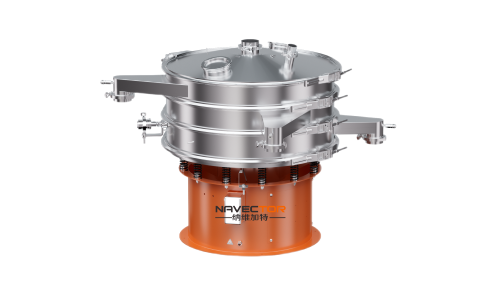
I. How Do Ultrasonic Vibrating Screens Improve the Screening Performance of Precipitated Calcium Carbonate?
Conventional vibrating screens rely primarily on screen body vibration to move material across the screen surface and separate particles by size. For fine powders that are prone to adhesion or agglomeration, conventional vibration alone may not be sufficient to keep the screen openings clear over time. Some particles may adhere to the mesh or become lodged in the openings because their sizes are close to the aperture dimensions, restricting material passage.
Ultrasonic vibrating screens superimpose high-frequency, low-amplitude ultrasonic vibrations onto the screen mesh, keeping fine particles on the screen surface in a more active state of motion. Ultrasonic vibration can suppress factors that contribute to screen clogging, including particle adhesion, friction, flattening, and wedging. This improves screen cleaning and allows material that meets the required particle size specifications to pass through the openings more smoothly.
This operating principle is suitable for various difficult-to-screen powders, including precipitated calcium carbonate. However, the ultrasonic system primarily improves the working condition of the screen mesh and cannot replace pretreatment processes such as powder drying, deagglomeration, or grinding. The moisture content, degree of agglomeration, and particle size distribution of the material will continue to affect actual screening results.
II. Why Is Precipitated Calcium Carbonate Prone to Screen Clogging?
The screening performance of precipitated calcium carbonate depends on powder fineness, particle condition, and production conditions. The finer the particles, the more attention must be paid to interactions between particles and between particles and the screen mesh during screening. When the powder tends to adhere or agglomerate, some particles may not disperse properly or pass through the screen openings smoothly. Particles whose sizes are close to the aperture dimensions may also become lodged in the mesh during movement.
The effects of screen clogging usually become apparent gradually. As the number of effective open passages decreases, material throughput may decline and screening time may increase. If the production line requires continuous feeding, fluctuations in screening efficiency may also disrupt coordination between upstream and downstream processes.
When addressing these problems, equipment suitability cannot be determined solely by the mesh count. The same mesh count may produce different operating results when used with different powders. For precipitated calcium carbonate, the actual particle size, powder flow behavior, and clogging characteristics must be considered to determine whether the main problem lies in screen configuration, material agglomeration, or the inability of the existing vibration method to meet screening requirements.
III. Which Precipitated Calcium Carbonate Processing Stages Are Suitable for Ultrasonic Vibrating Screens?
In precipitated calcium carbonate production, ultrasonic vibrating screens can be used for fine screening and particle size classification to help control coarse particles and material that does not meet the target particle size specifications. Under operating conditions where conventional vibrating screens are prone to clogging and declining screening efficiency, ultrasonic vibration can improve screen cleaning performance.
If the production process has specific requirements for particle size consistency, equipment selection must also be validated against the target particle size and actual processing capacity. Screening equipment performs particle size separation; it cannot directly resolve coarse particles caused by insufficient grinding, nor can it replace solid-liquid separation equipment in wet processing. If the material has a high moisture content or is in slurry form, its physical state and process requirements should be established before determining the appropriate separation method.
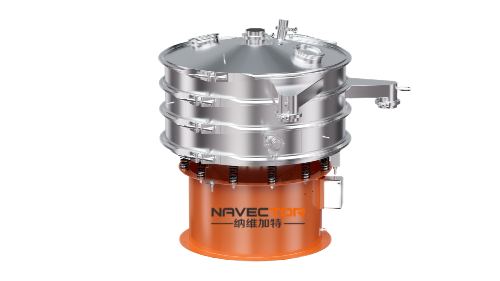
IV. What Are the Differences Between Ultrasonic Vibrating Screens and Conventional Vibrating Screens?
The main difference lies in screen cleaning and the screening methods used for fine powders. Conventional vibrating screens rely on screen body vibration to move material, while ultrasonic vibrating screens superimpose high-frequency, low-amplitude ultrasonic vibrations on conventional vibration to reduce clogging caused by fine particle adhesion and particles becoming lodged in the mesh.
For difficult-to-screen powders such as precipitated calcium carbonate, this combination can help improve screening efficiency and screen cleaning performance while reducing the impact of clogging on continuous production. Ultrasonic vibration can also reduce the need for additional screen cleaning devices and help extend screen mesh service life. According to Navector's product information, ultrasonic vibrating screens operate at relatively low and stable temperatures. Ultrasonic action does not cause localized temperature increases or alter the inherent properties of the material.
In specific applications, the extent of improvement provided by the ultrasonic system still depends on material conditions, screen specifications, and equipment operating parameters. For powders that already exhibit good screening performance, adding an ultrasonic system may not deliver comparable benefits. Equipment selection should therefore be based on actual test results.
V. How Should Screening Equipment Be Selected for Precipitated Calcium Carbonate?
The first step in equipment selection is to define the production objectives: Is the goal to remove coarse particles or achieve finer particle size classification? What is the target particle size? How much material must be processed per hour? These factors determine the appropriate screen specifications, equipment dimensions, and operating parameters.
The condition of the material is equally important. Whether the powder tends to agglomerate, whether screen clogging occurs frequently during operation, and whether throughput declines after a period of screening all affect equipment configuration. If the main problems are fine particle adhesion and screen opening blockage, ultrasonic vibrating screens should be evaluated. If the problems primarily result from excessive moisture, severe agglomeration, or insufficient pretreatment, the entire process flow must also be examined to identify the underlying causes.
For projects where the equipment model has not yet been determined, screening tests using the actual material are recommended to evaluate screening performance, processing capacity, and operating stability. Equipment specifications and mesh count alone are insufficient to accurately determine whether the equipment can meet production requirements.
Screening precipitated calcium carbonate tests the equipment's ability to accommodate powder characteristics and the production process's overall control of particle size, agglomeration, and screening efficiency. By applying high-frequency, low-amplitude ultrasonic vibrations to improve screen cleaning, ultrasonic vibrating screens provide an additional technical option for fine powder screening. Equipment selection should not rely on specifications alone. It must be grounded in actual production conditions, with the causes of screen clogging identified, particle size requirements clearly defined, and operating performance verified through material testing. Only when the equipment's operating principles align with the material characteristics and production objectives can the screening process remain stable and the equipment deliver tangible value in production.
 English
 中文
 Español
 ภาษาไทย
 Pусский
 Bahasa Indonesia
 Tiếng Việt