In the rubber industry, carbon black is a commonly used fine powder. Due to its fine particles and low density, some carbon black can easily agglomerate during screening. If the particles are not sufficiently dispersed, the screening results may be affected. For samples that require particle size analysis, reducing agglomeration and maintaining a stable screening process are important considerations for screening equipment.
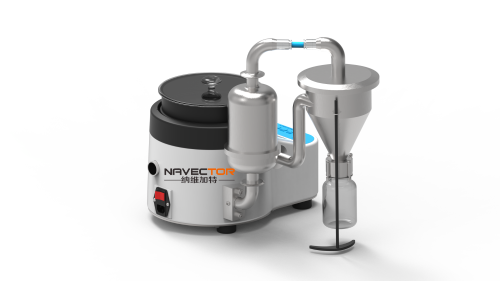
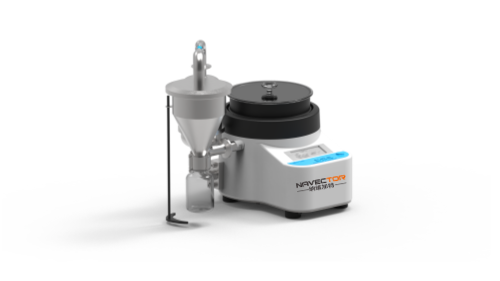
The small negative pressure airflow sieve uses aerodynamic screening. It disperses materials through negative pressure and air injection. The equipment is suitable for low-density, easily agglomerated fine particles and can be used with analytical sieves with apertures of 10 μm and above. The average screening time is 2–3 minutes.
I. Why Does Carbon Black Tend to Agglomerate During Screening?
Carbon black particles are relatively fine and tend to aggregate during screening. If the material remains on the screen surface in an agglomerated state, some particles cannot properly contact the screen openings, which can affect the screening results.
For this type of powder, the screen aperture is only one factor. Whether the material can remain dispersed on the screen surface is equally important. Simply relying on mechanical movement to push the material may not effectively solve the problem of fine-particle agglomeration.
The small negative pressure airflow sieve uses air injection. The airflow acts directly on the screen surface, helping disperse fine particles while also cleaning the screen. It is therefore suitable for screening and analysis of low-density, easily agglomerated powders.
II. How Does the Small Negative Pressure Airflow Sieve Screen Carbon Black?
After the equipment is connected to a vacuum cleaner or air extraction device, negative pressure is created inside the screening instrument. Due to the pressure difference, airflow is generated at the nozzle. Air is sprayed from the nozzle toward the screen surface and then drawn into the area below the screen openings.
Particles smaller than the screen aperture pass through the screen openings with the airflow and enter the vacuum cleaner or cyclone separator. During the screening process, the airflow also helps disperse the particles and clean the screen.
The entire process mainly relies on aerodynamic forces. For fine powders that are prone to agglomeration, the airflow can reduce the impact of particle aggregation on the screening process.
The nozzle velocity can be adjusted, and the screening time, negative pressure, and spray velocity also support digital adjustment. Since different materials behave differently, these parameters can be adjusted according to the actual screening conditions during operation.
The equipment can be connected to a manually adjustable industrial air extraction device or equipped with an automatic air extraction device. Continuous and stable airflow helps maintain consistent screening conditions, thereby improving the repeatability of screening results.
III. Why Is the Small Negative Pressure Airflow Sieve Suitable for Fine Powders Such as Carbon Black?
One practical issue when screening carbon black is that the particles tend to aggregate. The equipment uses air injection rather than relying solely on mechanical movement of the screen surface, allowing airflow to directly participate in material dispersion.
When the airflow is sprayed onto the screen surface, agglomerated fine particles can be dispersed to a certain extent. Particles smaller than the screen aperture then pass through the screen with the airflow. At the same time, the airflow continuously acts on the screen surface, reducing the impact of particles on the screen openings.
The adjustable parameters are also a feature that makes the equipment suitable for screening analysis. The nozzle velocity, negative pressure, and screening time can all be adjusted according to actual conditions. For samples that require repeated testing, relatively consistent screening conditions can be maintained as much as possible, reducing the impact of operational variations on the results.
The average screening time is 2–3 minutes, making the equipment suitable for rapid screening analysis of fine particles.
IV. What Are the Application Scenarios for Carbon Black Screening in the Rubber Industry?
The small negative pressure airflow sieve is used in various fields, including chemicals, plastics, rubber, minerals, pigments, colorants, ceramics, and food.
In the rubber industry, it is more suitable for screening and analysis of fine powders such as carbon black. When a material has low density, fine particles, and a tendency to agglomerate, and conventional screening methods have difficulty maintaining a stable screening state, negative pressure airflow-assisted screening can be considered.
It is particularly suitable for applications requiring repeated sample analysis. By adjusting the screening time, negative pressure, and nozzle velocity, samples from different batches can be screened under relatively consistent conditions as much as possible. In this way, the screening equipment does more than simply “screen the powder through.” It can also provide more stable operating conditions for particle size analysis.
It should be noted that the small negative pressure airflow sieve is compatible with analytical sieves with apertures of 10 μm and above. Therefore, in practical applications, the appropriate screen aperture should still be selected according to the particle size range of the carbon black and the specific analysis requirements. The suitability of the equipment cannot be determined simply by using a fixed mesh number.
V. How Should Screening Equipment for Carbon Black Be Selected?
For carbon black screening in the rubber industry, equipment selection should first consider the material characteristics and then determine the screening method. If the material is a low-density, fine powder that is prone to agglomeration and is mainly used for particle size analysis, the aerodynamic screening method of the small negative pressure airflow sieve is highly targeted.
During actual operation, the screen aperture, screening time, negative pressure, and nozzle velocity need to be properly matched. The equipment supports adjustment of these parameters, allowing them to be modified according to the actual material condition.
Navector has long focused on screening technology. Its product range covers ultrasonic vibrating sieves, gyratory screens, rotary vibrating sieves, 3D printing screening machines, negative pressure airflow sieves, and other types of equipment, with micron-level screening technology capabilities. For easily agglomerated fine powders such as carbon black, the key to equipment selection is not simply to pursue stronger mechanical vibration, but to keep the material well dispersed under appropriate screening conditions.
The difficulty of carbon black screening ultimately lies in the tendency of fine particles to agglomerate, which can make the screening process unstable. The small negative pressure airflow sieve uses a negative pressure environment and air injection to involve airflow in particle dispersion and screen cleaning, providing an alternative to conventional mechanical screening for low-density, easily agglomerated fine powders.
For carbon black screening in the rubber industry, equipment selection should be based on the material characteristics, screen aperture, and actual analysis requirements. Only when the screening method matches the material characteristics can the stability and repeatability of the screening process be effectively improved.
 English
 中文
中文 Español
 ภาษาไทย
 Pусский
 Bahasa Indonesia
 Tiếng Việt