In the field of IVD diagnostics, latex microspheres, fluorescent microspheres, and other polymer microspheres are commonly used functional materials. After the microspheres are prepared, they still need to undergo post-processing procedures such as filtration, washing, dewatering, and drying. If each process uses separate equipment, the material needs to be transferred repeatedly, making the process more complex and increasing the possibility of material exposure and agglomerate formation during drying.
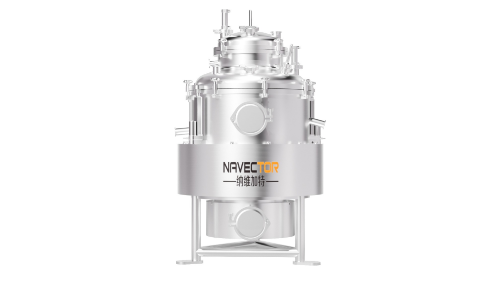
Navector's microsphere sieve is designed for this type of microsphere post-processing process. It integrates filtration, washing, dewatering, and drying into a single piece of equipment and uses centrifugal separation, negative-pressure fluid separation, and ultrasonic vibration for processing. The equipment features a fully sealed structure, which can reduce intermediate material transfers and provide a continuous post-processing solution for materials such as IVD latex microspheres.
I. What Is the Operating Principle of This Equipment?
The microsphere sieve is mainly used for solid-liquid separation of microspheres, integrating filtration, washing, dewatering, and drying into a single piece of equipment. The equipment uses centrifugal separation and negative-pressure fluid separation for processing, with ultrasonic vibration added during the drying process, without the need for a mechanical stirring device. The entire process can be carried out under sealed conditions, reducing material transfers between different pieces of equipment.
The ultrasonic function mainly operates during the filtration and drying processes. Ultrasonic vibration can distribute the product more evenly across the filter screen and accelerate drying, reducing the formation of agglomerates during the drying process. Ultimately, the solid material can be collected and stored as a dry, free-flowing powder without lumps.
Therefore, the microsphere sieve does not simply replace a conventional screening step. Instead, it is designed specifically for the microsphere post-processing process, completing solid-liquid separation and subsequent drying within the same equipment system.
II. Why Can It Improve Agglomeration Problems?
Agglomeration of microspheres during post-processing does not necessarily occur during the screening stage. Dewatering and drying after filtration can also affect the final material condition. Especially during drying, if the microspheres are unevenly distributed on the filter screen, localized aggregation can easily occur.
The microsphere sieve uses ultrasonic vibration to distribute the product evenly across the filter screen and accelerate drying to reduce the formation of agglomerates. The equipment does not include a mechanical stirring device and mainly relies on centrifugal separation, negative-pressure fluid separation, and ultrasonic functions to complete the corresponding processes.
The filter screens can also be configured according to different process requirements, including two-layer, three-layer, and five-layer filter screens, and Japanese imported filter sheets can be used. The equipment provides options such as adhesive mesh and sintered mesh, while diamond filter mesh is used to improve filter mesh hardness and durability. The filter screens are manufactured independently by Navector, allowing the production process to be controlled in-house.
Therefore, the microsphere sieve addresses agglomeration not simply by increasing mechanical action, but by focusing on material distribution during filtration and the drying process to reduce the formation of agglomerates.
III. Who Needs This Type of Equipment Most?
The microsphere sieve is mainly used for solid-liquid separation and post-processing of microspheres in the biopharmaceutical field. It can process materials such as chromatography packing media, drug-loaded microspheres, medical aesthetic microspheres, and IVD microspheres.
IVD microspheres include silica microspheres, polymer microspheres, fluorescent microspheres, latex microspheres, as well as inorganic-organic composite magnetic microspheres composed of iron oxide and polystyrene.
For R&D and production processes involving microsphere filtration, washing, dewatering, and drying, the appropriate equipment can be selected according to the specific material characteristics and processing capacity.
The product-contact parts are made of 316L stainless steel, with electropolishing achieving a surface roughness better than Ra < 0.4. The fully sealed design can meet sterile requirements while supporting CIP/SIP and temperature control.
IV. Which Production Processes Can Use It?
The main application of the microsphere sieve is not to perform a single "screening" operation, but to handle solid-liquid separation and drying during microsphere post-processing.
Filtration and solid-liquid separation: Solid-liquid separation is performed on microsphere-containing materials to provide the conditions required for subsequent washing, dewatering, and drying.
Washing and dewatering: Filtration, washing, and dewatering are completed under sealed conditions, reducing intermediate transfers between different pieces of equipment.
Drying: Ultrasonic vibration distributes the product evenly across the filter screen and accelerates the drying process, reducing the formation of agglomerates. After processing, the solid material is collected and stored as a dry, free-flowing powder without lumps.
This means that several steps originally requiring multiple pieces of equipment can be completed within the microsphere sieve, from filtration through drying.
V. Under What Operating Conditions Does It Offer Greater Advantages Than Conventional Processing Methods?
The microsphere sieve is more suitable for applications requiring sealed processing, sterile conditions, and the integration of multiple post-processing steps.
When material transfers need to be reduced
The equipment features a fully sealed design and can continuously complete filtration, washing, dewatering, and drying under sealed conditions, reducing intermediate transfers.
When higher equipment hygiene standards are required
The entire machine is made of 316L stainless steel, and the material-contact parts undergo electropolishing, achieving a surface roughness better than Ra < 0.4. The equipment supports CIP/SIP and can meet the corresponding cleaning and sterile process requirements.
When agglomerates tend to form during drying
The ultrasonic function can distribute the product more evenly across the filter screen while accelerating drying and reducing the formation of agglomerates.
When gradual scale-up from laboratory testing is required
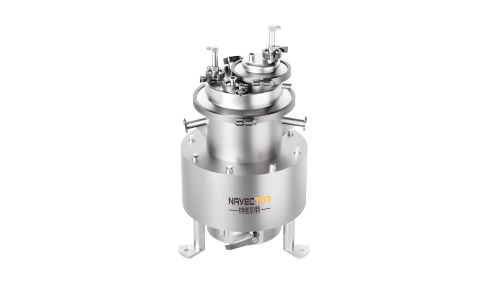
The equipment can be used for both testing and scaled production. According to the provided data, the test machine has a single-batch processing capacity of approximately 1.2 L under sterile conditions. Different models can meet production requirements at different scales; PV10, PV15, and PV20 have working chamber volumes of 3.55 L, 14.5 L, and 30.5 L, respectively.
VI. How Do You Choose the Right Model for Your Material?
When selecting a microsphere sieve, the first consideration is the material processing capacity, followed by the working chamber volume, filter area, and specific process requirements.
The PV10 has a working chamber volume of 3.55 L and a material handling capacity of 0.1–0.7 kg; the PV15 has a working chamber volume of 14.5 L and a material handling capacity of 0.5–1.5 kg; the PV20 has a working chamber volume of 30.5 L and a material handling capacity of 1–10 kg. The material-contact parts of all three models are made of 316L stainless steel.
For R&D and small-scale testing, the appropriate specification can be selected according to the actual test quantity. After entering pilot-scale or batch production, a larger working chamber can be selected according to the processing capacity. At the same time, the filter area, number of filter layers, and specific requirements for filtration, washing, dewatering, and drying should also be considered when determining the configuration.
For IVD latex microspheres, the microsphere sieve is not simply about whether the material can be "screened successfully." It is more suitable for integrating filtration, washing, dewatering, and drying during microsphere post-processing, reducing material transfers through a sealed structure while using ultrasonic vibration to improve material distribution on the filter screen and drying conditions. The appropriate filter and equipment model still need to be determined according to the specific characteristics, processing capacity, and process requirements of the latex microspheres.


 English
 中文
中文 Español
 ภาษาไทย
 Pусский
 Bahasa Indonesia
 Tiếng Việt