A plastic modification materials company once encountered the following problem: a batch of ultrafine calcium carbonate could initially pass through the screen normally, but as screening continued, the fine powder gradually agglomerated, with some fine particles accumulating on the screen surface and the screening rate decreasing accordingly. Even after extending the screening time, the screening results for the same batch of material could still vary.
This shows that screening ultrafine powders is not simply a matter of “how fast the screening is.” For low-density, easily agglomerated fine particles, the dispersion state of the material during screening also needs to be considered. Sometimes, particles fail to pass through the screen not because the screening time is insufficient, but because they have already clumped together.
For this type of fine powder, a small negative pressure airflow sieve uses aerodynamic forces for screening. The airflow helps disperse the particles, providing another approach for screening low-density, easily agglomerated fine particles. So, where exactly does the difficulty lie in screening ultrafine calcium carbonate? And how does a negative pressure airflow sieve address this problem? This article analyzes these questions in combination with applications in the plastics, rubber, and other industries.
I. Why Does Ultrafine Calcium Carbonate Tend to Cause Problems During Screening?
The main difficulty in screening ultrafine calcium carbonate lies first in the tendency of the particles to agglomerate. When multiple fine particles gather together, the overall size of the resulting agglomerate may be larger than the screen aperture. Even if some individual particles are smaller than the screen aperture, they may still have difficulty passing through the screen smoothly because of agglomeration.
Fine powder screening is also easily affected by the dispersion state of the material and the condition of the screen. If the particles are not sufficiently dispersed, fine powder can accumulate on the screen surface and may even cause screen apertures to become blocked, thereby affecting screening efficiency and results.
Another easily overlooked issue is the repeatability of screening results. If the material dispersion state, negative pressure, nozzle speed, and other conditions vary during each screening operation, the same batch of material may produce different screening results.
Therefore, screening ultrafine calcium carbonate is not simply a matter of allowing “large particles to remain and small particles to pass.” For easily agglomerated fine powders, whether the particles can be sufficiently dispersed, whether the screen apertures can remain clear, and whether the screening conditions remain stable will all directly affect the final screening results.
II. What Is a Negative Pressure Airflow Sieve?
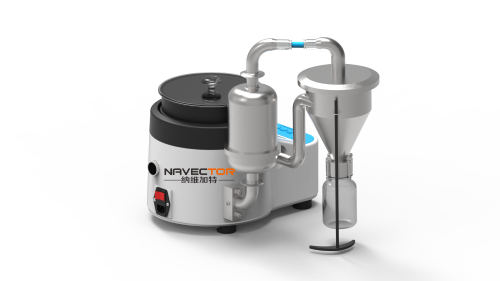
A negative pressure airflow sieve is a screening device that uses aerodynamic forces for screening, mainly for low-density, easily agglomerated fine particles.
Its working principle is relatively simple. After the screening instrument is connected to an air extraction device, negative pressure is created inside the system. Due to the pressure difference, a strong airflow is generated at the nozzle. The airflow acts on the screen surface and moves downward through the screen apertures. Particles smaller than the screen aperture pass through the screen with the airflow and enter a dust collector or cyclone separator.
The key is not only to use airflow to perform screening, but also to use the airflow to assist particle dispersion and screen cleaning at the same time. For easily agglomerated ultrafine powders, insufficient particle dispersion may affect screening results. The negative pressure airflow sieve uses air jets to reduce the agglomeration of fine particles and uses continuous airflow to help clean the screen, making the screening process more stable.
III. How Does a Negative Pressure Airflow Sieve Improve the Screening of Ultrafine Calcium Carbonate?
For low-density, easily agglomerated fine particles, the small negative pressure airflow sieve uses aerodynamic screening. Its core approach can be summarized as follows: first disperse the particles with airflow, then separate them through the screen apertures, and finally ensure the repeatability of the screening process through parameter adjustment.
The first step is airflow dispersion. After the screening instrument is connected to a dust collector or air extraction device, negative pressure is created inside the screening chamber. Under the pressure difference, the air at the nozzle forms a strong airflow, which is directed toward the screen surface and then drawn through the area below the screen apertures. The airflow helps disperse particles, reduce agglomeration, and clean the screen.
The second step is screen-aperture separation. The equipment is compatible with analytical sieves with apertures of 10 μm and above. During screening, samples smaller than the screen aperture pass through the apertures with the airflow and enter the dust collector or cyclone separator, thereby completing screening analysis within the corresponding particle-size range.
The final step is parameter control. Screening time, negative pressure, and nozzle speed can all be digitally adjusted. The equipment supports manual operation, with automatic pressure regulation available as an option. It can also be connected to manually adjustable industrial air extraction equipment or automatic air extraction equipment to provide continuous airflow during screening, helping improve the repeatability of screening results.
Therefore, the solution is not to “screen more aggressively,” but to disperse the particles first, complete the separation afterward, and control the screening process through adjustable conditions. For easily agglomerated fine powders, this sequence is more important than simply increasing mechanical action.
IV. When Should a Negative Pressure Airflow Sieve Be Considered?
Not all calcium carbonate screening applications require a negative pressure airflow sieve. Whether this screening method should be considered mainly depends on the material characteristics and actual analytical requirements.
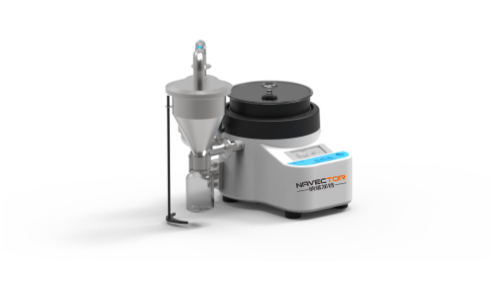
When the material consists of low-density, easily agglomerated fine particles, a small negative pressure airflow sieve can be considered. It is also suitable for screening analysis that requires a relatively gentle method and does not require additional mechanical screening accessories.
In addition, when the same type of sample needs to undergo repeated screening analysis and a certain level of repeatability is required, this type of equipment is also worth considering. The equipment allows screening time, negative pressure, and nozzle speed to be adjusted, and can work with air extraction equipment to provide continuous airflow.
In simple terms, low-density, easily agglomerated fine powders, as well as analytical applications requiring gentle screening and repeatable results, are the main situations in which a negative pressure airflow sieve should be considered.
V. What Screening Applications Is a Negative Pressure Airflow Sieve Mainly Used For?
A negative pressure airflow sieve is not a universal screening device for all types of powders. Its main application is the screening analysis of low-density, easily agglomerated fine particles.
First, it is suitable for fine powder screening analysis. The small negative pressure airflow sieve is compatible with analytical sieves with apertures of 10 μm and above, with an average screening time of 2–3 minutes, and is designed for low-density, easily agglomerated fine particles.
Second, it is suitable for applications requiring repeated screening analysis. Screening time, negative pressure, and nozzle speed can all be adjusted. The equipment can also work with manually adjustable industrial air extraction equipment or automatic air extraction equipment to provide continuous airflow during screening, helping maintain the repeatability of results.
Third, it is suitable for applications where particle dispersion needs to be improved. The airflow helps disperse particles and clean the screen, allowing samples smaller than the screen aperture to pass through the apertures with the airflow.
Therefore, for fine powders such as ultrafine calcium carbonate, the main purpose of a negative pressure airflow sieve is not simply to “blow the powder through,” but to first improve particle dispersion and then perform screening analysis.
VI. Which Industries Involve Ultrafine Calcium Carbonate Screening?
Ultrafine calcium carbonate is not limited to a single industry. Related powder applications can be found in plastics, rubber, powder coatings, pigments, toners, minerals, and other industries. Among these, plastics and rubber are relatively typical application areas for ultrafine calcium carbonate.
In addition to the industries mentioned above, pharmaceutical materials, chemicals, ceramics, food, and other fields also fall within the application range of small negative pressure airflow sieves. Although the specific materials vary, whenever screening analysis involves low-density, easily agglomerated fine particles, corresponding application scenarios exist. From this perspective, a negative pressure airflow sieve is not targeted at a particular industry, but rather at a category of fine powders with similar screening characteristics.
VII. Summary and Engineering Recommendations
The difficulty of screening ultrafine calcium carbonate lies not only in its fine particle size, but also in whether the powder can maintain good dispersion and whether the screening conditions remain stable. Therefore, equipment selection should not focus solely on the sieve model or mesh size. Instead, the material characteristics should first be evaluated: whether the material consists of low-density, easily agglomerated fine particles, whether the aperture of the analytical sieve is within the applicable range of the equipment, and whether repeatability of the screening results is required.
For powders that meet these characteristics, the screening approach should also shift from simply “passing the powder through the screen” toward improving particle dispersion and adjusting screening conditions. After all, if the powder keeps clumping together, even the best screen can only stand there helplessly.
Ultimately, fine powder screening is not about the equipment simply exerting more force. It is about matching the material characteristics, screen aperture, and screening conditions. Understand the material first, then select the equipment accordingly, and the screening results are more likely to remain stable.
 English
 中文
中文 Español
 ภาษาไทย
 Pусский
 Bahasa Indonesia
 Tiếng Việt