In biopharmaceutical production, when wet microspheres enter the screening process, engineers often face a critical challenge: how to remove abnormal particles without damaging qualified microspheres. Although it appears to be only a particle classification process, it actually tests the equipment’s ability to balance screening accuracy, operational stability, and material protection.
Unlike ordinary powders, wet microspheres remain in slurry systems for extended periods and are prone to agglomeration, adhesion, and screen clogging. Excessive mechanical action may affect the integrity of microspheres. With the development of biologics such as monoclonal antibodies and recombinant proteins, chromatography packing materials have increasingly higher requirements for microsphere particle size distribution and quality consistency. Achieving wet microsphere screening with “high precision, low damage, and stable operation” has become an important direction for post-processing optimization.
I. Core Challenges: Why Are Wet Microspheres Becoming Increasingly Difficult to Screen?
First, microspheres are prone to agglomeration. The liquid bridge effect and interactions between particles in the slurry can form agglomerates. During production, equipment may operate normally at the initial stage, but as screening continues, the number of agglomerated particles increases, causing screening efficiency to gradually decline. Simply increasing vibration intensity not only fails to significantly improve screening performance but may also increase the risk of microsphere damage.
Second, wet slurries are prone to screen clogging. Microspheres and slurry materials can adhere to the screen surface, reducing the effective screening area and affecting stable equipment operation. Meanwhile, the biopharmaceutical industry requires screening processes to remain enclosed and clean to reduce contamination risks.
In addition, microspheres are more sensitive to mechanical forces. For example, PLGA microspheres and polymer microspheres may experience breakage or deformation under impact or shear forces, affecting particle size distribution.
II. Technical Principle: How Does Navector Microsphere Sieve Achieve Stable Classification?
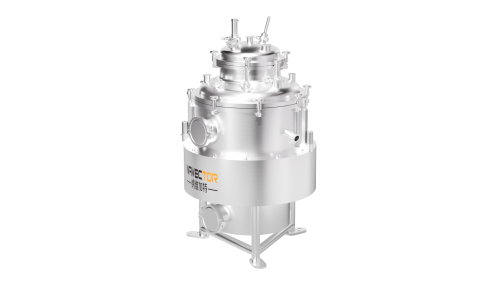
The challenge of wet microsphere screening is not simply increasing screening intensity, but finding a balance between efficiency, precision, and microsphere protection. Traditional equipment mainly relies on mechanical vibration to drive materials through the screen, which can easily cause impact and friction. Navector PV Series adopts a “negative pressure airflow conveying + dynamic screening + fully enclosed processing” approach to change the movement state of microspheres during the screening process.
The equipment uses negative pressure airflow to transport materials into the screening area, allowing microspheres to maintain better dispersion and reducing agglomeration and local accumulation. At the same time, ultrasonic-assisted technology is integrated to reduce particle adhesion on the screen surface, alleviate screen clogging issues commonly encountered during wet slurry operation, and improve continuous production stability.
For microsphere particle size control requirements, the PV Series adopts a multi-stage screening method. Different mesh sizes are used to gradually complete classification, preventing materials from directly entering the fine screening stage and reducing screen loading, thereby improving screening process stability.
In addition, the equipment adopts a fully enclosed structure and supports CIP/SIP online cleaning and sterilization. Screening, washing, dehydration, drying, and other post-processing steps can be integrated into a single system, reducing contamination risks caused by material transfer.
From an application perspective, the PV Series is not simply a replacement for traditional screening equipment. Instead, it is optimized based on the characteristics of wet microspheres, including “high tendency for agglomeration, high sensitivity to damage, and strict cleanliness requirements.” While maintaining microsphere integrity, it enables more stable precision classification.
III. Process Advantages: How Does Microsphere Sieve Balance Precision, Integrity, and Continuous Operation?
For wet microspheres, the value of screening equipment is not only reflected in improving processing capacity but also in maintaining particle integrity and production stability. Traditional screening focuses more on whether materials can quickly pass through the screen, while microsphere screening focuses more on whether the screening process can be controlled.
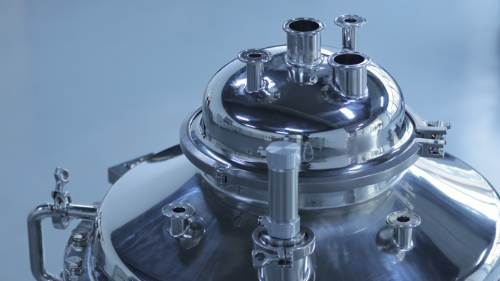
First, it reduces mechanical damage during screening. Some traditional screening methods rely on vibration forces to promote material passage through the screen. For sensitive materials such as PLGA microspheres and polymer microspheres, long-term operation may cause impact and friction damage. Microsphere sieve uses negative pressure airflow-assisted screening to complete particle size classification while reducing the influence of mechanical forces on microsphere integrity.
Second, it improves continuous production stability. Wet slurries are prone to agglomeration and screen clogging, requiring frequent shutdowns for maintenance with traditional equipment. Microsphere sieve combines ultrasonic assistance and multi-stage screening design to reduce particle adhesion, improve screening stability, and better meet the requirements of products such as chromatography packing materials that demand high batch consistency.
More importantly, it meets the requirements of clean production in biopharmaceutical manufacturing. Microsphere sieve adopts a fully enclosed structure and supports CIP/SIP online cleaning and sterilization. Screening, washing, dehydration, drying, and other post-processing steps can be connected within the same system, reducing material transfer and manual operations while lowering contamination risks.
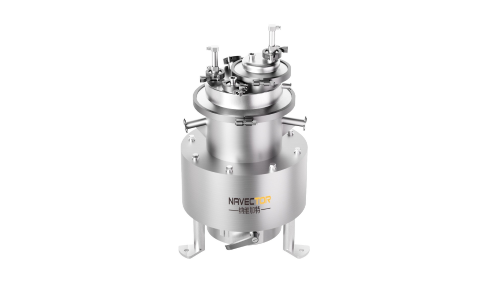
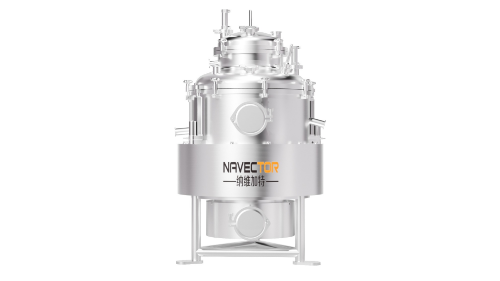
During actual equipment selection, enterprises can match equipment according to production stages: PV10 can be selected for laboratory research and development, PV15 for pilot-scale production, and PV20 for large-scale manufacturing. For high-viscosity microsphere slurries, an ultrasonic-assisted system can be added to improve screening stability and support future production capacity expansion.
IV. Application Value: Which Microsphere Production Scenarios Are Suitable for Microsphere Sieve?
Microsphere sieve is mainly designed for high-value microsphere materials requiring strict particle size control and clean production conditions, especially wet post-processing applications in the biopharmaceutical industry.
In chromatography packing material production, silica microspheres, polymer microspheres, and polysaccharide soft gel microspheres such as dextran microspheres require precise classification to control particle size distribution and meet the performance requirements of chromatography separation processes. Microsphere sieve can achieve stable screening under wet conditions, providing more uniform microsphere raw materials for subsequent applications.
In addition, during the production of drug-loaded microspheres (such as PLGA and PCL microspheres), medical aesthetic microspheres, and IVD microspheres, products also have strict requirements for particle size consistency and impurity control. Through precise classification, microsphere sieve helps enterprises improve the stability of microsphere post-processing and meet the production requirements of high-quality microsphere materials.
V. Development Trends: How Will Microsphere Screening Move Toward Process Integration?
With the development of biopharmaceutical manufacturing toward continuous and precision production, microsphere screening is gradually evolving from a single separation process into an important part of the overall post-processing system.
In the future, microsphere screening will place greater emphasis on process integration. Screening, washing, dehydration, and other steps will become more closely coordinated to reduce material transfer and improve production stability. Meanwhile, equipment intelligence will continue to improve. Through parameter monitoring, process recording, and data traceability, enterprises can achieve more precise process control. In addition, with the continuous development of advanced domestic pharmaceutical equipment, equipment selection will shift from simply comparing specifications toward a deeper understanding of material characteristics and application scenarios. Comprehensive solutions that truly meet microsphere production requirements will become a key direction for industry development.
The development of wet microsphere screening is essentially not about making microspheres pass through the screen faster, but about making the entire post-processing process more stable, repeatable, and verifiable. In the future, screening solutions that truly understand microsphere material characteristics and deeply integrate with production processes will be able to meet the continuously improving quality requirements of the biopharmaceutical industry.
 English
 中文
中文 Español
 ภาษาไทย
 Pусский
 Bahasa Indonesia
 Tiếng Việt