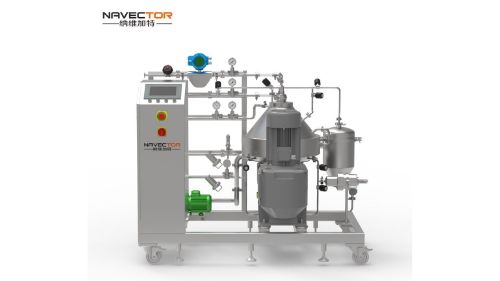
Ⅰ. Principle
A disc stack centrifuge is a vertical sedimentation centrifuge that uses the powerful centrifugal force generated by the high-speed rotation of the bowl to separate components with different densities in a mixture according to differences in their settling velocities.
A set of conical discs is stacked inside the bowl, with narrow gaps between the discs. The suspension or emulsion enters through the central feed pipe and flows upward through the gaps between the discs. Under the centrifugal force, denser solid particles settle onto the inner surfaces of the discs, slide outward, and accumulate at the maximum diameter of the bowl. The lighter liquid flows inward along the outer surfaces of the discs and is eventually discharged through the liquid outlet.
The key function of the disc stack is to shorten the settling distance of particles and significantly increase the settling area, thereby greatly improving separation efficiency and processing capacity.
Ⅱ. Disc Stack Centrifuge Structure
The disc stack centrifuge consists of four major sections:
(1) Stationary Section
Base, housing, feed pipe, liquid discharge pipe, bearing housing, and vibration isolator.
Function: Supports the entire machine, collects and discharges the separated materials, and isolates vibration.
(2) Rotating Section
Bowl body, upper cover, locking ring, disc stack, distributor, central feed pipe, main shaft, and centripetal pump.
Function: Generates a high-speed centrifugal force field. The disc stack increases the settling area to achieve separation of light and heavy phases.
(3) Solids Discharge Section
Sliding piston, operating water chamber, solids discharge port, and operating water valve/solenoid valve.
Function: In models with automatic solids discharge, the sliding piston is controlled by operating water to discharge the solid phase at preset intervals and quantities.
(4) Drive and Control Section
Motor, variable frequency drive, transmission system, upper and lower bearings, seals, sensors, PLC control cabinet, lubrication system, and cleaning system.
Function: Provides power, speed control and braking, safety interlocking, and automated operation.
Working Process
The material enters the disc stack through the central feed pipe and distributor. In the centrifugal force field, the light phase moves toward the center, while the heavier phase and solid phase move outward and are discharged separately. During solids discharge, the sliding piston opens the solids discharge port and automatically returns to its original position after discharge.
Ⅲ. Applications of Disc Stack Centrifuge
The disc stack centrifuge is suitable for fine solid-liquid separation, efficient clarification, and multiphase separation. It is used across food and beverage processing, plant and traditional Chinese medicine extraction, biopharmaceutical processing, and industrial separation.
Food & Beverage: Used for continuous clarification during production to reduce the filtration load in downstream processes. Suitable for beer, wine, fruit juice, dairy products, plant-based beverages, edible oils, and other materials.
Plant & Traditional Chinese Medicine Extraction: Moves efficient solid-liquid separation upstream to the extraction stage. Suitable for plant extracts, traditional Chinese medicine extracts, essential oils, natural products, and other materials.
Biopharmaceuticals: Designed for high-load solid-liquid separation requirements in biopharmaceutical processes. Applications include vaccines, monoclonal antibodies, recombinant proteins, enzymes, biological products, fermentation broth, cell harvesting, and microbial cell harvesting.
Industrial Applications: Used for liquid clarification, oil-water separation, and multiphase separation in industrial processes.
Ⅳ. Disc Stack Centrifuge Specifications
|
Parameter |
LNC05 (Under Development) |
LNC10 |
LNC15 |
LNC20 |
LNC25 |
|
Flow Rate with Water (L/h) |
1000 |
3000 |
5000 |
10000 |
12000 |
|
Recommended Processing Capacity (L/h) |
50–200 |
200–500 |
800–1500 |
1000–2000 |
1500–3000 |
|
Settling Area (m²) |
8400 |
13200 |
28000 |
48000 |
80000 |
|
Maximum Speed (rpm) |
13500 |
10350 |
8500 |
7500 |
7200 |
|
Separation Factor (G) |
20000 |
14000 |
12500 |
11500 |
11000 |
|
Bowl Diameter (mm) |
260 |
300 |
380 |
440 |
510 |
|
Bowl Volume (L) |
1.5 |
3 |
6 |
8.5 |
17 |
|
Solids Chamber Volume (L) |
0.6 |
1 |
2.5 |
4 |
7 |
|
Solids Discharge Method |
Sliding Valve |
||||
|
Wetted Parts Material |
316L |
||||
|
Surface Roughness (μm) |
Ra 0.4 |
||||
|
Seal Material |
EPDM & PA6 |
||||
|
CIP |
√ |
√ |
√ |
√ |
√ |
|
SIP |
× |
√ |
√ |
√ |
√ |
|
Motor Power (kW) |
4 |
5.5 |
7.5 |
11 |
22 |
|
Overall Dimensions (L × W × H, mm) |
770 × 470 × 800 |
930 × 780 × 1100 |
1200 × 950 × 1100 |
1300 × 1000 × 1450 |
1700 × 1300 × 1400 |
|
Machine Weight (kg) |
245 |
400 |
615 |
740 |
1150 |


 English
 中文
中文 Español
 ภาษาไทย
 Pусский
 Bahasa Indonesia
 Tiếng Việt