I. Key Challenges: Where Does Graphite Powder Classification Get Stuck?
The core challenge of graphite powder classification lies in the mismatch between material characteristics and conventional screening logic. Graphite powder has a low specific gravity, making insufficient dispersion likely during conventional screening. Fine powder may also agglomerate during the screening process, affecting its passage through the screen. In addition, some fine powders are prone to generating static electricity. After passing through the screen, the material may adhere to the back of the screen, causing screen openings to become blocked. This affects both screening efficiency and continuous operation. For finer and ultrafine powders, if the material state cannot be effectively controlled during screening, screening efficiency and classification stability can also be affected.
II. Principle Breakdown: How Does a Centrifugal Screen Address These Challenges?
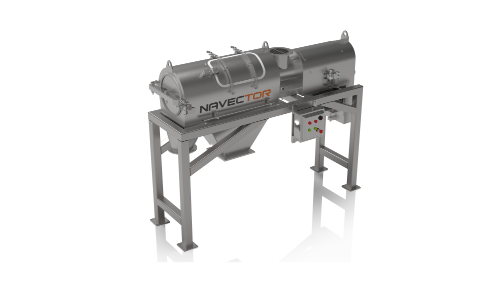
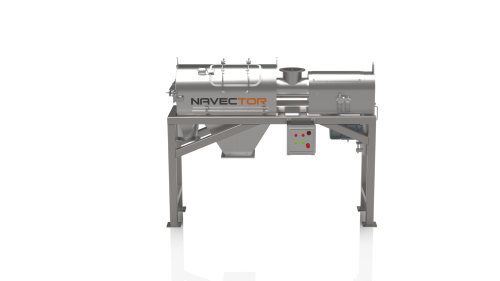
The core principle of a centrifugal screen is to use airflow to drive particle separation, combined with centrifugal force and cyclone propulsion force to complete screening. Unlike conventional screening, which relies on screen surface vibration to allow materials to pass through the screen, the material is first mixed and atomized with airflow through a screw conveying system before entering a cylindrical screen. Under the action of the fan blades inside the screen cylinder, the material is simultaneously subjected to centrifugal force and cyclone propulsion force, allowing it to pass through the screen. Fine material that can pass through the screen is discharged through the fine material outlet, while material that cannot pass through the screen moves along the cylinder wall and is discharged through the coarse material outlet.
This overall design is well suited to material characteristics such as low weight, easy agglomeration, susceptibility to static electricity, and a tendency to cause screen blockage. For difficult-to-screen materials, the equipment can also be equipped with an ultrasonic system to enhance screen cleaning, reduce screen opening blockage, and extend screen service life. An externally mounted transducer can help prevent material contamination during the screening process. At the same time, the equipment is capable of further crushing agglomerated materials, helping improve the condition of agglomerated material before and during screening.
III. Production Line Implementation: What Should Be Considered in Terms of Screens, Materials, and Continuous Operation?
The first step in implementing a production line is to match the screen specifications to the required classification. The specific selection should be determined based on the actual particle size, agglomeration state, and screening requirements of the graphite powder. Different material conditions correspond to different screening operating conditions, so the screen specifications cannot be determined simply based on the material name, graphite powder.
Next, attention should be paid to the material state during screening. When graphite powder is lightweight and fine powder is prone to agglomeration, whether the material can be sufficiently dispersed and whether the screen can maintain an effective screening state will directly affect the final classification results. A centrifugal screen drives material movement through the screw conveying system, airflow, and the centrifugal force and cyclone propulsion force generated by the fan blades, making it more suitable for the rapid screening of relatively lightweight materials as well as fine and ultrafine powders.
In mass-production applications, screen cleaning capability should also be a key consideration. For materials that are prone to screen blockage, an ultrasonic system can be added according to the actual operating conditions to enhance screen cleaning and reduce declines in screening efficiency caused by blocked screen openings. The equipment can also process agglomerated materials, providing a more stable material state for continuous screening.
IV. Selection Decision: How Should the Equipment and Supplier Be Selected?
Before selecting equipment, send samples of the graphite powder to be classified for screening tests. Confirm whether the actual classification results, material handling condition, and processing capacity meet production line requirements, avoiding a mismatch between the purchased equipment and the material characteristics. For graphite powder that is prone to agglomeration and screen blockage, actual testing should be used to observe the operating condition of the screen before determining the specific equipment configuration.
Second, do not cut costs at the screen stage. As a core component of the centrifugal screen that directly participates in classification, the specifications and suitability of the screen directly affect screening performance. During selection, an appropriate screen should be determined according to the actual particle size and screening requirements, rather than simply pursuing a higher mesh count.
Third, processing capacity should be determined according to actual production requirements. Equipment model, material condition, and screening requirements will all affect actual processing capacity, so configuration should not be based solely on theoretical capacity.
Fourth, priority should be given to suppliers that can provide screening tests, equipment selection, and process adaptation services. For powders such as graphite powder that are prone to agglomeration and screen blockage, testing first and selecting equipment afterward is often more reliable than selecting equipment solely based on equipment specifications.
V. As Graphite Powder Becomes Finer, What Else Can Screening Technology Offer?
A centrifugal screen uses airflow to drive particle separation, combined with centrifugal force and cyclone propulsion force to complete screening, while an ultrasonic system can further enhance screen cleaning. This provides a targeted approach for screening relatively lightweight and fine powders such as graphite powder. The externally mounted transducer can help reduce material contamination, while the equipment also has the ability to further crush agglomerated materials, providing a certain degree of adaptability to materials prone to agglomeration and screen blockage.
Powders in the new materials industry are continually moving toward finer particle sizes, and the challenges encountered during screening are becoming increasingly concentrated around specific issues such as material dispersion, agglomeration, and screen blockage. For graphite powder classification, equipment selection should not focus solely on the equipment name and specifications. Greater attention should be paid to material condition, screen specifications, screening method, and actual operating performance. Conducting material testing first and then determining the equipment configuration can make the screening solution better aligned with production requirements.
 English
 中文
中文 Español
 ภาษาไทย
 Pусский
 Bahasa Indonesia
 Tiếng Việt