Ultrafine copper powder is an important powder raw material in the electronic materials industry and can be used in conductive pastes, electromagnetic shielding materials, electronic packaging, and other applications. For this type of ultrafine powder, the screening process must ensure effective particle size classification while also meeting the processing capacity requirements of continuous production.
Ultrafine powder screening is prone to problems such as screen clogging, poor classification, and insufficient capacity. Especially when the powder particle size enters the D50 and below 1 μm range, the processing capacity and screening performance of traditional screening equipment are more likely to be limited. The high-speed screen is redesigned with vibration modes and operating parameters for such ultrafine powders. Through low-frequency high-speed vibration, stepless speed adjustment, and high-performance screens, it improves the screening efficiency and classification capability of ultrafine powders.
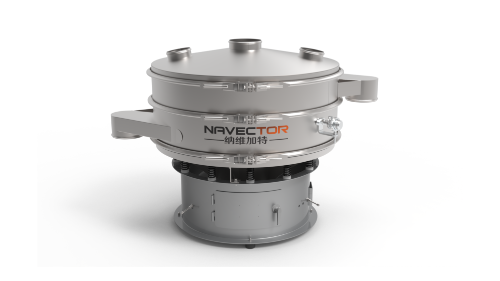
I. Key Challenges: Where Exactly Does Copper Powder Screening Get Stuck?
The difficulty of screening ultrafine copper powder first comes from the particle size itself. When the powder enters the ultrafine range of D50 and below 1 μm, problems such as agglomeration and screen clogging are more likely to occur during screening, and traditional screening machines may experience incomplete screening and unclear classification.
Another issue is processing capacity. Ultrafine powder screening cannot focus only on classification accuracy; the production line also needs to continuously process a certain amount of material. If the screening efficiency of the equipment is insufficient, the capacity may fail to keep pace with the production rhythm.
Taken together, these issues create a typical contradiction in ultrafine copper powder screening: finer screening may make it difficult to increase processing capacity, while pursuing higher capacity may affect screening performance.
The design concept of the high-speed screen is to optimize these problems of screen clogging, poor classification, and insufficient capacity in ultrafine powder screening. Its positioning is specifically for precision screening of ultrafine powders with a D50 particle size and below 1 μm.
II. Principle Breakdown: How Does the High-Speed Screen Improve These Challenges?
The high-speed screen adopts low-frequency high-speed vibration technology, with a speed range of 0–3000 rpm and stepless speed adjustment. The operating speed can be adjusted according to different material characteristics, while the classic flower-disc adjustment structure is retained, allowing screening accuracy and processing capacity to be adjusted simultaneously.
The core change lies in enabling the material to disperse rapidly on the screen surface and pass through the screen sufficiently. For ultrafine powders that are prone to agglomeration and screen clogging, the screening efficiency and classification accuracy can be improved by adjusting the material movement trajectory and screening state.
For powders such as ultrafine copper powder that require fine classification, the operating parameters are not fixed. The 0–3000 rpm stepless speed adjustment system provides a wider adjustment range, allowing the operating speed to be matched to the actual material condition.
Processing capacity is also an important design focus of the high-speed screen. Its processing capacity can reach 5 times that of ordinary screening machines and 3 times that of traditional small-particle screening machines. In continuous ultrafine powder production, this processing capacity can reduce the pressure of relying solely on increasing the number of machines to expand production capacity.
For the screen, the high-speed screen is equipped with a dedicated Magenite screen, featuring high tension, high wear resistance, and high screening efficiency. Its tension can reach 50 N, and its service life is 2–3 times that of ordinary screens. Combined with the operating mode of the high-speed screen, it can reduce screen clogging and particle blockage while extending the service life of the screen.
Therefore, the approach of the high-speed screen to solving ultrafine powder screening problems is relatively clear: improve material movement through high-speed vibration, adjust screening parameters through stepless speed control, and combine these with a high-performance screen to improve screening efficiency, classification accuracy, and processing capacity.
III. Production Line Implementation: What Should Be Considered in Actual Ultrafine Copper Powder Screening?
Ultrafine copper powder screening cannot be evaluated based on a single equipment parameter. In actual equipment selection, the material particle size, screening requirements, and capacity requirements need to be considered together.
First are the operating parameters. The high-speed screen supports 0–3000 rpm stepless speed adjustment, allowing the operating speed to be flexibly adjusted according to different material characteristics. For ultrafine powders with different particle size ranges and screening conditions, suitable operating parameters need to be determined through actual testing.
Next is the screen. The high-speed screen is equipped with a dedicated Magenite screen, with a tension of up to 50 N, featuring high tension, high wear resistance, and high screening efficiency. Its service life is 2–3 times that of ordinary screens. For continuous screening production, screen performance itself is an important factor affecting operational stability.
There is also the issue of equipment upgrades. If the production line already uses a small-particle screening machine, a high-speed screen upgrade solution can also be considered. The high-speed screen supports the upgrading and modification of existing small-particle screening machines. There is no need to replace the entire machine; the upgrade can be completed simply by replacing the stepless-speed motor and control system. For production lines that already have an equipment base, this approach can reduce the investment associated with replacing the entire machine.
As for the specific screen specifications and operating parameters, they need to be determined according to the actual particle size, classification requirements, and processing capacity of the copper powder. The core positioning of the high-speed screen is the screening of ultrafine powders with a D50 particle size and below 1 μm. The specific equipment configuration should still be based on material testing results.
IV. Selection Decisions: How Should the Equipment and Supplier Be Selected?
First, it is necessary to determine whether the equipment is actually designed for ultrafine powder screening. The high-speed screen has a clear application focus, targeting ultrafine powders with a D50 particle size and below 1 μm, while addressing problems such as screen clogging, poor classification, and insufficient capacity.
Second, look at the parameter adjustment capability. The 0–3000 rpm stepless speed adjustment allows the operating speed to be adjusted according to material characteristics, while the flower-disc adjustment structure further helps adjust the screening condition. For production lines with differences in material characteristics, this adjustment range has more practical significance than a single fixed operating parameter.
Third, look at the screen configuration. The dedicated Magenite screen features high tension, high wear resistance, and high screening efficiency, with a tension of up to 50 N and a service life 2–3 times that of ordinary screens. The screen and equipment operating conditions need to be evaluated together rather than comparing only individual purchase prices.
Finally, it is also necessary to consider whether the equipment can adapt to the existing production line. If a small-particle screening machine was previously used, it is worth checking whether upgrading and modification are supported. The high-speed screen does not require replacement of the entire machine; the upgrade can be completed simply by replacing the stepless-speed motor and control system. This has practical value for production lines that already have an equipment base.
Navector's high-speed intelligent screening machine was upgraded and developed on the basis of the original ultrasonic small-particle screening machine. It is designed for precision screening requirements of ultrafine powders, with applications covering lithium batteries, solid-state batteries, new materials, electronic materials, and fine chemicals.
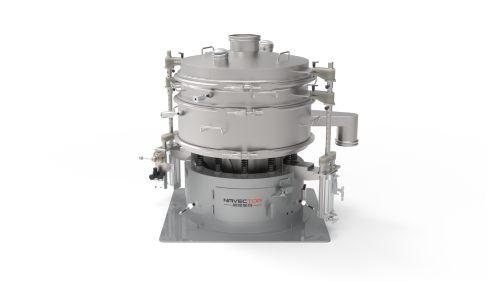
V. As Copper Powder Becomes Finer, What Else Can Screening Technology Bring?
The challenges of ultrafine powder screening are often concentrated in several areas: whether the material can be fully dispersed, whether the screen can maintain a stable screening condition, and whether the equipment can handle a higher processing capacity while maintaining classification performance.
The high-speed screen starts with low-frequency high-speed vibration. Through 0–3000 rpm stepless speed adjustment and flower-disc adjustment, the equipment can adjust its operating condition according to material characteristics. For electronic material powders such as ultrafine copper powder, equipment selection for screening ultimately needs to return to the material itself. First clarify the particle size range, classification requirements, and processing capacity, then determine the operating parameters and screen configuration through actual screening tests so that the equipment can truly match the production line.
This is also where the value of the high-speed screen lies: it addresses the common problems of screen clogging, poor classification, and insufficient capacity in ultrafine powder screening separately, then recombines vibration mode, parameter adjustment, and screen configuration to provide more room for adjustment between precision and processing capacity.


 English
 中文
中文 Español
 ภาษาไทย
 Pусский
 Bahasa Indonesia
 Tiếng Việt