In powder laboratories, screening 1000-mesh silicon powder is basically considered a “classic challenge.”
Many engineers have encountered similar scenarios: the laboratory needs to conduct particle size analysis, the selected sieve mesh is 1000 mesh (about 10 μm), and as soon as the machine starts, three problems appear: the sieve quickly gets clogged, the powder hardly feeds through, and after 10 minutes of screening, the results show almost no change.
Many people’s first reaction is: is the sieve quality poor? Is the equipment vibration insufficient? But from an engineering perspective, the problem is often only one thing: the powder is too fine + severe agglomeration + insufficient energy from traditional vibrating sieves.
Today, we will use the six-step logic commonly used by engineers—What / Why / Who / When / Where / How—to clearly explain the issue of screening 1000-mesh silicon powder.
I. What | What is a Negative Pressure Airflow Sieve?
If explained in one sentence commonly used by engineers: negative pressure airflow sieve = using air to disperse the powder first, and then complete the screening. Its screening logic is completely different from that of traditional vibrating sieves.
Traditional vibrating sieve: vibration → particle jumping → passing through the sieve openings
Negative pressure airflow sieve: airflow dispersion → single-particle state → passing through the sieve openings
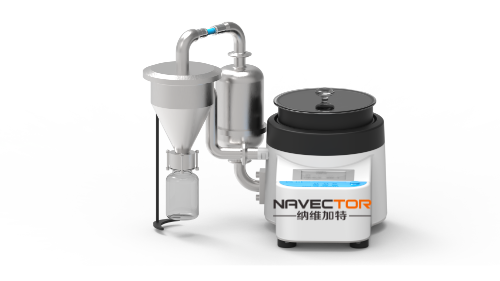
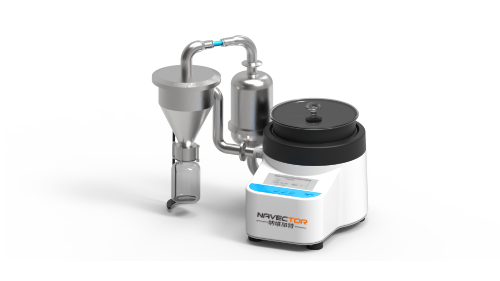
Taking the Navector NQV200 ultrasonic negative pressure airflow sieve as an example, the equipment mainly consists of the following parts:
filter, slotted rotating nozzle, acrylic sealed cover, sieve analyzer main body, vacuum cleaner negative pressure system, collection bottle and control bottle, ultrasonic system
Several key figures can be used to understand the core parameters:
Working negative pressure: 0–10 kPa
Nozzle speed: 30±2 rpm
Maximum sample quantity: 100 g
Sieve diameter: 200 mm
Applicable particle size: 5–4000 μm
In simple terms, it can be summarized in one sentence:
A vibrating sieve “shakes the sieve,” while an airflow sieve “blows the powder.”
II. Why | Why Must 1000-Mesh Silicon Powder Use an Airflow Sieve?
First, let’s look at a real laboratory case.
A research institute was conducting a 1000-mesh silicon powder screening test:
|
Equipment Screening |
Time |
Result |
|
Vibrating sieve |
10 minutes |
Basically clogged |
|
Airflow sieve |
2–3 minutes |
Normal screening |
Why is the difference so significant?
There are mainly three reasons.
1.Silicon powder particles are extremely fine
The particle size corresponding to 1000 mesh silicon powder is approximately: 10 μm, which already belongs to ultrafine powder. The smaller the particles, the higher the surface energy, and the easier they are to agglomerate.
A common laboratory phenomenon is:
10 μm particles → agglomerated into 50 μm particles
2.Traditional vibrating sieves cannot break up agglomeration
The vibration acceleration of vibrating sieves is generally: 3–5 g. For micron-level agglomerated particles, this energy is basically insufficient.
As a result, the agglomerated particles are directly treated as large particles, and the screening efficiency becomes extremely low.
3.Airflow impact can disperse the powder
The nozzle airflow of a negative pressure airflow sieve can generate approximately: 3000 Pa air pressure. This airflow will:
break up agglomerated particles and convert the powder into a single-particle state.
III. Who | Who Most Needs 1000-Mesh Silicon Powder Screening Equipment?
If your work involves the following scenarios, you are very likely to encounter this issue:
1.Materials research institutes
Frequently conduct:
powder particle size analysis
material process validation
2.New materials laboratories
Common materials include:
ultrafine silicon powder
conductive carbon black
nano oxides
3.Battery material companies
During the R&D stage of silicon-based anode materials, they need:
frequent particle size verification through screening
In one sentence: as long as the powder particle size is at the 10 μm level, an airflow sieve is basically standard equipment.
IV. When | When Must an Airflow Sieve Be Used?
There are four situations where it is recommended to directly use a negative pressure airflow sieve.
1.Powder reaches 1000 mesh or above
For example: 800 mesh, 1000 mesh, 1250 mesh
Traditional vibrating sieves will basically:
clog rapidly.
2.Powder density is relatively low
For example, silicon powder: specific gravity about 0.5–0.7
This type of powder is especially suitable for airflow sieves.
3.Fast laboratory testing pace
R&D laboratories usually need to test:
tens of grams of samples every day
For example:
testing 100 g of samples per day, completed in 3 batches, with each airflow screening taking 2–3 minutes, resulting in very high efficiency.
4.High dust control requirements
The negative pressure airflow sieve adopts:
a sealed + negative pressure system, so dust will not leak out.
V. Where | In Which Industries Are Negative Pressure Airflow Sieves Mainly Used?
Although today’s topic is the screening of 1000-mesh silicon powder, airflow sieves are actually already used in many industries.
Typical industries include:
Materials industry: silicon powder, graphite, conductive carbon black
Pharmaceutical industry: API raw materials, lactose powder
Fine chemicals: pigments, coating powders
Ceramic materials: alumina, silicon nitride
These industries share one common characteristic: powder particle size is less than 20 μm.
VI. How | How to Achieve 1000-Mesh Silicon Powder Screening?
To achieve stable screening, engineers generally focus on three key points.
1.Sieve selection
For 1000-mesh silicon powder:
it is recommended to use a 10 μm sieve, preferably a diamond sieve mesh. This type of sieve has a diamond-coated surface, with the advantage of being smoother and less likely to clog.
2.Ultrasonic assistance
Ultrasonic waves can generate high-frequency vibration, whose function is to prevent particles from getting stuck in the sieve openings and improve the pass-through rate.
3.Airflow parameter adjustment
The key parameters of the airflow sieve include:
Negative pressure range: 0–10 kPa
Nozzle speed: 5–55 rpm
By adjusting these two parameters, a stable screening state can be achieved.
VII. Real Customer Case
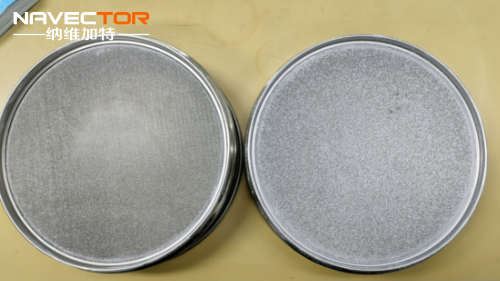
At the testing site of a new energy materials company in Guangzhou, engineers conducted a 1000-mesh silicon powder screening test.
The customer’s requirement was very simple: test approximately 100 g of silicon powder samples every day.
Testing process: using the NQV200 ultrasonic negative pressure airflow sieve
Configured with: 10 μm diamond sieve mesh, ultrasonic system
Result: approximately 1/3 of the sample screening completed in 15 minutes
Smooth feeding, no obvious clogging, and the customer’s on-site evaluation was very direct: the screening effect far exceeded expectations.
VIII. Common Problem Analysis
1.Why does 1000-mesh silicon powder screening easily clog the sieve?
There are mainly two reasons:
First, the powder particles are too fine (about 10 μm) and prone to agglomeration;
second, humidity or static electricity causes particles to adhere.
The agglomerated particles become larger, thereby blocking the sieve openings.
2.Can 1000-mesh silicon powder be screened with a regular vibrating sieve?
Generally, it is not very suitable. Traditional vibrating sieves are more suitable for powders above 50 μm, while 1000-mesh silicon powder belongs to ultrafine powder and is more prone to clogging and low screening efficiency. Laboratories usually use negative pressure airflow sieves for screening.
3.What is the screening principle of a negative pressure airflow sieve?
The negative pressure airflow sieve disperses the powder through airflow and then completes the screening.
The airflow can destroy powder agglomeration, allowing particles to pass through the sieve openings in a single-particle state, thereby improving screening efficiency.
4.How long does 1000-mesh silicon powder screening generally take?
Under laboratory conditions, using an airflow sieve usually takes only 2–3 minutes to complete one screening test. The specific time will vary depending on powder properties and equipment parameters.
If I had to summarize the issue of screening 1000-mesh silicon powder in one sentence: it is not that screening is difficult, but that the powder is too fine. Traditional vibrating sieves basically struggle to handle 10 μm-level powder. The core logic of the negative pressure airflow sieve is: first use airflow to disperse the powder, and then complete the screening.
When the powder returns to a single-particle state, the screening efficiency is higher, the particle size results are more realistic, and the data repeatability is more stable.
This is also why more and more laboratories, when dealing with ultrafine silicon powder screening, are beginning to prioritize negative pressure airflow sieves.
 English
 中文
中文 Español
 ภาษาไทย
 Pусский
 Bahasa Indonesia
 Tiếng Việt