In solid-state battery production, sulfide electrolytes are important powder materials. However, as materials move toward ultrafine particle sizes, screening becomes increasingly difficult. When processing such materials, traditional screening equipment can easily encounter problems such as mesh clogging, poor classification, and insufficient processing capacity. Maintaining stable screening while ensuring particle size control has therefore become an issue that needs to be addressed in actual production.
Today, the Navector high-speed sieve provides a new solution for this type of ultrafine powder screening requirement. How does it use low-frequency, high-speed vibration to enable ultrafine powders to pass through the screen more effectively? What kind of screening adjustment flexibility can the 0–3000 rpm stepless speed control provide for different materials? Starting from the screening challenges of sulfide electrolytes, this article analyzes how the high-speed sieve can improve the screening conditions of ultrafine powders.
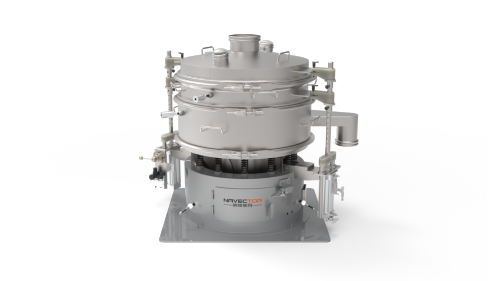
I. Industry Scenario: Why Do Solid-State Battery Sulfide Electrolytes Require Fine Screening?
Sulfide electrolytes are important powder materials used in solid-state battery production. During production, electrolyte powders need to be screened and classified according to the target particle size, separating particles that do not meet the required particle size and providing particle-size-stable materials for subsequent processes.
As the screening particle size enters the ultrafine range, screening becomes more difficult. Ultrafine powders are prone to agglomeration, while problems such as mesh clogging and unstable screening may also occur during the screening process, further affecting classification performance and processing capacity.
For ultrafine powders such as sulfide electrolytes, screening equipment must not only separate particles by size but also address problems such as mesh clogging, poor classification, and insufficient capacity that can easily occur during ultrafine powder screening.
II. Causes of the Problem: Why Are Ultrafine Sulfide Electrolytes Prone to Mesh Clogging?
Mesh clogging in ultrafine powders is not caused by a single factor. It is related to the extremely fine particle size as well as agglomeration and particle lodging during the screening process.
As particle size decreases, materials are more likely to adhere to and become lodged in the screen openings during screening. Some particles remain in the openings and gradually affect the effective open area of the screen. At the same time, ultrafine particles are prone to forming agglomerates. After fine particles that could originally pass through the screen agglomerate, their overall size increases, making them more likely to remain on the screen surface and further reducing the opportunities for effective screening.
Therefore, ultrafine powder screening cannot be evaluated based only on screen aperture size. Whether the material can maintain good dispersion and whether its movement state on the screen surface is appropriate also affect screening efficiency and classification performance.
III. Production Losses: Why Does Mesh Clogging Further Affect Classification and Capacity?
When the screen becomes clogged, the effective screening area is affected first. When screen openings are covered or blocked by particles, the effective open area of the screen decreases, reducing the opportunities for fine particles to pass through the openings. Although the equipment continues to operate, its screening efficiency has already been affected.
As screening efficiency decreases, classification stability also deteriorates. When target particles cannot pass sufficiently through the screen openings, deviations may occur in the particle size distribution after screening, ultimately resulting in poor classification. At the same time, reduced effective screening capacity directly limits the amount of material that can be processed per unit of time, making it difficult for the equipment to reach the expected capacity.
IV. Screening Limitations: Why Do Traditional Equipment Have Difficulty Solving Ultrafine Powder Mesh Clogging?
Traditional screening equipment mainly relies on mechanical vibration to drive material movement. For conventional powders, this method can generally meet screening requirements. However, when materials enter the ultrafine range with a D50 particle size below 1 μm, problems such as agglomeration and mesh clogging are more likely to occur, while screening accuracy and processing capacity are also affected.
The challenge of ultrafine powder screening is not simply the magnitude of the vibration force. When materials are not sufficiently dispersed on the screen surface, accumulation and lodging can easily occur, reducing the effective open area of the screen and consequently affecting screening efficiency. Therefore, when dealing with ultrafine powders, screening equipment needs to further improve the movement state of the material on the screen rather than simply adjusting the vibration force. This is precisely the point of technical upgrading targeted by the Navector high-speed sieve for ultrafine powder screening.
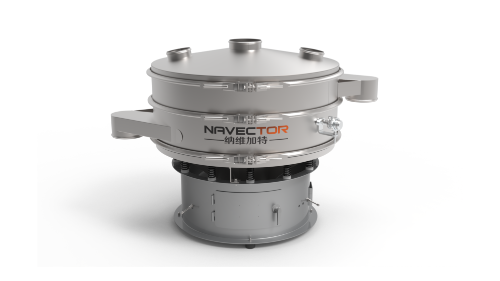
V. Technical Solution: How Does the High-Speed Sieve Improve Ultrafine Powder Dispersion and Screening?
To address the problems of agglomeration and mesh clogging in ultrafine powders with a D50 particle size below 1 μm, the Navector High-Speed Intelligent Screening Machine mainly improves screening conditions from three aspects: material dispersion, parameter adjustment, and screen performance.
First, low-frequency, high-speed vibration improves material dispersion. The equipment adopts low-frequency, high-speed vibration technology, keeping the material moving rapidly on the screen surface, promoting powder dispersion and effective screening, thereby improving problems such as accumulation and insufficient screening that commonly occur with ultrafine materials.
Second, 0–3000 rpm stepless speed adjustment provides flexible screening parameter control. The screening conditions of different materials are not exactly the same. The equipment can flexibly adjust the operating speed according to material characteristics, allowing the screening parameters to match the actual material conditions.
Finally, high-performance dedicated screen mesh helps stabilize screening. The supporting Maigenaite dedicated screen mesh has a tension force of up to 50 N and a service life 2–3 times that of ordinary screen mesh, helping reduce the impact of mesh clogging and particle lodging on continuous screening.
Therefore, the high-speed sieve does not simply increase the rotational speed. Instead, it improves the overall screening process for ultrafine powder problems such as mesh clogging, poor classification, and insufficient capacity by promoting dispersion through high-speed vibration, adjusting screening conditions through stepless speed control, and assisting screening with dedicated screen mesh.
VI. Suitable Materials and Actual Benefits: Which Powders Are More Suitable for the High-Speed Sieve?
The high-speed sieve is mainly designed for ultrafine powders used in industries such as solid-state batteries, lithium batteries, new materials, electronic materials, and fine chemicals. It is specifically suitable for materials such as sulfide electrolytes, high-nickel single-crystal materials, single-crystal small-particle lithium iron phosphate, and conductive agents. These materials share the common characteristics of relatively fine particle sizes and high requirements for screening accuracy and processing capacity. When existing equipment encounters problems such as mesh clogging, poor classification, or insufficient capacity, the high-speed sieve offers a highly targeted solution.
In terms of equipment performance, the high-speed sieve can achieve a capacity up to 5 times that of ordinary screening machines and 3 times that of traditional small-particle screening machines. The supporting Maigenaite dedicated screen mesh has a service life 2–3 times that of ordinary screen mesh. The equipment also supports 0–3000 rpm stepless speed adjustment, making it easier to adjust screening parameters according to different material characteristics.
The high-speed sieve is more suitable for production scenarios with high requirements for the screening accuracy, stability, and processing capacity of ultrafine powders. Specific equipment configurations and screening performance should be confirmed through testing with the actual material.
VII. Equipment Selection Recommendations: Identify the Material Problem First, Then Determine the Screening Solution
When selecting screening equipment for solid-state battery sulfide electrolytes, it is not enough to look only at the material name. More importantly, the particle size range and existing screening problems need to be identified.
First, consider the target particle size. If the material is an ultrafine powder with a D50 particle size below 1 μm and also has problems such as mesh clogging, poor classification, or insufficient capacity, the high-speed sieve can be considered as a priority.
Second, examine the actual screening conditions. If the material is prone to agglomeration and lodging during screening, resulting in insufficient screening, it is also necessary to evaluate the equipment's ability to improve material dispersion and screening conditions.
Finally, determine the solution through actual material testing. The high-speed sieve supports 0–3000 rpm stepless speed adjustment, allowing the operating speed to be adjusted according to different material characteristics. The specific screen mesh specifications and operating parameters should be determined based on the actual screening performance of the material.
VIII. FAQ: Frequently Asked Questions About Screening Solid-State Battery Sulfide Electrolytes
1.Why are sulfide electrolytes prone to mesh clogging?
This is mainly related to their ultrafine particle size and agglomeration. During screening, ultrafine particles are prone to agglomeration and lodging, with some particles remaining in the screen openings. This reduces the effective open area of the screen and consequently affects subsequent screening.
2.What problems does the high-speed sieve mainly solve?
The high-speed sieve mainly addresses mesh clogging, poor classification, and insufficient capacity when screening ultrafine powders with a D50 particle size below 1 μm. It improves the movement state of materials on the screen surface through low-frequency, high-speed vibration, promoting powder dispersion and screening.
3.How can you determine whether the high-speed sieve is suitable?
If existing equipment has long-term problems with ultrafine powder mesh clogging, unclear classification, or insufficient processing capacity, the high-speed sieve can be evaluated as a potential solution. Specific screen mesh specifications and operating parameters should be determined through testing with the actual material. Existing small-particle screening machines can also be upgraded by replacing the stepless variable-speed motor and control system.
Ultrafine powder screening is not about how high a vibration intensity the equipment can achieve. What matters is whether the material, screen mesh, and operating conditions can maintain a reasonable match. As solid-state battery materials continue to move toward finer particle sizes, screening is no longer simply a matter of particle size separation. It has become a key process affecting powder classification stability and production continuity. Truly mature screening technology is not simply about pursuing “higher speed,” but about making ultrafine powder screening more stable and accurate while making subsequent production more controllable.


 English
 中文
中文 Español
 ภาษาไทย
 Pусский
 Bahasa Indonesia
 Tiếng Việt