Feed pellet screening needs to balance throughput, grading accuracy, and pellet integrity. During screening, the movement of material across the screen surface, residence time, and screen mesh cleanliness all affect actual operating performance. If screening efficiency is unsatisfactory, simply extending equipment operating time may not solve the problem. Material properties and screening methods must also be taken into account.
The Navector NTS Series Gyratory Screener is designed for high-throughput, high-precision screening of granular materials and can be used for fine screening in the feed industry. Starting with its technical principles, this article examines the screening capabilities and applicable conditions of gyratory screening, as well as how it supports fine grading of feed pellets.
I. What Factors Affect Feed Pellet Screening Performance?
Feed pellet screening typically involves particle size classification, the separation of foreign matter or nonconforming pellets, and the differentiation of materials with different specifications. In production, three key aspects require particular attention.
Whether the throughput meets production requirements. When screening volumes are high, the equipment needs sufficient effective screening area and must maintain an appropriate material movement pattern across the screen surface. Uneven material distribution or insufficient utilization of the screen surface may reduce actual processing capacity.
Whether grading results remain consistent. Screening equipment needs to ensure sufficient contact between particles of different sizes and the screen mesh. Excessively rapid material movement or uneven distribution may reduce the opportunities for particles to pass through the apertures. For production processes requiring separation into multiple size grades, the equipment must also meet the corresponding classification requirements.
Whether pellet integrity is maintained. Pellet breakage during screening must be evaluated by considering pellet strength, moisture content, equipment motion, and actual operating parameters. When selecting equipment, attention should be paid to whether the screening motion is suitable for the material. Tests should be conducted to examine pellet conditions before and after screening, as breakage cannot be assessed based on equipment type alone.
II. What Screening Requirements Are Suited to the Motion of the NTS Series Gyratory Screener?
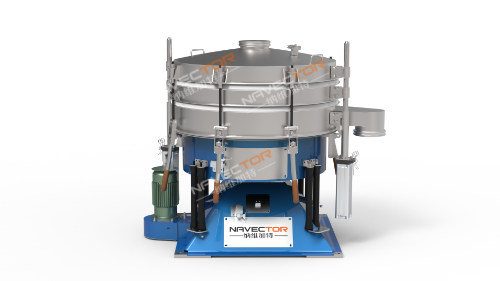
The Navector NTS Series Gyratory Screener is a circular screening machine designed for high-throughput, high-precision screening of granular materials. It simulates manual sieving by adjusting the eccentricity, radial motion, and tangential angle to combine circular motion with upward parabolic motion. This creates a three-dimensional tumbling trajectory that combines horizontal movement and throwing motion across the screen surface.
After entering the machine, material spreads outward from the center of the screen surface toward the periphery and moves axially along a spiral trajectory, undergoing screening as it travels. This motion provides a continuous screening path for granular materials. For feed pellets, achieving an appropriate balance between grading performance and pellet integrity requires evaluation through material testing and operating parameter adjustments.
The NTS Series Gyratory Screener has a screening diameter of up to 3,000 mm, providing a large screening area for high-throughput applications. According to the product specifications, screening efficiency can reach 95%–99%, and the machine supports separation into 1–6 grades, making it suitable for granular materials requiring multiple size classifications. Actual efficiency remains dependent on material properties, screen mesh configuration, and feed conditions. The stated specifications should not be equated directly with the actual performance of a specific feed production line.
If screen mesh cleaning is a challenge, the NTS Series Gyratory Screener can also be equipped with an ultrasonic system. By transmitting high-frequency ultrasonic waves to the screen mesh, the system enhances screen cleaning and improves screening efficiency. Whether this configuration is necessary should be determined based on screen blinding conditions and test results.
III. What Conditions Should Be Checked When Selecting the NTS Series Gyratory Screener for a Feed Production Line?
Selecting a gyratory screener for a feed production line requires more than simply considering the equipment diameter or number of screen decks. The key is whether the equipment can meet the actual screening requirements. Selection can be assessed step by step from three perspectives: screening objectives, equipment configuration, and production line conditions.
1. Define Pellet Specifications, Throughput, and Grading Requirements
Before selecting equipment, determine the particle size range of the feed pellets, the target throughput, the particle size ranges to be separated, and the acceptable proportion of broken pellets in the finished product. These factors guide the selection of screen aperture size, number of grading decks, and equipment specifications.
If the production line needs to separate material into multiple size grades, the screening requirements for each grade must also be clearly defined. The NTS Series Gyratory Screener supports separation into 1–6 grades. The specific configuration should be determined according to grading requirements and material flow rate, rather than judging suitability solely by the number of decks.
2. Check Screen Mesh and Cleaning Configurations According to Material Conditions
Screen mesh specifications must match the target particle sizes, and the screening area must be sufficient to handle the expected throughput. The NTS Series Gyratory Screener has a screening diameter of up to 3,000 mm. However, equipment dimensions alone do not determine the actual capacity for a specific material. Material testing is still required for confirmation.
3. Check Compatibility with the Existing Production Line
Equipment selection must also account for available installation space, feed and discharge positions, screen mesh replacement and routine maintenance requirements, as well as the processing capacities of upstream and downstream equipment. For projects involving integration into an existing production line, equipment interfaces and production line operating schedules should be checked in advance to avoid mismatches between the screening machine and adjacent processes. Supporting requirements, including sealing, cleaning, and dust collection, should also be evaluated in accordance with the on-site process and production management standards. Confirming these conditions during the selection stage helps reduce adjustments after equipment installation.
Actual equipment selection should be based on process requirements and material testing. Once the screening objectives are defined, the screen mesh, number of grading decks, and equipment specifications can be determined. Installation conditions and supporting systems should then be checked to assess how well the gyratory screener fits the feed production line.
IV. Which Industries and Materials Are Suitable for Gyratory Screening?
Gyratory screeners are widely used in the chemical, food and flavoring, new materials, plastics, mining, pharmaceutical, metallurgical, rubber, animal feed, fertilizer, sugar processing, salt processing, resource recycling, woodworking and plywood, glass microsphere, and silicon metal industries. They are suitable for screening fine and ultrafine powders and granular materials.
In actual production, gyratory screening suitability can be evaluated according to material properties and production requirements, whether the application involves particle size classification of food ingredients, fine screening of chemical powders, or the screening of mineral particles, plastic granules, and feed pellets. For applications involving high screening volumes, fine grading requirements, or challenging material screening conditions, the Navector NTS Series Gyratory Screener can serve as a reference option during equipment selection.
Feed pellet screening involves multiple requirements, including throughput, grading accuracy, pellet integrity, and screen mesh cleanliness. The NTS Series Gyratory Screener uses a three-dimensional tumbling motion that simulates manual sieving and can be equipped with an ultrasonic system according to material conditions, providing an equipment option for high-throughput granular material screening.
For a specific feed production line, equipment suitability must ultimately be evaluated against the material itself, the required pellet size grades, the target throughput, and whether persistent screen blinding occurs on-site. By translating these requirements into screen mesh configurations, equipment specifications, and actual test results, a more accurate assessment can be made of how well the gyratory screener matches the production process.
 English
 中文
 Español
 ภาษาไทย
 Pусский
 Bahasa Indonesia
 Tiếng Việt