Graphite is an important component of lithium-ion battery anode materials. Its particle size distribution and impurity control are closely related to the processing quality of anode materials. During production, graphite powder needs to undergo screening to separate particles that do not meet the required particle size specifications, providing relatively consistent raw materials for subsequent processing.
Screening ultrafine graphite powder is often challenging. Some materials have strong adsorption properties and are prone to agglomeration. They may also be affected by factors such as static electricity, resulting in particles adhering to the screen surface or becoming trapped in the mesh openings. The higher the mesh count, the smaller the openings, and the more pronounced these problems become. When materials cannot pass through the screen smoothly, screening efficiency and continuous operation can easily be affected.
To address screen clogging and separation difficulties in fine powder screening, ultrasonic vibrating screens combine an ultrasonic system with mechanical vibration. By improving material movement across the screen surface through high-frequency vibration, they provide a fine screening solution for difficult-to-screen materials such as graphite powder.
I. What Are the Main Challenges in Screening Ultrafine Graphite Powder?
The difficulty of screening graphite powder primarily comes from the characteristics of the particles themselves. Fine powder particles are easily affected by interparticle forces, static electricity, and adsorption, which can lead to adhesion and agglomeration. Some particles may also adhere to the screen surface or become trapped in the mesh openings, preventing them from passing through smoothly and reducing the effective screening area.
Agglomeration can also affect particle size classification. When multiple fine particles gather together, the equipment may encounter them as larger agglomerated particles, potentially interfering with the actual screening results. For lithium battery graphite powder that requires precise particle size distribution control, these conditions increase the difficulty of maintaining a consistent screening process.
Screen mesh count is another factor to consider. High-mesh screens have smaller openings and place greater demands on material dispersion and screen-cleaning performance. If particles continuously adhere to or block the mesh, the openings gradually become obstructed, making it difficult for materials to pass through. The equipment may also need to be stopped for cleaning.
II. How Does an Ultrasonic Vibrating Screen Improve Graphite Powder Screening?
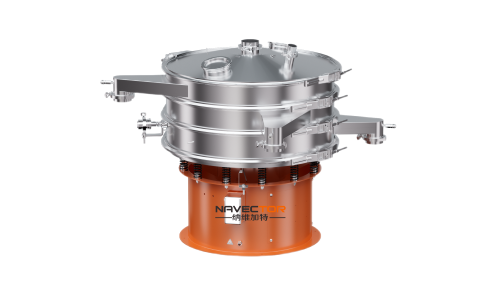
An ultrasonic vibrating screen is a fine screening device developed on the basis of conventional vibrating screens. It combines an ultrasonic system with mechanical vibration and is primarily designed to address screen clogging and separation difficulties during fine powder screening.
During operation, high-frequency, low-amplitude ultrasonic vibration waves are superimposed on the screen mesh, generating greater ultrasonic acceleration for ultrafine powder on the screen surface. The materials remain in a suspended state across the screen surface, helping suppress factors that interfere with screening, such as particle adhesion, friction, settling, and mesh blockage. This improves screening efficiency and screen-cleaning performance.
This principle is suitable for certain ultrafine graphite powder screening applications. Ultrasonic vibration can reduce particle adhesion to the screen surface and the risk of mesh blockage, helping maintain good operating conditions and allowing materials to pass through the mesh openings more smoothly. For difficult-to-screen powders with strong adsorption properties, a tendency to agglomerate, or high static electricity, the equipment can improve screening conditions. However, actual performance still needs to be verified based on material characteristics and process requirements.
In terms of equipment specifications, Navector's ultrasonic vibrating screens have a conventional screening range of 2–400 mesh and are suitable for powders such as graphite, carbon powder, and battery materials. The screening process does not alter the material properties. The equipment operates at a low and stable temperature without causing localized temperature increases, supporting continuous operation.
III. What Should Be Considered When Selecting Screening Equipment for Lithium Battery Graphite?
Whether an ultrasonic vibrating screen is suitable for a specific graphite powder production process cannot be determined by screen mesh count alone. Material characteristics and production conditions must also be considered.
First, clarify the screening objectives. Different graphite products have different requirements for particle size ranges and classification results. Before selecting equipment, it is necessary to understand the material's particle size distribution, target particle size, processing capacity, and screening accuracy requirements before determining the screen configuration. Simply increasing the screen mesh count does not guarantee the expected screening results.
Second, consider the material characteristics. The adsorption properties, degree of agglomeration, and electrostatic characteristics of graphite powder all affect its movement across the screen surface and its ability to pass through the mesh. For materials that are prone to adhesion and screen clogging, particular attention should be paid to how effectively the ultrasonic system improves screen-cleaning performance. Actual sample testing can then be used to evaluate equipment suitability.
Production continuity is another important consideration during equipment selection. For lithium battery material production lines that require long operating hours, equipment operating temperature, screen-cleaning performance, and continuous screening stability are all worth evaluating. Only when equipment operating conditions match the production schedule can the impact of the screening stage on overall production be minimized.
Before finalizing the equipment selection, it is recommended to provide actual graphite powder samples for screening tests. By observing material passage, classification results, and operating conditions under different screen configurations, the appropriate equipment model and specific solution can be determined. This approach is more reliable than selecting equipment solely based on specification sheets.
IV. Conclusion: Stable Material Passage Is Key to Fine Graphite Powder Screening
During ultrafine graphite powder screening, particle adhesion, agglomeration, and mesh blockage are common factors affecting screening performance. By superimposing high-frequency, low-amplitude vibration waves on the screen mesh, ultrasonic vibrating screens improve material movement across the screen surface and reduce interference from factors that cause screen clogging. This provides an equipment option for the fine screening of graphite and other battery materials.
Navector specializes in the research, development, and application of screening technologies and related equipment. Its product range includes ultrasonic vibrating screens, gyratory swing screens, and negative-pressure airflow screens. For specific production projects, it is recommended to begin with material testing and comprehensively evaluate screening accuracy, processing capacity, and continuous operating performance before determining the appropriate equipment and process configuration.
 English
 中文
 Español
 ภาษาไทย
 Pусский
 Bahasa Indonesia
 Tiếng Việt