Washing powder is a common household chemical product. Its manufacturing process involves raw material mixing, granulation, and subsequent screening. Screening is primarily used to separate oversized particles and remove foreign matter, directly affecting the uniformity of the finished granules and the stability of subsequent production.
Washing powder generally contains both granules and powder. Lumps or particles that do not meet requirements may occur during production. If the screening equipment lacks sufficient capacity, material can accumulate at the screening stage. An unsuitable equipment structure or poor integration with the production line can also make feeding, discharge, and routine cleaning inconvenient. For chemical manufacturers operating continuous production lines, screening equipment must meet oversized-particle separation requirements while also taking installation space, discharge method, and ease of maintenance into account.
A direct discharge screen is a low-profile, multipurpose screening machine that can be used for granular materials such as washing powder. It is suitable for processes including foreign-material removal, oversized-particle separation, and uniform feeding. What are its structural and operating characteristics? How should it be selected for a washing powder production line?
I. What Screening Problems Need to Be Addressed in Washing Powder Production?
Screening in washing powder production generally involves removing agglomerated particles, separating oversized particles that do not meet specifications, and intercepting foreign matter mixed into the material. Requirements vary between production stages: some processes focus on oversized-particle separation, while others place greater emphasis on smooth material discharge and integration with upstream and downstream processes.
Washing powder contains both granules and powder, and its material condition is not completely uniform. If the feed rate does not match the screening capacity, material distribution across the screen surface and the discharge rhythm may be affected. For large-scale production lines, equipment capacity, discharge method, and installation space all need to be considered.
In addition, equipment cleaning and maintenance must be considered at the washing powder production site. If screening equipment is difficult to dismantle or its internal structure makes cleaning difficult, routine maintenance will add to the operators’ workload. Screening washing powder therefore requires more than simply checking the mesh size; the suitability of the equipment structure must also be assessed in relation to the specific process.
II. Operating Principle and Structural Features of the Direct Discharge Screen
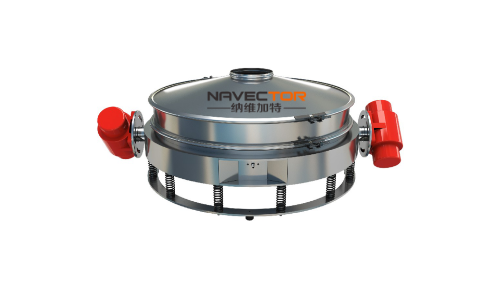
The direct discharge screen is a low-profile, multipurpose screening machine designed for industrial production. Its screening mode can be adjusted according to material characteristics and process requirements. It is suitable for foreign-material removal, oversized-particle separation, buffering, uniform feeding, and mixing.
The machine generates excitation force through a vibration motor. Two sets of eccentric weights mounted at the upper and lower ends of the motor shaft convert the motor’s rotary motion into various forces, including horizontal, vertical, inclined, and centrifugal forces. These forces are transmitted to the screen surface, causing the material to move across it and undergo screening. Adjusting the phase angle and weight of the upper and lower eccentric blocks changes the magnitude of the excitation force and the material’s movement path to suit the screening requirements of different materials.
One structural feature of the direct discharge screen is that screened material can be discharged directly downward from the center of the machine, making it easier to connect with the production line. Direct discharge can also help increase production throughput. In washing powder production, this discharge method can be used for oversized-particle separation and foreign-material interception. The actual results depend on the feed condition and equipment configuration.
The machine has a low-profile, compact structure, making it suitable for sites with limited installation space and easy to move. Its fully enclosed design helps reduce dust escape. It operates with relatively low noise and energy consumption. The machine is easy to dismantle and assemble, and both its interior and exterior are easy to clean, with no obvious hard-to-clean areas. This helps reduce the workload associated with routine cleaning and maintenance.
III. How Can a Direct Discharge Screen Be Matched to a Washing Powder Production Line?
Whether a direct discharge screen can meet washing powder production requirements must be assessed in light of the screening objective, material condition, and production-line conditions.
The screening task should be defined first. If the main purpose is to remove oversized or agglomerated particles from washing powder, the size of the particles to be retained should be specified, and the screen mesh should then be selected according to the screening target. Aperture size affects how material passes through the screen. Choosing a smaller aperture alone is not sufficient; the actual feed rate and discharge condition must also be considered.
The equipment’s processing capacity should then be checked. The applicable particle-size range of the direct discharge screen is 1 micrometer to 20 millimeters, and its feed rate ranges from 1 kilogram per hour to 10 tonnes per hour, depending on the machine size. These ranges can serve as an initial reference for selection. Actual production capacity must be confirmed through sample testing, taking into account the particle condition of the washing powder, feeding method, and target screening requirements.
Installation conditions should also be confirmed in advance. The direct discharge screen has a low-profile, compact structure and is suitable for production sites with limited space. Screened material is discharged downward from the center, facilitating connection to the production line. During project planning, the available height, inlet and outlet positions, and layout of upstream and downstream equipment should be checked to ensure that the machine can be integrated smoothly into the existing process.
For production stages that require frequent cleaning, attention should also be paid to the ease of dismantling the equipment and cleaning its interior. The direct discharge screen is easy to dismantle and its interior and exterior are easy to clean, making maintenance convenience a relevant factor in equipment selection.
IV. What Capabilities Should a Direct Discharge Screen Supplier Have?
Screening equipment should not be selected solely on the basis of product specifications. For a specific material such as washing powder, it is advisable to define the target particle size, processing capacity, feeding method, and site installation conditions before arranging tests with the actual material.
During testing, key points to observe include the interception of oversized particles, the passage of qualified material, and the equipment’s discharge condition. These results should be considered alongside the production cycle to determine whether the equipment is suitable for the current process. For a new production line or equipment replacement project, the machine dimensions, inlet and outlet positions, and available site space should also be checked in advance to reduce problems during installation and integration.
The supplier’s product experience and technical service are equally important. The ability to conduct screening tests based on material characteristics and determine equipment configurations in light of production-line conditions will affect the equipment’s performance after installation. Navector (Shanghai) Screening Technology Co., Ltd. has long been engaged in the research, development, and application of screening equipment and related technologies. It can provide screening tests and equipment selection support based on customers’ materials and production requirements.
V. Conclusion: Adapting Screening Equipment to the Production Process
Separating oversized particles and removing foreign matter in washing powder production requires appropriate screening capacity, as well as consideration of the discharge method, installation space, and routine cleaning and maintenance. The direct discharge screen features a low-profile structure and adjustable screening modes. Screened material is discharged downward from the center of the machine, making it suitable for screening granular materials such as washing powder.
For chemical manufacturers, equipment selection should begin with a clear screening objective. The configuration should then be determined based on material testing, processing capacity, and site layout. Matching equipment specifications to actual production conditions helps screening become an effective part of the entire production line.
 English
 中文
 Español
 ภาษาไทย
 Pусский
 Bahasa Indonesia
 Tiếng Việt