I. What Is the Working Principle of This Equipment?
When walking into a lithium battery material screening workshop, situations like this are often seen: material discharge is relatively smooth when the equipment is first started, but after continuous operation for a period of time, fine powder gradually begins to “hang” on the screen mesh, while some particles repeatedly bounce around near the mesh openings without passing through. Operators can only stop the machine to knock and clean the screen, interrupting the production rhythm. This becomes even more noticeable when processing 20–300μm fine powders such as lithium iron phosphate and high-nickel materials, where electrostatic adsorption and slight agglomeration are more likely to occur.
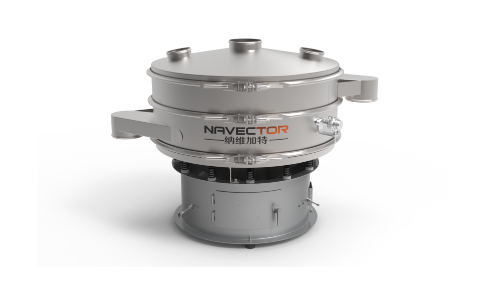
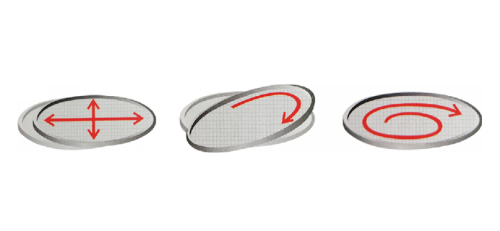
The Navector lithium battery industry dedicated small particle screening machine is specifically designed for these working conditions. The equipment adopts ultrasonic screening technology combined with both 3D vibration and gyratory vibration modes, allowing materials to move across the screen surface not just in a simple “up-and-down” motion, but in a more uniform three-dimensional movement trajectory. As a result, fine powders remain continuously dispersed on the screen surface, reducing localized accumulation and minimizing particles becoming trapped in the mesh openings.
During actual operation, the ultrasonic system continuously transmits high-frequency micro-vibrations to the screen mesh, helping fine powders attached to the mesh surface loosen in time. For lithium battery materials with strong adsorption tendencies and high static generation, this method can effectively reduce screen blockage and mesh blinding. Many on-site operators notice the difference quite directly: in the past, after running for a period of time, the screen surface would gradually become “sluggish,” whereas now material passing becomes more uniform, and the frequency of shutdowns for screen cleaning is reduced.
Compared with traditional vibrating screens, this compound motion mode is more suitable for long-term continuous processing of fine powders, especially under 50–635 mesh fine screening conditions, where both screening efficiency and operational stability can be maintained.
II. Why Can It Solve Agglomeration Problems?
In many lithium battery material production workshops, the biggest concern for operators is often not that the equipment “cannot screen,” but that the screening condition becomes unstable. Fine powders such as lithium iron phosphate and lithium cobalt oxide can gradually begin to agglomerate after several hours of continuous production due to static electricity, slight moisture absorption, or increased powder adhesion. Initially, only localized slowing of material discharge may occur, but eventually powder accumulation, mesh blockage, and even shutdowns for cleaning can become necessary. This issue becomes even more obvious when processing 20–300μm small particle powders.
When designing the Navector lithium battery industry dedicated small particle screening machine, special attention was paid to this “long-term operational stability” problem. The equipment adopts ultrasonic screening technology combined with 3D vibration and gyratory vibration modes. As materials pass across the screen surface, mildly agglomerated particles can be continuously dispersed, reducing powder buildup and mesh plugging.
Many customers have reported after practical use that, in the past, the phrase they feared hearing most during production was “the screen is clogged again.” Now, the screening rhythm has become much more stable, and screen service life has also been extended. For continuous production lines, reducing downtime is often more important than simply increasing instantaneous output.
III. Who Needs This Equipment Most?
Currently, this equipment mainly serves three core groups:
① Cathode material manufacturers, for classification after precursor drying to ensure a more uniform powder particle size distribution;
② Electrode slurry manufacturers, using stable screening to reduce coarse particles and oversized particles entering the slurry system, thereby improving the stability of subsequent coating processes;
③ Lithium battery recycling companies, for processing mixed materials after electrode sheet crushing, improving powder recovery efficiency and purity.
Trial production data from a leading power battery manufacturer showed that after introducing this equipment, the sedimentation rate of cathode material slurry decreased by 42%, while electrolyte consumption during the liquid injection process was reduced by 18%. In many cases, screening may appear to be just a “small step” on the production line, but its influence on downstream process stability is often much greater than expected.
IV. Which Production Stages Can Use This Equipment?
In cathode material production processes, this equipment can be applied at three key stages:
① Primary screening after precursor calcination, where particle size spans are relatively large and preliminary classification of mixed materials within the 5–200μm range is required;
② Fine classification after coating modification, ensuring coating layer thickness uniformity;
③ Quality inspection before finished product packaging, where many manufacturers use different mesh sizes to reclassify fine powders and abnormal particles, maximizing final product consistency.
Beyond the lithium battery industry, this type of equipment also performs well in lightweight powder applications. A photovoltaic silicon powder manufacturer reported that when processing lightweight silicon powder, adjusting the vibration amplitude parameter (0.5–2 mm) increased screening efficiency to 2.8 times that of traditional screening machines.
V. Under What Conditions Does It Perform Better Than Traditional Screens?
This type of equipment is more suitable for processing fine powders with strong adsorption, high static electricity, and easy agglomeration tendencies, especially during the screening of 20–300μm lithium battery materials.
For example, in many lithium battery material workshops, screening is usually normal when the machine first starts operating. However, after several hours of continuous operation, fine powders such as lithium carbonate and high-nickel materials may gradually become sticky and accumulate on the screen mesh due to moisture absorption, static electricity, or mild agglomeration. Eventually, not only does material discharge slow down, but mesh blockage and particle plugging are also likely to occur. These issues become even more obvious in high-temperature and high-humidity summer environments.
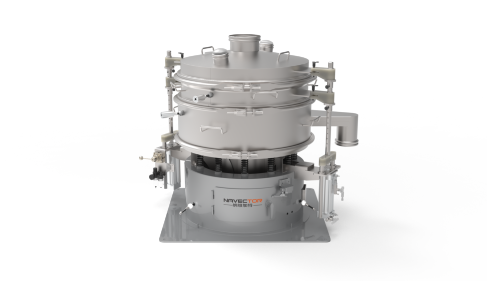
The Navector lithium battery industry dedicated small particle screening machine adopts ultrasonic screening technology combined with 3D vibration and gyratory vibration modes, allowing materials to maintain a more uniform movement state on the screen surface and effectively reducing fine powder accumulation and mesh blockage.
For working conditions requiring long-term continuous production, the overall operating temperature rise of the equipment remains relatively low, and the screening condition becomes more stable. Many on-site operators clearly feel that, in the past, they constantly had to keep an eye on the screen mesh, whereas now they no longer need to repeatedly run over and knock the screen every few hours.
VI. How Do You Choose the Right Model for Your Material?
Lithium battery material screening model selection usually requires comprehensive evaluation based on material characteristics, processing capacity, and on-site production processes.
First are the material characteristics. Fine powders such as lithium carbonate and high-nickel materials, which easily absorb moisture and agglomerate, are more suitable for models equipped with ultrasonic screening systems to reduce mesh blockage and powder accumulation problems;
Second is processing capacity. Different screen surface sizes and single-layer or multi-layer screen configurations directly affect screening capacity and accuracy. For working conditions requiring simultaneous control of coarse particle and fine powder proportions, multi-layer screen solutions are usually adopted to improve particle size classification consistency;
Finally, on-site production processes must also be considered comprehensively. During actual model selection, many companies focus more on whether the equipment can maintain long-term stable operation rather than only short-term output. Especially in 20–300μm fine powder screening scenarios, whether the equipment is prone to mesh blockage and whether screen service life remains stable are often more important than parameters alone.
If you are currently experiencing issues such as fine powder mesh blockage, agglomeration, or unstable screening efficiency, you can also contact us at 15601937055 to schedule a free material testing appointment. In many cases, running an on-site material test is far more intuitive than simply reviewing technical parameters.
 English
 中文
中文 Español
 ภาษาไทย
 Pусский
 Bahasa Indonesia
 Tiếng Việt