“Many microsphere problems are not caused by the inability to screen them out, but because they are ‘damaged’ during filtration, washing, and dewatering.” In bioprocessing and medical aesthetic microsphere production, this statement is frequently mentioned by process engineers. Especially after polymer microspheres enter the wet slurry stage, the real challenge is often not simply “screening them out,” but how to continuously complete filtration, washing, dewatering, and drying without contamination, agglomeration, or damage to particle size distribution.
Many workshops have experienced similar situations: the polymerization reaction stage goes smoothly, but once the process reaches downstream separation, the material starts “causing trouble” — today the mesh clogs, tomorrow the material agglomerates, and the next day the dried product shows poor flowability. Engineers spend hours troubleshooting the equipment, only to realize that the issue is often far more complicated than simply “low screening efficiency.”
I. Why Do Polymer Microspheres Always Encounter Problems During Separation?
In the production of medical aesthetic microspheres, drug delivery microspheres, and functional polymer beads, materials usually exist in the form of wet slurry. The slurry not only contains water or organic solvents, but may also carry fine particles, residual monomers, and polymer systems with a certain level of viscosity. Many production lines still rely on centrifugal separation, bag filtration, or step-by-step transfer drying processes, so most problems tend to concentrate during the solid-liquid separation stage.
First, microsphere particle sizes are becoming increasingly fine. Some medical aesthetic microspheres have already entered the range of several tens of microns or even smaller. Fine particles tend to form dense filter cakes on the filter surface. The equipment may operate smoothly at startup, but after running for some time, the liquid permeation rate begins to decrease significantly, and filtration resistance continuously increases.
Second, materials are more likely to agglomerate under high liquid-content conditions. Microsphere surfaces inherently possess certain adhesive properties. When slurry remains stationary or accumulates locally, liquid bridges easily form between particles, and after drying, these bridges further develop into hard agglomerates, affecting flowability and dispersion performance.
Another issue is contamination risk caused by intermediate transfer. Especially in medical aesthetics and bioprocessing workshops with high cleanliness requirements, workflows such as “transferring to barrels after filtration and transporting again after drying” usually mean longer exposure times and greater manual involvement.
Therefore, for many microsphere production lines, the real challenge is not simply “whether screening is fast enough,” but whether filtration, washing, dewatering, and drying can be completed continuously within a sealed environment.
II. Why Do Traditional Filtration Systems Become More Prone to Clogging Over Time?
Wet microsphere slurry differs from ordinary powder because it combines characteristics of both liquid filtration and fine particle separation, resulting in much higher requirements for equipment stability.
Traditional centrifugal equipment mainly relies on high-speed rotation for solid-liquid separation. However, when microsphere particle sizes are very fine, some particles can easily penetrate into the filter media. After long-term operation, gradual clogging occurs, resulting in increased filtration resistance and reduced throughput.
Under high liquid-content conditions, ordinary vibrating screens are more likely to experience mesh blinding. After wet microspheres enter the screen surface, liquid surface tension continuously causes fine particles to accumulate around the mesh openings. When particle size approaches mesh aperture size, “wedging” phenomena may also occur, leaving the mesh in a semi-blocked state.
At the same time, polymer microspheres themselves possess certain adhesive properties, causing fine particles to attach to the screen surface and further reduce the effective open area. This is why many medical aesthetic microsphere production sites often encounter situations where “the mesh clogs again shortly after cleaning.”
III. Why Is Transfer-Free Filtration Becoming Increasingly Important?
In recent years, many companies in the bioprocessing industry have started paying attention to “closed-loop microsphere separation.” The reasons are very practical. Once materials are repeatedly transferred between filtration, washing, and drying stages, production risks increase significantly, including:
Wet microspheres may absorb moisture or become contaminated after exposure to air;
Manual transfer can easily cause batch loss;
Agglomeration affects subsequent dispersion performance;
Microsphere particle size distribution may be damaged;
Sterile workshop management becomes more difficult.
Especially for medical aesthetic microsphere products, consistency in particle size distribution and flowability are critical. Many companies are ultimately concerned not with “whether filtration is possible,” but with “whether the microsphere condition can remain stable after filtration.” Some products may appear normal immediately after screening, but during downstream dispersion or filling processes, agglomeration, sedimentation, or poor flowability problems begin to appear.
IV. Sterile Integrated Microsphere Separation Is Replacing Traditional Processes
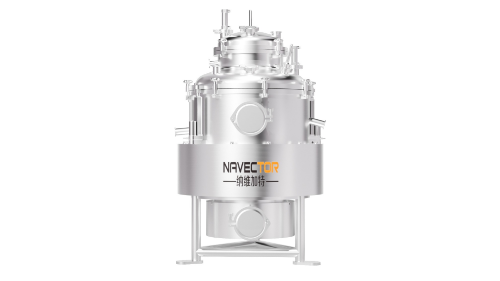
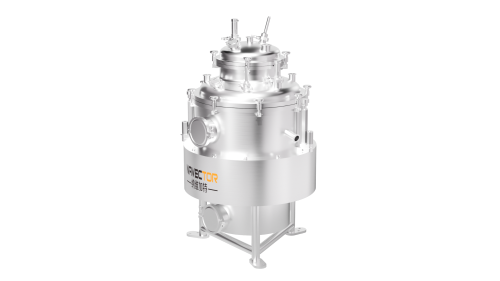
To address clogging and agglomeration issues during wet microsphere filtration, dewatering, and drying, some bioprocessing production lines have begun adopting sterile integrated separation solutions. The focus of this type of equipment is not simply increasing vibration intensity, but integrating filtration, washing, dewatering, and drying into a single sealed system to reduce intermediate transfer and manual intervention.
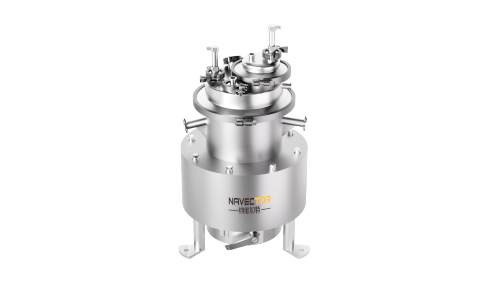
Taking the Navector microsphere screening solution as an example, the equipment combines centrifugal separation, negative-pressure fluid separation, and ultrasonic vibration to achieve continuous wet microsphere processing. Compared with traditional mechanical stirring methods, this type of system minimizes mechanical shear on microspheres as much as possible, avoiding particle damage or changes in particle size distribution.
Among these technologies, ultrasonic vibration mainly acts on the interface between the screen mesh and particles. It is not simply “shaking materials downward,” but rather using high-frequency micro-vibrations to reduce particle accumulation and mesh blockage while lowering the probability of liquid bridge formation, thereby mitigating agglomeration issues.
Many production sites discover that even after the same dewatering process, microspheres produced by different equipment systems can show significant differences in condition. Some easily form wet lumps or hard agglomerates, while others maintain relatively good flowability. The difference usually lies in the downstream separation and drying methods.
V. Which Industries Are Beginning to Use Integrated Microsphere Screening Equipment?
Currently, this type of microsphere screen and sterile medical aesthetic microsphere screening equipment is mainly used in the following process scenarios:
Bioprocessing microsphere carrier separation;
Medical aesthetic filler microsphere screening;
Drug sustained-release microsphere filtration;
Polymer resin bead dewatering;
Functional material microsphere washing and drying;
Laboratory-scale microsphere process scale-up.
These materials usually share several common characteristics: fine particles, high liquid content, easy agglomeration, sensitivity to contamination, and strict requirements for particle size integrity.
VI. Frequently Asked Questions About Microsphere Screening
Question 1: What is the difference between a microsphere screen and a conventional vibrating screen?
Microsphere screens place greater emphasis on wet slurry processing, sterile sealing, and integrated filtration, washing, and drying, while conventional vibrating screens are mainly used for standard powder classification.
Question 2: Why do polymer microspheres easily agglomerate?
This is mainly related to high moisture content, surface adhesion properties, and liquid bridge formation during drying, which makes fine particles prone to agglomeration.
Question 3: Are medical aesthetic microspheres suitable for high-temperature drying?
Some materials may deform, stick together, or undergo structural changes under high temperatures, so many processes adopt low-temperature negative-pressure dewatering methods.
Problems related to polymer microsphere screening often only become fully apparent under real slurry operating conditions. Material moisture content, particle size distribution, slurry viscosity, and agglomeration state changes can all directly affect filtration stability and downstream drying performance.
If you encounter problems during microsphere screening, washing, or dewatering processes, feel free to contact Navector for free material testing and process consultation to obtain customized solutions better suited to actual production conditions.


 English
 中文
中文 Español
 ภาษาไทย
 Pусский
 Bahasa Indonesia
 Tiếng Việt