Screening may seem simple, but it is a process that is easily underestimated in pharmaceutical powder production. Lumps and foreign matter need to be removed, while particle size also needs to be properly controlled; when dealing with lightweight, fine, easily agglomerated powders that are prone to generating static electricity, however, things are not quite so simple. Screening may proceed normally at the beginning, but after running for a period of time, material accumulation, screen adhesion, and blocked apertures may occur, causing the screening rate to decline.
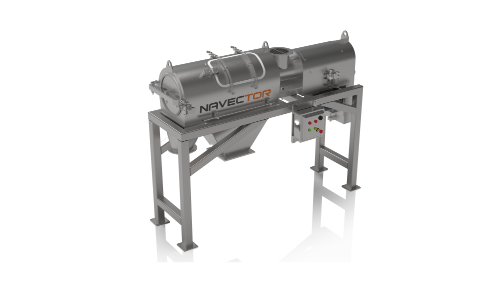
The problem is often not just the screen itself, but changes in the movement state of the material during screening. Traditional mechanical vibration mainly relies on screen movement to achieve separation. For certain fine-powder applications, simply adjusting the vibration parameters may not solve the problem. The NCF Series centrifugal sieve takes a different approach, using airflow, centrifugal force, and cyclonic propulsion to drive material movement and achieve separation, providing another option for fine-powder screening.
I. From “Able to Pass the Screen” to “Continuous Screening”: Why Is Pharmaceutical Powder Screening Important?
Pharmaceutical powder screening performs two basic tasks: first, removing lumps and larger particles formed during production, storage, and conveying; second, separating materials according to particle size requirements so that qualified powder can enter subsequent processes.
For active pharmaceutical ingredients, excipients, and intermediate products, particle size conditions can affect subsequent processing. If screening is inadequate, lumps and larger particles that should be removed are not effectively separated, making it difficult to control particle size requirements; if material accumulation or screen blockage occurs during screening, the screening rate decreases and the production process may also be affected.
Pharmaceutical powder screening needs to achieve two results: whether the material that should be removed can actually be screened out, and whether the material that should pass can continue to pass steadily. The former is related to powder particle size and cleanliness, while the latter is related to screening efficiency and continuous operation. Although this process may seem simple, it provides an important foundation for the smooth progress of subsequent pharmaceutical processing.
II. The Screen Apertures Have Not Changed, So Why Does Screening Become Slower?
Fine-powder screen blockage often starts with particle agglomeration. Lightweight, fine pharmaceutical powders tend to aggregate during conveying and screening. Fine particles that could originally pass through the screen apertures may form agglomerates, affecting screening, while some material begins to remain on the screen surface.
Static electricity can make the situation even more pronounced. When powder generates static electricity during conveying and screening, the adhesion between particles and between the powder and the screen increases. After some fine powder passes through the screen apertures, it may also adhere to the back of the screen and gradually cover the apertures. As the apertures become occupied, the effective open area decreases, and the material passing rate also declines.
In actual screening operations, screen blockage is often a gradual process: particles first agglomerate, static electricity further increases adhesion, and the final result is obstructed apertures and slower screening.
III. Choosing a Screening Method: Why Can't Mechanical Vibration Be the Only Consideration?
Mechanical vibrating screening relies on the movement of the screen surface, allowing the material to continuously contact the screen and achieve separation. Conventional materials can maintain normal screening under this method, but when the material condition changes during operation, simply adjusting the vibration parameters may not maintain stable screening performance. Equipment selection should consider not only screen mesh size and vibration intensity, but also the movement state of the material inside the equipment.
The NCF Series centrifugal sieve adopts a different screening approach. Instead of relying on screen vibration to move the material, it allows the material to enter a cylindrical screen under the combined action of airflow and rotation and then completes separation. The difference can be summarized in one sentence: a vibrating screen drives the screen surface, while a centrifugal sieve drives the material. This change in screening method also provides another option for certain powders whose screening performance is not stable enough with conventional vibrating screens.
IV. Beyond Mechanical Vibration: How Does a Centrifugal Sieve Separate Powder?
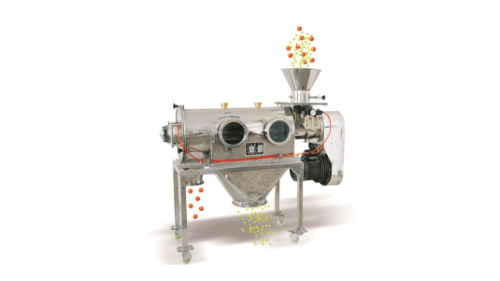
The centrifugal sieve uses a screening method different from that of conventional vibrating screens. Instead of relying on screen vibration to drive material separation, it uses airflow to carry the material into the screen cylinder and utilizes centrifugal force and cyclonic propulsion to complete screening. The key change lies in altering the interaction between the material and the screen.
1. Combining Airflow and Centrifugal Action to Improve Material Separation Efficiency
After entering the screen cylinder through the screw conveying system, the material is thoroughly mixed with airflow. The fan-wheel blades inside the screen cylinder drive the material to rotate, causing the particles to simultaneously experience centrifugal force and cyclonic propulsion. Fine particles that meet the required particle size are driven through the screen and discharged through the fine-material outlet; material that cannot pass through the screen moves along the cylinder wall and is discharged through the coarse-material outlet.
This cylindrical screen structure changes the way the material contacts the screen, allowing the powder to maintain a relatively well-dispersed state during screening and making it more suitable for screening lightweight, fine powders.
2. Equipped with an Ultrasonic System to Assist Screen Cleaning
For certain difficult-to-screen materials, the NCF Series can be equipped with an ultrasonic system. After ultrasonic energy is applied to the screen, it can enhance screen-cleaning performance, reduce particle blockage and aperture clogging, help maintain good screen permeability, and extend screen service life.
3. External Transducer Design to Reduce the Risk of Material Contamination
The NCF Series adopts an external transducer structure. The ultrasonic system does not directly enter the material screening area, avoiding contact between the transducer and the material and reducing the risk of contamination during screening. For the pharmaceutical industry, equipment structure affects not only screening efficiency but also cleanliness requirements during production.
V. Which Pharmaceutical Powders Are More Suitable for Centrifugal Screening?
Whether a pharmaceutical powder is suitable for centrifugal screening cannot be determined solely by particle size. Production conditions provide a more practical basis for judgment: whether the material is lightweight or fine, whether it tends to agglomerate or generate static electricity during screening, and whether screen adhesion, material accumulation, or aperture blockage occurs after extended operation.
For pharmaceutical powders whose screening condition tends to change during operation, the NCF Series centrifugal sieve has strong applicability. In particular, when the material can initially pass through the screen normally but gradually becomes slower as screening continues, it is worth reconsidering the screening method from the equipment perspective.
Specific equipment selection should also take into account material particle size, processing capacity, and screening requirements. Different pharmaceutical powders have different flow characteristics and tendencies to agglomerate, so actual material testing remains an important basis for determining whether the equipment is suitable.
VI. How Can Pharmaceutical Powder Screening Equipment Be Selected Properly?
When selecting screening equipment for the pharmaceutical industry, start with the material and screening objective: whether the purpose is to remove lumps or separate coarse and fine particles; then consider particle size, processing capacity, and whether the material tends to agglomerate or block the screen during screening. Different problems call for different screening methods.
For lightweight, fine, easily agglomerated pharmaceutical powders, if a conventional vibrating screen has difficulty maintaining stable screening performance, an ultrasonic vibrating screen and the NCF Series centrifugal sieve can be further compared. Equipment contact materials, cleaning and maintenance methods, and other factors should also be considered together with pharmaceutical production requirements.
Ultimately, there is no one-size-fits-all answer to equipment selection. Even for the same pharmaceutical powder, changing the particle size, processing capacity, or process conditions may lead to different screening performance. Testing with the actual material is often the most practical step in the equipment selection process.
VII. Frequently Asked Questions About Centrifugal Sieves in the Pharmaceutical Industry
Q1: Why can a centrifugal sieve reduce screen blockage?
The centrifugal sieve uses airflow to carry the material and combines the centrifugal force and cyclonic propulsion generated by the fan wheel for separation. It can also be equipped with an ultrasonic system to enhance screen cleaning, thereby reducing particle blockage and aperture clogging.
Q2: What is the difference between a centrifugal sieve and an ultrasonic vibrating screen?
The two use different screening methods. A centrifugal sieve uses a cylindrical screen and drives material separation through airflow and centrifugal force, making it more suitable for lightweight, easily agglomerated fine powders. An ultrasonic vibrating screen, on the other hand, adds high-frequency, low-amplitude ultrasonic vibration on the basis of mechanical vibration, mainly to improve fine-powder screening and screen blockage issues.
Q3: What should be considered when selecting a centrifugal sieve for the pharmaceutical industry?
In addition to screening accuracy, attention should be paid to the equipment's operating condition under actual working conditions, including processing capacity, target particle size, and screening performance during continuous operation. Equipment materials, cleaning and maintenance, and on-site hygiene requirements should also be considered.
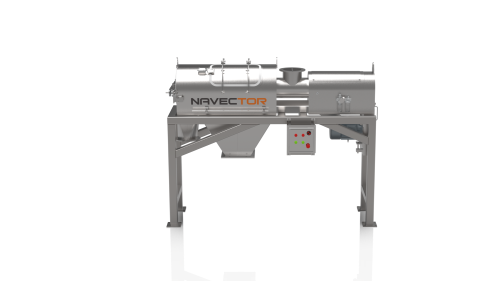
The fact that screening equipment can operate normally at the beginning does not necessarily mean that the entire screening solution is well matched. Once continuous production begins, whether the material condition remains stable and whether the screen can continue to operate normally often provide a better indication. When efficiency declines or operation becomes unstable during screening, instead of continuously adjusting operating parameters, it may be worth reassessing whether the screening method is suitable for the current material.
The NCF Series centrifugal sieve provides a new screening approach for certain complex powder applications. For pharmaceutical companies, equipment selection should ultimately return to the actual material and production conditions. The value of screening equipment lies not only in completing a single screening task, but also in enabling the screening process to operate stably and continuously.
 English
 中文
中文 Español
 ภาษาไทย
 Pусский
 Bahasa Indonesia
 Tiếng Việt