For powders such as powder coatings that are relatively lightweight, prone to agglomeration, and susceptible to static electricity, screening is not simply a matter of separating coarse particles from fine particles. Once the material agglomerates during the screening process, or adheres to the back side of the screen after passing through it, the mesh openings may become blocked, affecting screening efficiency and production continuity.
For this type of screening challenge, traditional methods that rely solely on mechanical vibration are not necessarily suitable for all materials. The Navector centrifugal sieve uses airflow to drive particle separation and combines centrifugal force, cyclonic propulsion, and ultrasonic assistance, providing another approach for the rapid screening of lightweight, fine, and ultrafine powders in the chemical industry.
I. How Does This Equipment Actually Work?
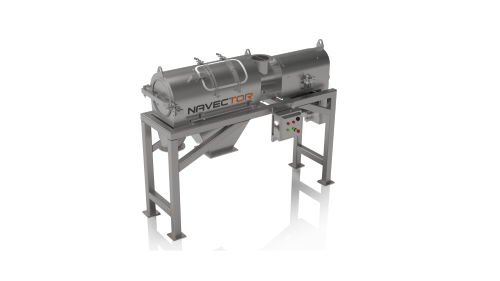
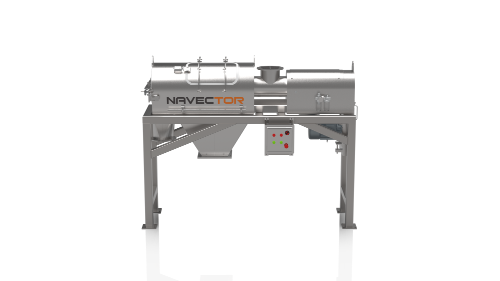
The biggest difference between a centrifugal sieve and traditional flat screening equipment is that it uses a cylindrical screen and relies on the combined action of airflow and mechanical components to separate materials.
The material first enters the equipment through a screw conveying system, where it is mixed and atomized with airflow before entering the screen cylinder. The impeller blades inside the screen cylinder drive the material, causing it to experience both centrifugal force and cyclonic propulsion. Fine material capable of passing through the screen is projected through the mesh and discharged from the fine material outlet, while material that cannot pass through the screen moves along the cylinder wall and is eventually discharged from the coarse material outlet.
This screening method does not simply rely on the vibration of material on the screen surface to achieve separation. Instead, it uses airflow to disperse the material and creates a continuous separation process inside the screen cylinder. For lightweight, fine, and agglomeration-prone powders, this working method can better accommodate their screening characteristics.
At the same time, the equipment can be combined with an ultrasonic system to further improve the processing of difficult-to-screen materials and enhance screen cleaning performance.
II. Why Can It Solve Agglomeration and Mesh Blinding Problems?
During the screening process, chemical powders such as powder coatings often face not only particle agglomeration but also adhesion caused by factors such as static electricity. In particular, when material adheres to the back side of the screen after passing through it, the mesh openings may gradually become obstructed, eventually leading to mesh blinding.
This is exactly the type of problem that a centrifugal sieve is designed to address.
First, after entering the equipment, the material is mixed and atomized with airflow before entering the cylindrical screen, preventing it from remaining on the screen surface for extended periods in a simply accumulated state. Then, under the action of the impeller blades, the material is subjected to both centrifugal force and cyclonic propulsion, continuously driving fine particles toward and through the screen.
Second, the equipment can be combined with an ultrasonic system, making it more effective for difficult-to-screen materials while enhancing screen cleaning performance and reducing the impact of mesh blinding on the screening process.
In addition, for materials that have already formed lumps, the centrifugal sieve can also re-crush the agglomerated material. In other words, it does not only address the problem of material “failing to pass through the screen”; it also considers whether the material can be re-dispersed before reaching the screen. A decline in screening efficiency is sometimes not caused by the screen itself, but because the material has already clumped together before screening even begins.
III. Who Needs This Type of Equipment Most?
Based on the characteristics of materials suitable for the equipment, the centrifugal sieve is better suited for chemical and related powder manufacturers facing the following screening challenges:
The first category is lightweight and fine powders.
During traditional screening, these materials may suffer from insufficient dispersion and difficulty passing through the screen, requiring a screening method better suited to the movement characteristics of fine powders.
The second category is powders prone to agglomeration or static electricity.
When particles agglomerate or adhere to one another, the actual screening behavior of individual particles changes, which can easily affect normal separation. By using airflow to disperse the material and combining it with an ultrasonic system, the centrifugal sieve can help improve the processing of difficult-to-screen materials.
The third category is materials prone to adhesion on the back side of the screen and mesh blinding.
This is one of the key operating conditions targeted by the NCF Series Centrifugal Sieve. When screen cleaning performance is insufficient, the condition of the mesh openings gradually changes. Even if the screening equipment continues operating, the actual screening performance may become increasingly poor.
Therefore, powder coatings are only one representative application. Other lightweight, agglomeration-prone, and static-prone chemical fine and ultrafine powders can also be evaluated based on their specific material characteristics.
IV. Which Production Stages Can It Be Used In?
Based on actual screening requirements, centrifugal sieves can be used in chemical production processes involving the rapid separation of fine and ultrafine powders.
For example, before raw materials enter the next processing stage, screening can be carried out according to production requirements to separate materials that do not meet the target particle size requirements. For powders that become agglomerated during production, the equipment can also be used to re-crush and screen the agglomerated material. During finished product processing, finer powders can be further separated according to process requirements.
For materials such as powder coatings, the specific installation point still needs to be determined based on the actual production process, target particle size, and material condition.
It should be noted that the value of a centrifugal sieve does not lie in replacing all types of screening equipment. Instead, when a material is lightweight, prone to agglomeration, susceptible to static electricity, or likely to cause mesh blinding, it provides the production line with a more targeted solution through a different screening principle. Whether the equipment is suitable ultimately depends on the material, not simply on the fact that “screening” is required.
V. Under What Conditions Is It More Effective Than Traditional Screens?
Not all powders require a centrifugal sieve. Its advantages are mainly reflected in materials that tend to encounter specific problems during traditional screening.
For example, when a material is lightweight and difficult to disperse effectively across the screen surface, a centrifugal sieve uses airflow to drive particle separation, changing the conventional approach of relying solely on mechanical vibration. When a material is prone to agglomeration, airflow mixing and atomization, together with the equipment's ability to re-crush agglomerated material, can help improve dispersion before the material enters the screening state. When a material easily generates static electricity and adhesion, particular attention should be paid to material buildup on the back side of the screen and mesh blinding, while the equipment can be combined with an ultrasonic system to enhance screen cleaning performance.
In addition, for the rapid screening of fine and ultrafine powders, the continuous centrifugal separation and cyclonic propulsion inside the cylindrical screen also give the equipment operating characteristics different from those of traditional flat screens.
Ultimately, selecting screening equipment should not be based simply on comparing which machine “vibrates harder.” Why does the material cause mesh blinding? Where does adhesion occur? Has the material already agglomerated before reaching the screen? Once these questions are clarified, equipment selection is less likely to go in the wrong direction from the very beginning.
VI. How Can You Choose the Right Model for Your Material?
The selection of a centrifugal sieve should begin with the material and the actual screening problem rather than being determined simply by production capacity or screen mesh size.
First, consider the material characteristics.
Key factors include whether the material is lightweight, prone to agglomeration, has a relatively low melting point, easily generates static electricity, and whether it tends to adhere to the back side of the screen after passing through the mesh, causing mesh blinding. These factors directly determine whether a centrifugal sieve is suitable for the current operating conditions.
Second, consider the actual screening objective.
It is necessary to determine whether the purpose of screening is to separate coarse and fine materials, process agglomerates, or solve persistent mesh blinding during the rapid screening of fine powders. Different objectives also place different requirements on equipment configuration and process parameters.
Third, consider process integration.
The equipment uses a screw conveying system to mix and atomize the material with airflow before feeding it into the screen cylinder. Therefore, the existing production line's material feeding, fine material discharge, and coarse material discharge methods should also be evaluated as a whole. For difficult-to-screen materials, an ultrasonic system can also be considered according to actual requirements.
For materials such as powder coatings, the real challenge is often not whether the material “can be screened,” but whether agglomeration, adhesion, and mesh blinding can be reduced during the screening process so that the screen remains in good working condition. Only by first identifying the specific cause of mesh blinding and then selecting a screening method that matches the material characteristics does screening efficiency have practical meaning.
If you are processing powders that are lightweight, prone to agglomeration, susceptible to static electricity, or likely to cause mesh blinding due to adhesion on the back side of the screen, screening tests can be conducted based on the specific material characteristics. The actual screening performance of the material can then be used to further determine whether the configuration of the centrifugal sieve and ultrasonic system matches the production conditions.
 English
 中文
中文 Español
 ภาษาไทย
 Pусский
 Bahasa Indonesia
 Tiếng Việt