“Many screening problems may look like equipment issues, but in essence, they come from a lack of true understanding of powder behavior.”
In the powder industry, even when targeting the same “300-mesh screening,” the actual difficulty can vary by more than ten times depending on the material. Lithium battery materials tend to clog screens due to electrostatic adsorption, food additives easily agglomerate because of sugar content and air humidity, while metal powders often suffer from reduced screening efficiency due to high bulk density and poor flowability. Many production lines only realize after replacing several machines that the real factor affecting screening results is not the screening machine itself, but whether the powder characteristics match the material movement trajectory.
This is also why the same vibrating screen can run stably in one industry but frequently suffer from mesh clogging, material leakage, or poor separation in another industry.
I. Why Is Powder Screening Becoming More Difficult?
In the past, many factories treated screening simply as a process of “removing oversized particles.” However, modern industrial production has already shifted from coarse screening to precision classification.
Taking lithium battery materials as an example, some cathode and anode materials are now screened within the 20μm–300μm range; metal 3D printing powders require increasingly narrow particle size distributions; and the food and pharmaceutical industries are placing greater emphasis on foreign particle control and dust-free screening. This means screening equipment must not only “allow material to pass,” but also maintain stable particle size distribution, prevent fine powders from escaping through the mesh, and avoid coarse particles mixing into qualified products.
The problem is that powders are not ideal “independent particles.”
In actual production, many materials are affected by static electricity, humidity, temperature, particle morphology, and particle size distribution. Especially for ultrafine powders, once particle size drops below 100μm, van der Waals forces between particles become significantly stronger, and slight moisture absorption may cause soft agglomeration. Meanwhile, materials such as metal powders, carbon powders, and graphite are prone to electrostatic charging during friction, causing them to adhere to the screen mesh.
Many production sites observe that screening works normally when the machine first starts, but after several hours of continuous operation, the passing rate begins to decline. In most cases, this does not mean the equipment is “broken,” but rather that the powder state itself has changed.
II. Why Do Screening Problems Often Appear in the Later Stage of Production?
Many process engineers have had similar experiences.
The same batch of material performs well during laboratory testing, but once transferred to the production line, issues such as mesh clogging, reduced throughput, or material mixing appear. The reason is often that laboratory conditions are completely different from continuous production conditions.
For example, moisture content. Some food additives may have a moisture content of only 0.3% during storage, but seasonal humidity changes in summer can create a slight deliquescent layer on the powder surface. Particles begin sticking together, forming “false particles” during screening, which reduces screening accuracy.
Another example is static electricity. Lithium battery materials, resin powders, and non-metallic powders continuously rub against each other during high-speed vibration, causing charge accumulation on particle surfaces. Once static electricity reaches a certain level, fine powders directly adhere to the screen surface. Even if the mesh aperture is large enough, the powder still cannot pass through smoothly.
Some issues also originate from particle size distribution. If the proportion of “near-size particles” is too high, meaning many particles are close in size to the screen aperture, these particles continuously roll and wedge into the mesh openings, eventually causing blockage. In many screening processes above 300 mesh, this is the core issue.
Therefore, truly stable screening is not simply about “strong vibration,” but about creating the proper material movement trajectory on the screen surface.
III. Overview of Mainstream Screening Equipment: Major Differences in Working Principles
The core difference among common industrial screening equipment lies in the “material movement method.”
Conventional rotary vibrating screens are typical three-dimensional vibrating screens. Through vibration motors, materials move across the screen surface in rotational and jumping motions. They are suitable for standard powder classification and impurity removal, offering strong versatility and wide application ranges.
Ultrasonic vibrating screens add high-frequency, low-amplitude ultrasonic vibration on top of conventional vibration. The ultrasonic system creates high-frequency micro-vibrations on the screen mesh, keeping materials in a suspended state and reducing particle adhesion and mesh clogging. For easily agglomerated, highly electrostatic, and ultrafine powders, ultrasonic screening is usually more stable. Navector’s ultrasonic vibrating screens are developed based on this principle and are mainly used for fine powder classification and precision screening.
Tumbler screens are closer to manual screening actions.
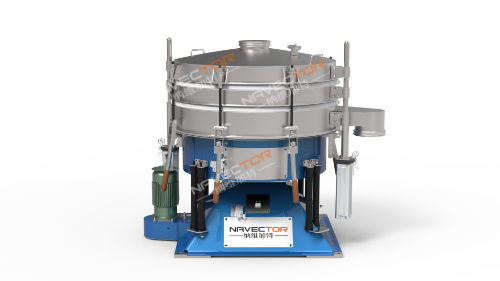
Their core feature is low-frequency tumbling motion. By simulating the “rolling + throwing” trajectory of manual screening, materials stay on the screen surface for a longer path. Compared with ordinary vibrating screens, tumbler screens have greater advantages in high-capacity and high-precision screening, especially for granular and high-density materials. The NTS Series Tumbler Screen can also be equipped with an ultrasonic system for high-capacity ultrafine powder screening.
Negative pressure airflow screens follow an entirely different concept.
Instead of relying on traditional vibration force, they use airflow conveying and centrifugal separation for screening. For lightweight, floating, and easily clogging ultrafine powders, airflow screens reduce material accumulation and improve passing rates. Materials such as carbon powder, graphite, and light calcium carbonate are often processed using airflow screening or cyclone screening solutions.
In addition, specialized equipment such as lithium battery industry small particle screening machines and non-metallic screening machines are designed specifically for high static electricity environments, metal contamination control, and continuous fine particle screening.
IV. How to Match Equipment with Powder Characteristics? Common Powder Selection Guide
The most common mistake in equipment selection is focusing only on mesh size.
In reality, screening performance is usually determined by the combined influence of several factors: particle size distribution, moisture content, bulk density, electrostatic characteristics, temperature, and target processing capacity.
For conventional granular powders such as sugar, salt, plastic pellets, and standard chemical granules, rotary vibrating screens are usually sufficient. These materials generally have good flowability and low screen adhesion, so throughput and operational stability are the main concerns.
If the material particle size exceeds 300 mesh, especially for lightweight powders, ultrafine powders, and easily agglomerated powders, ultrasonic vibrating screens are more suitable because ultrasonic vibration reduces particle adhesion and friction while improving mesh passing efficiency.
For lithium battery materials, graphite, carbon powder, and high-nickel materials, both electrostatic control and metal contamination prevention must be considered. In these applications, ultrasonic screening systems combined with non-metallic contact structures are typically preferred.
If the production line requires both high capacity and high precision, while the material particles are relatively uniform—such as fertilizers, glass beads, resin pellets, and metal granules—tumbler screens are generally more suitable. Their low-speed flexible motion causes less particle damage and provides a longer screening trajectory.
For lightweight powders that easily float, agglomerate, or have extremely poor flowability, negative pressure airflow screens or cyclone screens should be considered. These systems disperse materials through airflow, reducing accumulation on the screen surface.
Another often overlooked factor is temperature. Some heat-sensitive materials may soften or adhere due to localized temperature rise during prolonged high-frequency vibration. Therefore, many factories prefer low-frequency screening structures in continuous production to reduce heat accumulation.
V. Summary and Equipment Selection Recommendations
At its core, screening equipment selection is about matching “powder behavior.”
A truly mature equipment selection process does not start with the brand, but with analysis of the material itself. What is the particle shape? Is the material prone to agglomeration? Does the moisture content fluctuate? How narrow is the target particle size range? Is static electricity present? These factors determine the required movement mode, screen structure, and anti-clogging solution.
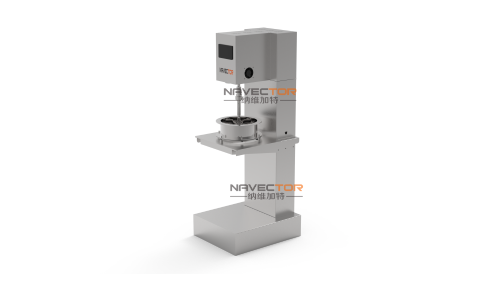
Navector Screening Technology has long specialized in the field of fine screening. Its products include ultrasonic vibrating screens, tumbler screens, ultrasonic tumbler screens, negative pressure airflow screens, lithium battery industry small particle screening machines, non-metallic screening machines, microsphere screens, and more. Customized screening solutions and material testing support can be provided according to different powder processing conditions.
For the powder industry, screening has never been simply about “passing through a screen.” It is more like a control engineering process centered on particle behavior. The better one understands powder behavior, the better one can truly optimize screening performance.
 English
 中文
中文 Español
 ภาษาไทย
 Pусский
 Bahasa Indonesia
 Tiếng Việt