In lithium battery material production, conductive additives account for only a small proportion of the formulation, yet they play a vital role in building conductive networks and improving electron transport efficiency. From lithium iron phosphate (LFP) and high-nickel ternary materials to solid-state batteries, as new energy materials continue to evolve toward higher performance, conductive additives are also developing toward finer particle sizes and higher specific surface areas. In particular, conductive carbon black, carbon nanotubes (CNTs), and composite conductive materials have already reached the micron and even submicron range.
However, while material performance improves, new challenges are also emerging in manufacturing processes. Many companies have found that screening equipment that once operated stably now frequently experiences mesh clogging, poor classification accuracy, and reduced throughput when handling the new generation of ultrafine conductive additives. Some production lines perform normally when first started, but after several hours of continuous operation, material gradually accumulates on the screen surface, screening efficiency continuously declines, and production must be interrupted for cleaning.
Behind this phenomenon is not a sudden decline in equipment performance, but rather a change in material characteristics. As conductive additives enter the era of ultrafine powders, screening is no longer merely a matter of particle size separation. Instead, it becomes the combined result of electrostatic attraction, particle agglomeration, mesh blockage, and other interacting factors. How to maintain long-term stable operation while ensuring screening accuracy has become a practical challenge that more and more lithium battery material manufacturers need to solve.
I. Why Is Conductive Additive Screening Becoming More Difficult?
Today, conductive additive screening is gradually becoming a key factor affecting lithium battery material quality and production stability. The fundamental reason lies in the continuous trend toward ultrafine conductive additives. Whether conductive carbon black, carbon nanotubes (CNTs), or various composite conductive materials, all are evolving toward finer particle sizes and higher specific surface areas. As material performance improves, interactions between powder particles also become stronger.
For ultrafine conductive additives, screening is no longer simply a particle separation issue. During conveying and screening, particles are prone to electrostatic attraction, while the reduction in particle size increases van der Waals forces between particles, making agglomeration more pronounced. At the same time, lightweight powders tend to float and accumulate on the screen surface, reducing effective contact between particles and screen apertures. As agglomerated particles continue to accumulate, mesh clogging gradually occurs.
These issues are often not obvious during laboratory testing but become increasingly amplified in continuous production. As operating time increases, the effective open area of the screen continuously decreases, causing mesh blockage, poor classification, and declining screening efficiency to emerge simultaneously, ultimately affecting particle size consistency and production continuity.
In a sense, conductive additives are becoming harder to screen not because screening equipment has regressed, but because the materials themselves have changed. As the lithium battery industry continues to pursue finer particle sizes and higher material consistency, traditional screening methods are facing new challenges. Those who can more reliably screen ultrafine powders are better positioned to ensure material quality and production efficiency.
II. Why Are Traditional Screening Solutions Increasingly Unable to Meet Demand?
Traditional vibrating screens primarily rely on relatively large amplitudes to drive material movement and are suitable for powders with good flowability and larger particle sizes. However, this screening method is not entirely suitable for ultrafine conductive additives such as conductive carbon black and carbon nanotubes.
As particle sizes continue to decrease, powders become more susceptible to electrostatic attraction, agglomeration, and localized material accumulation. Although increasing vibration amplitude can accelerate material movement, it does not necessarily improve screening efficiency. Instead, it may shorten the effective contact time between particles and screen apertures. Meanwhile, traditional mechanical screen-cleaning systems mainly address particle buildup and have limited effectiveness against micron-scale mesh blockage caused by particle adhesion and aperture plugging.
As a result, during ultrafine conductive additive screening, it is common to observe equipment performing normally during the initial stage of operation but gradually losing efficiency over time. The root cause is not insufficient screening capacity, but rather the growing mismatch between traditional screening methods and the movement characteristics of ultrafine powders.
III. Facing Mesh Clogging in Ultrafine Conductive Additives, High-Speed Screens Provide a New Solution
For ultrafine conductive additives, mesh clogging, poor classification, and reduced production capacity often occur simultaneously. The underlying reason is that powders are prone to agglomeration and accumulation, leading to a continuous decline in screen aperture utilization. Therefore, the key to solving these problems is not simply increasing vibration force, but improving the movement behavior of powders on the screen surface.
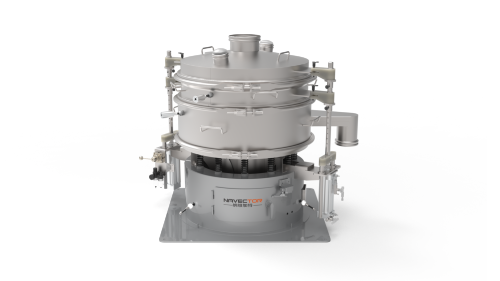
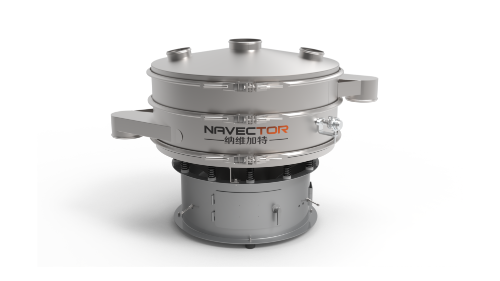
Taking the Navector High-Speed Intelligent Screening Machine as an example, it adopts low-frequency high-speed vibration technology and a stepless speed regulation system, enabling powders to disperse rapidly across the screen surface and form a uniform material layer. Compared with traditional screening machines, this screening method is more conducive to maintaining continuous particle contact with screen apertures, thereby improving screening efficiency and classification accuracy.
From a mechanistic perspective, high-speed screens optimize material movement trajectories, continuously break up weak agglomerates, reduce localized accumulation and mesh blockage, and improve effective screen utilization. When combined with Magnatt high-performance screen mesh, particle embedding can be further reduced, enabling long-term stable screening performance.
At present, this type of screening technology has been widely applied in the precision screening of conductive additives, sulfide electrolytes, high-nickel single-crystal materials, single-crystal fine-particle lithium iron phosphate, and other ultrafine new energy powders. It is particularly suitable for production environments with high requirements for screening accuracy, throughput, and continuous operational stability.
IV. How Should Companies Select Suitable Conductive Additive Screening Equipment?
When selecting conductive additive screening equipment, many companies focus first on throughput and mesh size. However, for ultrafine conductive additives, what truly determines screening performance is often not how fast the equipment can screen, but whether it can maintain stable screening performance over the long term.
Because conductive additives have fine particle sizes, strong agglomeration tendencies, and are prone to static electricity, equipment selection should comprehensively consider particle size distribution, agglomeration behavior, target screening size, and continuous operation requirements. For ultrafine powders, equipment capable of consistently maintaining screening accuracy and screen permeability often provides greater practical value than simply pursuing higher production capacity.
V. Frequently Asked Questions About Conductive Additive Screening
Q1: Why are conductive additives more prone to mesh clogging than ordinary lithium battery materials?
Because conductive additives have finer particle sizes and larger specific surface areas, electrostatic attraction and particle agglomeration are more pronounced.
Q2: Can increasing vibration intensity solve mesh clogging problems?
Not necessarily. Excessive vibration may shorten the contact time between particles and screen apertures, potentially reducing screening efficiency.
Q3: Are high-speed screens suitable for solid-state battery material screening?
For ultrafine solid-state battery powders such as sulfide electrolytes and oxide electrolytes, high-speed screens are highly suitable wherever mesh clogging prevention and precise classification are required.
The increasing difficulty of conductive additive screening is essentially an inevitable result of the continuous evolution of lithium battery materials toward finer particle sizes and higher performance. Once particles enter the micron or even submicron range, screening is no longer simply about particle size separation but must address multiple challenges, including electrostatic attraction, agglomeration, mesh blockage, and stable continuous operation.
The emergence of high-speed screens is not merely about improving equipment performance. Rather, by optimizing powder movement behavior, they provide a new solution for ultrafine powder screening. From conductive additives to solid-state electrolytes, and from high-nickel materials to single-crystal lithium iron phosphate, screening technology is evolving from “meeting production requirements” to “ensuring product quality.” In the future, as new energy materials continue to advance, precision screening technologies capable of balancing accuracy, efficiency, and stability will play an increasingly important role throughout the lithium battery industry chain.
 English
 中文
中文 Español
 ภาษาไทย
 Pусский
 Bahasa Indonesia
 Tiếng Việt