In the fields of biopharmaceuticals and aesthetic medical materials, drug-loaded microspheres are gradually becoming important functional carriers. From PLGA sustained-release microspheres and PCL microspheres to embolic microspheres and chromatography packing microspheres, these products are widely used in pharmaceutical formulations, bioengineering, aesthetic restoration, and other fields due to their excellent sustained-release performance, precise delivery capabilities, and stable functional properties.
However, as product value continues to increase, particle size control requirements become increasingly strict, and GMP standards impose higher requirements on clean production, more and more companies have found that the factors truly affecting product quality and production efficiency are often not the microsphere preparation process itself, but rather the subsequent post-processing stages such as filtration, washing, dehydration, and drying.
An engineer with many years of experience in microsphere process development once summarized: “The biggest challenge in microsphere production is not making the product, but maintaining its desired properties throughout every subsequent process.” This statement may sound simple, but it highlights a common challenge in current microsphere production — how to balance product quality, process stability, and production efficiency during post-processing.
I. Core Challenge: Why Are Drug-Loaded Microspheres Becoming Increasingly Difficult to Screen?
In the past, many microsphere products remained primarily at the laboratory research stage, where requirements for production capacity and continuous manufacturing were relatively low. However, with the rapid development of markets such as aesthetic filling materials, sustained-release formulations, and high-end chromatography packing materials, more and more companies have entered pilot-scale and large-scale production stages, making the importance of post-processing increasingly apparent.
Compared with ordinary powders, drug-loaded microspheres have characteristics such as low density, high adsorption tendency, and easy aggregation. During filtration, dehydration, and drying processes, particles can easily adhere and form agglomerates due to static electricity, changes in moisture content, or uneven local heating. Especially for polymer microspheres such as PLGA, aggregation can easily occur during screening, resulting in clogged screens, reduced screening efficiency, and frequent equipment shutdowns for cleaning.
Most traditional screening equipment is designed for ordinary particles, focusing more on “high processing capacity” and “rapid passing through the screen.” When this strong vibration mode is applied to the microsphere field, a typical problem often occurs: the equipment keeps vibrating, but the material is no longer moving.
Many companies have experienced similar issues during pilot production: frequent screen clogging, repeated manual disassembly and cleaning, and continuous reduction in production capacity. More importantly, under GMP conditions, frequent opening of equipment and manual intervention can also increase contamination risks.
For drug-loaded microspheres, the real challenge of screening is not simply “screening faster,” but how to make the entire processing procedure more stable, continuous, and controllable.
II. Technology Upgrade: What Has the Microsphere Screening System Actually Changed?
For drug-loaded microsphere production, the real difficulty is often not a single process step, but whether the entire post-processing procedure can operate stably over the long term.
In the past, filtration, washing, dehydration, and drying usually required multiple pieces of equipment to complete separately. Frequent material transfer between different processes not only complicated the workflow but also increased the risks of contamination, aggregation, and product loss. Especially for high-value microsphere products, batch variations often do not originate from the reaction stage but occur during post-processing.
Therefore, in recent years, the development trend of microsphere processing equipment has gradually shifted from “single-function equipment” toward “integrated processing systems.”
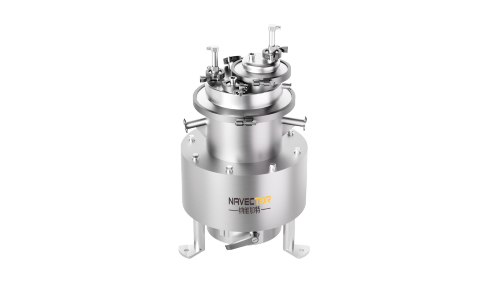
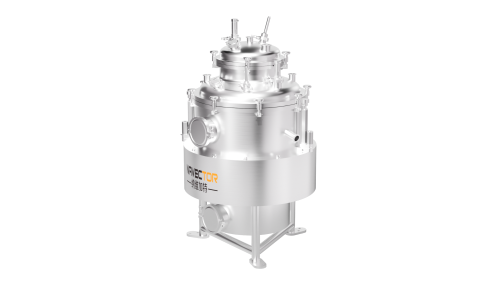
Taking the Navector microsphere screening system as an example, it integrates filtration, washing, dehydration, and drying processes into a single closed system. Through centrifugal separation, negative pressure fluid separation, and ultrasonic-assisted drying technologies, it reduces the need for repeated material transfer between different pieces of equipment.
The core value of this change is not only improved processing efficiency but also achieving a more stable, continuous, and controllable post-processing procedure. For the biopharmaceutical industry, the key factor determining product quality is often not a single equipment parameter, but the consistency of the entire manufacturing process.
III. Real Operating Conditions: Why Can Microsphere Screening Significantly Reduce Screen Clogging and Aggregation?
For drug-loaded microspheres, the root cause of screen clogging is often not that the screen openings are too small, but that microspheres gradually lose their flowability during dehydration and drying.
As liquid content decreases, particles are more likely to form aggregates due to electrostatic forces and adhesion effects. Once localized accumulation occurs, a “screen blinding” phenomenon quickly forms on the screen surface, ultimately reducing screening efficiency and causing frequent shutdowns.
To address these conditions, the Navector microsphere screening system uses ultrasonic-assisted drying and negative pressure fluid separation, allowing microspheres to distribute more evenly on the filter surface during processing. Without mechanical stirring, rapid drying can be achieved, reducing the formation of aggregates and hard lumps.
Compared with traditional methods, the biggest difference in this processing approach is that it does not rely on stronger vibration to “force” materials through the screen. Instead, it focuses on keeping microspheres in a stable and dispersed state throughout the process. The final collected product remains in a dry, non-agglomerated, free-flowing powder state, making it more suitable for subsequent packaging and application.
Meanwhile, the equipment adopts a fully enclosed design, enabling CIP/SIP online cleaning and sterilization. Combined with 316L electropolished material and a customized PLC control system, it meets sterile production requirements while further improving process stability.
IV. Industry Changes: Why Are More Companies Adopting Integrated Microsphere Processing?
Previously, filtration, washing, dehydration, and drying were usually completed separately by multiple pieces of equipment. This approach could meet laboratory-stage requirements, but as production scales expanded, problems caused by frequent transfers — including product loss, contamination risks, and process fluctuations — became increasingly obvious.
Especially for high-value products such as drug-loaded microspheres, every transfer may affect product conditions and batch consistency. Therefore, more and more companies are adopting integrated filtration, washing, dehydration, and drying solutions to complete the entire post-processing process within a single equipment system.
This change is not only aimed at improving efficiency but also at reducing human intervention, lowering quality risks, and making the production process more stable and controllable. It also represents an important direction for the biopharmaceutical industry’s development toward continuous, automated, and sterile manufacturing.
V. Application Trends: Which Companies Need This Type of Screening Solution?
Currently, these microsphere screening solutions are mainly applied in high-value fields such as drug-loaded microspheres, aesthetic filling microspheres, chromatography packing materials, IVD microspheres, and embolic microspheres. These products generally have strict requirements for particle size consistency, cleanliness, and batch stability, and post-processing procedures often directly affect final product quality.
As the biopharmaceutical and aesthetic industries move toward large-scale and standardized production, companies are no longer only concerned with whether separation and drying can be completed. Instead, they are focusing on whether the entire process is stable, controllable, and compliant with GMP requirements. Therefore, integrated and sterile microsphere processing solutions are becoming the preferred choice for more and more advanced biomaterial companies.
VI. Future Direction: Truly Advanced Equipment Is Not Just About “Being Able to Screen”
When selecting equipment, the microsphere industry has long moved beyond simply focusing on processing capacity and screening accuracy. More importantly, companies care about long-term operational stability. Because successful screening in a laboratory environment does not necessarily mean the same process performance can be maintained after scaling up to mass production.
As the biopharmaceutical industry develops toward standardization, continuous manufacturing, and sterile production, companies are paying increasing attention to equipment cleanability, contamination control capabilities, batch changeover efficiency, and continuous production capacity.
Ultimately, real production environments are not only about whether equipment can complete a single screening process, but whether the entire manufacturing process can operate stably and controllably over the long term.
High-value products such as drug-loaded microspheres have extremely high requirements for quality consistency, and screening is precisely one of the key process steps affecting product performance. It may not be the most visible piece of equipment on the production line, but it often determines whether products can be reliably scaled up and continuously manufactured. This is also the fundamental reason why future microsphere screening equipment continues to develop toward integration, sterility, and intelligence.


 English
 中文
中文 Español
 ภาษาไทย
 Pусский
 Bahasa Indonesia
 Tiếng Việt