In modern powder industry, fine powder screening is one of the key process links affecting product quality and production efficiency. With the rapid development of industries such as lithium battery materials, metal powder additive manufacturing, fine chemicals, and pharmaceuticals, powder particle sizes continue to become finer, and more and more production processes require precise classification of powders in the 10–100 micron range.
However, in actual production processes, traditional vibrating screens often face the following problems when handling fine powders:
Severe screen mesh blockage
Significant decrease in screening efficiency
Powder agglomeration affecting classification accuracy
Reduced equipment operation stability
The essence of these problems does not only originate from equipment structure, but is jointly determined by the physical properties of fine particles and screening dynamic conditions. When the particle size enters the micron range, van der Waals forces, electrostatic adsorption forces, and surface energy effects between particles increase significantly, causing powders to be more prone to agglomeration and adhesion.
To address this industry challenge, Navector has developed ultrasonic vibrating screen technology. This technology superimposes high-frequency ultrasonic vibration onto a traditional vibrating screen system, causing high-frequency micro-vibrations on the screen surface, thereby changing the movement state of powders on the screen and effectively solving the problems of screen blockage and agglomeration in fine powder screening.
This article will systematically analyze from an engineering perspective:
Why traditional vibrating screens struggle to handle fine powders
The physical working principle of ultrasonic vibrating screens
Core equipment structural design
The application value of the technology in industrial production
Table of Contents
Industrial technical challenges of fine powder screening
Working principle of ultrasonic vibrating screens
Key structural components of the equipment
How the technology improves screening efficiency
Performance comparison with traditional screening equipment
Typical industrial application fields
Production operation optimization suggestions
Equipment maintenance and stable operation recommendations
Future development trends of screening technology
Frequently Asked Questions (FAQ)
About Navector
I. Industrial Technical Challenges of Fine Powder Screening
When powder particle size decreases to below 100 microns, the complexity of the screening process increases significantly. The main reason is that the physical behavior of fine particles is completely different from that of coarse particles.
Enhanced interparticle forces
Fine powder particles have a larger specific surface area, resulting in significantly increased forces such as:
Van der Waals forces
Electrostatic adsorption forces
Surface tension
These forces make particles more likely to agglomerate.
Powder agglomeration phenomenon
Micron-level powders tend to form agglomerates during transportation and screening, preventing particles that should pass through the mesh from doing so smoothly.
Screen mesh blockage
Fine powder particles easily embed into the mesh openings, causing gradual blockage and reducing the effective screening area.
Decreased screening efficiency
The vibration frequency of traditional vibrating screens is typically: 20–50 Hz
Such low-frequency vibration has limited effectiveness in breaking up fine powder agglomerates.
Reduced classification accuracy
When the screen is blocked or material distribution is uneven, the particle classification accuracy during screening is significantly affected.
Therefore, in high-precision powder production, traditional vibrating screens are difficult to meet the requirements of fine powder screening.
II. Working Principle of Ultrasonic Vibrating Screens
An ultrasonic vibrating screen is a fine screening device that superimposes a high-frequency ultrasonic vibration system onto a traditional vibrating screen.
Its working principle mainly includes the following three aspects.
Synergistic effect of dual vibration systems
There are two vibration systems within the equipment:
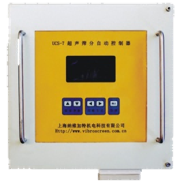
Mechanical vibration is responsible for material conveying, while ultrasonic vibration breaks powder agglomeration structures and cleans the mesh openings.
Ultrasonic energy transmission mechanism
The working process of the ultrasonic system is as follows:
The ultrasonic generator produces high-frequency electrical signals
The transducer converts electrical energy into mechanical vibration
The vibration is transmitted to the screen through a resonant ring
The screen generates high-frequency micro-vibration
The vibration frequency of the screen can reach: approximately 36,000 times per second
This high-frequency vibration significantly reduces the frictional resistance between particles and the screen.
Change in powder motion state
Under ultrasonic vibration, powders exhibit motion patterns different from traditional screening, such as:
Micro-jumping motion
Suspension motion
Dispersed motion
This motion state significantly increases the probability of particles passing through the screen.
III. Key Structural Components of the Equipment
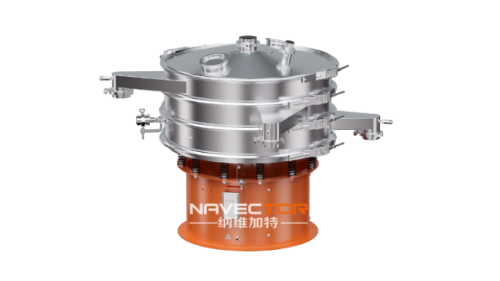
The ultrasonic vibrating screen system consists of multiple core components, which work together to achieve stable screening.
|
Equipment Component |
Function |
Technical Role |
|
Vibration motor |
Generates mechanical vibration |
Drives material movement on the screen surface |
|
Ultrasonic generator |
Produces high-frequency electrical signals |
Provides ultrasonic vibration energy |
|
Ultrasonic transducer |
Converts electrical energy into mechanical vibration |
Excites high-frequency screen vibration |
|
Resonant ring |
Transmits vibration energy |
Ensures uniform screen vibration |
|
Screen mesh assembly |
Performs particle classification |
Controls screening accuracy |
|
Screen frame structure |
Supports the screen mesh |
Ensures stable equipment operation |
This structural design allows ultrasonic vibration to be evenly distributed across the entire screen surface.
IV. How the Technology Improves Screening Efficiency
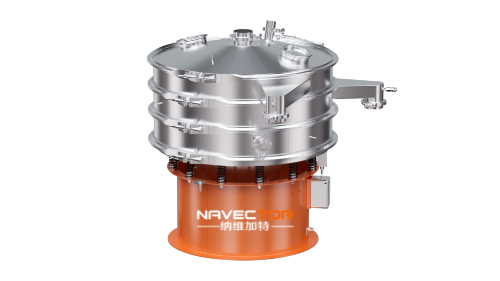
Ultrasonic vibrating screens improve screening performance in multiple ways by changing the motion state of powders.
|
Technical Feature |
Engineering Role |
Practical Production Benefit |
|
High-frequency micro-vibration |
Breaks particle agglomeration |
Improves screening efficiency |
|
Automatic mesh cleaning |
Prevents mesh blockage |
Reduces downtime for cleaning |
|
Uniform vibration |
Ensures stable screen surface |
Improves classification accuracy |
|
Reduced particle friction |
Minimizes material damage |
Improves product quality |
|
Increased passing rate |
Expands effective screening area |
Increases equipment capacity |
In many fine powder screening applications, efficiency can be improved by 50%–300%.
V. Performance Comparison with Traditional Screening Equipment
|
Technical Indicator |
Traditional Vibrating Screen |
Ultrasonic Vibrating Screen |
|
Applicable particle size range |
Greater than 100 microns |
10–100 microns |
|
Screen blockage condition |
Easily blocked |
Essentially no blockage |
|
Screening efficiency |
Moderate |
High |
|
Classification accuracy |
Poor stability |
High precision |
|
Frequency of shutdown for cleaning |
High |
Very low |
From a screening dynamics perspective, ultrasonic vibration significantly improves the fine powder screening environment.
VI. Typical Industrial Application Fields
Ultrasonic vibrating screens are widely used in various high-precision powder industries.
Lithium battery materials
Used for screening: cathode materials, anode graphite, conductive agents
Metal powders
Typical applications include: 3D printing metal powders, titanium alloy powders, stainless steel powders
Fine chemicals
For example: resin powders, catalysts, functional material powders
Pharmaceutical industry
Used for: active pharmaceutical ingredients, pharmaceutical excipients
Food industry
For example: milk powder, starch, food additives
VII. Production Operation Optimization Suggestions
In actual production, screening efficiency can be improved through the following methods:
Select appropriate mesh size based on powder particle size
Ensure uniform material feeding
Control material moisture content
Adjust the angle of the vibration motor
Regularly check the operating status of the ultrasonic system
Reasonable process parameters can significantly improve screening efficiency.
VIII. Equipment Maintenance and Stable Operation Recommendations
Proper maintenance ensures long-term stable operation of the equipment.
Main maintenance measures include:
Regularly check screen mesh tension
Inspect vibration motor operating condition
Clean the screen frame and sealing structure
Periodically test the ultrasonic system
Under normal maintenance conditions, the equipment can operate stably for a long time.
IX. Future Development Trends of Screening Technology
With the development of the powder industry, screening equipment is evolving in the following directions:
Intelligentization
Real-time monitoring of screening efficiency through sensors.
Automation
Integration with automatic conveying and packaging systems.
Energy efficiency
Optimizing vibration systems to reduce energy consumption.
Digitalization
Optimizing screening processes through data analysis.
Future screening equipment will become more efficient and intelligent.
X. Frequently Asked Questions (FAQ)
Question 1: Why is fine powder screening prone to mesh blockage?
Fine particles have a large specific surface area, and strong interparticle adhesion makes them easy to attach to the screen mesh.
Question 2: How fine powders are suitable for ultrasonic vibrating screens?
Generally suitable for powders above 10 microns.
Question 3: Will the ultrasonic system change material properties?
No. Ultrasonic vibration only changes the motion state of particles.
Question 4: Does the ultrasonic system consume high power?
Typically, the power consumption is low and has minimal impact on overall energy usage.
XI. About Navector
Navector (Shanghai) Screening Technology Co., Ltd. focuses on the research and development of fine screening technology and powder engineering equipment. The company’s main products include ultrasonic vibrating screens, tumbler screens, airflow screens, 3D printing powder recycling systems, and powder conveying equipment.
The company is committed to providing professional screening solutions for lithium battery materials, metal powders, pharmaceutical and food industries, and continuously promoting the development of fine screening technology.
 English
 中文
中文 Español
 ภาษาไทย
 Pусский
 Bahasa Indonesia
 Tiếng Việt