The decanter centrifuge generates centrifugal force through a high-speed rotating bowl and continuously conveys the settled solids to the solids discharge outlet through the differential speed between the internal screw conveyor and the bowl, enabling continuous feeding, continuous separation, and continuous solids discharge.
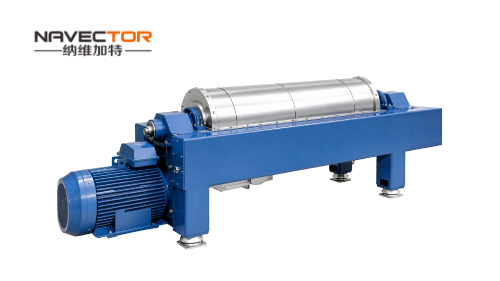
I. Decanter Centrifuge Principle
Bowl Sedimentation + Differential-Speed Screw Conveying
The decanter centrifuge generates centrifugal force through a high-speed rotating bowl, causing solid particles in the material to settle onto the inner wall of the bowl. The screw conveyor rotates at a certain differential speed relative to the bowl and continuously pushes the settled solids toward the solids discharge outlet, enabling continuous feeding, continuous separation, and continuous solids discharge.
Specifically, after the material enters the bowl through the feed pipe, sedimentation and separation take place in the centrifugal field generated by high-speed rotation. Solid particles settle onto the inner wall of the bowl, while the screw conveyor continuously conveys the solid phase toward the solids discharge outlet through the differential speed between the screw and the bowl. The separated liquid phase is discharged through the liquid overflow outlet.
Simply put, the bowl is responsible for sedimentation, the screw is responsible for conveying, and the differential speed between the bowl and the screw affects the conveying and separation conditions of the solid phase.
II. Key Advantages
High Throughput: Suitable for high-flow continuous production.
High Solid Content Handling Capacity: Capable of processing materials that are difficult for disc stack centrifuges to handle.
Continuous Solids Discharge: No need to stop the machine for solids discharge.
Continuous Operation: Suitable for 24-hour industrial production.
Solid Dewatering: Reduces the moisture content of the solid phase and lowers downstream processing costs.
III. Typical Applications
The decanter centrifuge is suitable for solid-liquid separation processes requiring continuous feeding, continuous separation, and continuous solids discharge. It is particularly suitable for separation processes involving high throughput, high solid content, and continuous discharge of the solid phase. Its applications cover food and beverage processing, plant extraction, wastewater treatment, and oil and fat processing.
Food & Beverage: Used for fruit and vegetable juice residue separation, bean processing, starch processing, plant protein extraction, and other processes.
Plant Extraction: Used for residue-liquid separation in plant extracts and related extraction liquids, suitable for high-fiber material processing and high-throughput continuous production.
Wastewater Treatment: Used for municipal sludge dewatering, industrial wastewater treatment, and sludge reduction. Continuous solids discharge enables solid-liquid separation of sludge and supports continuous wastewater treatment processes.
Oil & Fat Processing: Used for the separation and refining of palm oil, olive oil, animal fats, and other materials, meeting solid-liquid separation requirements in oil and fat processing.
Typical Separation Tasks: Sludge dewatering, industrial wastewater treatment, palm oil, olive oil, and plant protein.
IV. Decanter Centrifuge Specifications
|
Parameter |
LND250 |
LND350 |
LND450 |
LND530 |
LND580 |
LND650 |
|
Water Throughput (m³/h) |
3 |
10 |
20 |
30 |
40 |
50 |
|
Bowl Diameter (mm) |
250 |
350 |
450 |
530 |
580 |
650 |
|
Main Motor Power (kW) |
15 |
22 |
30 |
45 |
55 |
75 |
|
Auxiliary Motor Power (kW) |
4 |
7.5 |
11 |
15 |
15 |
22 |
|
Overall Dimensions (L × W × H, m) |
2.7 × 0.7 × 0.85 |
3.54 × 0.92 × 1.05 |
4.35 × 1.12 × 1.35 |
4.6 × 1.25 × 1.52 |
5.12 × 1.3 × 1.48 |
5.58 × 1.35 × 1.65 |
|
Machine Weight (kg) |
1100 |
2300 |
4500 |
5500 |
6500 |
9500 |
 English
 中文
中文 Español
 ภาษาไทย
 Pусский
 Bahasa Indonesia
 Tiếng Việt